Best Freight Forwarding Sales Software (2026): Ranked for Forwarders
Author:
Pamela
Published On:
1 min read
Best Freight Forwarding Sales Software (2026): Ranked for Forwarders
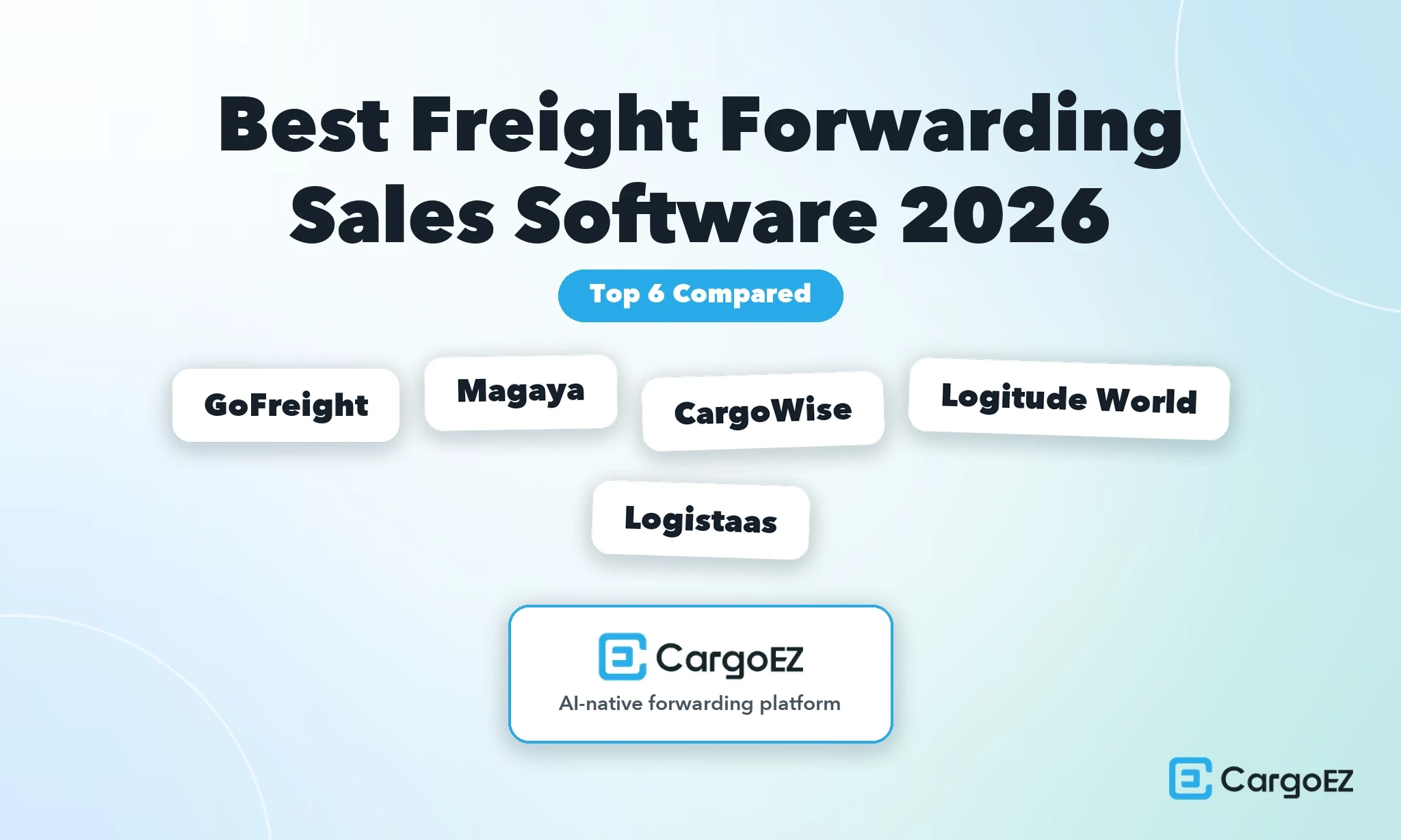
Comparing the top-rated freight forwarding sales software for 2026: 1. CargoEZ, 2. GoFreight, 3. Magaya, 4. CargoWise, 5. Logitude World, 6. Logistaas.
Winning freight is a different job from moving it. Sales software is the tool your business-development team uses to turn an enquiry into a won booking: capture the lead, quote it, chase it, close it, and see which lanes and reps actually make money.
Here is the rule to keep in mind while you read. A CRM stores the relationship; sales software moves the deal. For a forwarder the same module usually does both, so judge each tool on the sales job: does it turn enquiries into won bookings, and does the won deal flow into operations without anyone re-keying it? That second part is where freight-native tools pull away from generic ones.
Best freight forwarding sales software: quick picks
Here is the shortlist, split into the two kinds of tool a forwarder actually chooses between.
Freight-native sales platforms (sales, quotes, and shipments in one system):
CargoEZ — best for a built-in forwarding CRM where sales, quotes, and shipments live in one system
GoFreight — best for a modern built-in sales CRM for small and mid US forwarders
Magaya — best for a dedicated freight CRM synced to your operations
CargoWise — best for sales inside a global enterprise forwarding suite
Logitude World — best for a customizable sales funnel with Outlook sync
Logistaas — best for an affordable freight-specific sales and pricing tool
Generic sales CRMs (strong pipelines you wire to your forwarding system):
HubSpot — best for easy pipelines and marketing automation
Salesforce — best for enterprise sales operations and deep customization
Pipedrive — best for a simple visual pipeline at a low price
Zoho CRM — best for low-cost sales tooling that scales with add-ons
Freshsales — best for AI-assisted pipelines on a budget
The short version: freight-native platforms understand a shipment, so a won deal becomes a booking with no re-keying. Generic CRMs have excellent pipelines but no idea what a lane, a mode, or a rate request is, so they need wiring to your operations system to be useful. Most forwarders are better served by a freight-native tool, led by CargoEZ, and this guide ranks those first.
Evaluation criteria to choose these brands
Full disclosure first: CargoEZ is our product, so yes, we placed it at the top, and you should read any vendor-authored list with that in mind. To keep it fair, every tool here is judged on the same sales-specific test, not on brand size or our preference. A pretty contact list is not sales software. The tool has to move deals and connect the win to the work.
Here are the six things each platform was judged on:
Sales pipeline and deal stages — a visual pipeline with stages you can customize, so reps always know what to do next.
Freight-native deal record — can the deal and account carry mode (air or ocean), trade lane (origin and destination), direction (import or export), and the quoted rate, plus shipper profiles, lane histories, active bids, and carrier preferences? This freight context is the whole reason a generic CRM struggles here.
Quote and RFQ tracking in the pipeline — outstanding quotes, quote-to-win rate, and follow-up reminders on quotes, so nothing sits unanswered. This is quote tracking, not the rate engine itself.
Won deal to booking handoff — when a deal is won, does it become a booking and shipment in the same system, or does someone re-type it into a separate operations tool?
Sales analytics and forecasting — win rate, deals won, win and loss by trade lane, revenue by mode, sales funnel, and a rep leaderboard, so managers can see the pipeline clearly.
G2 and Capterra reviews — we also read what real users say on G2 and Capterra, so the ratings here reflect verified customer feedback, not vendor marketing. Where a tool has too few reviews to be meaningful, we say so instead of leaning on the number.
A note on scope. Freight-broker and agent sales CRMs (Salesdash, Tai, UltraShip, and similar) are built for a different market and persona, so they are not ranked here. This guide is for a freight forwarder's own sales team.
Best freight forwarding sales software at a glance
These are the freight-native platforms with a real built-in sales module, ranked. The generic CRMs follow in their own section.
Platform | Best for | Starting price | Freight-native sales/CRM | Rating (G2 / Capterra) |
1. CargoEZ | Built-in forwarding CRM where sales, quotes, and shipments live in one system | Custom / quote | Yes (Leads + Contacts) | 4.8 / n/a (G2, 40) |
2. GoFreight | A modern built-in sales CRM for small and mid US forwarders | Quote (~$100-500/user) | Yes | 4.8 / 4.6 |
3. Magaya | A dedicated freight CRM synced to operations | Custom / quote | Yes (Magaya CRM) | 4.4 / 4.4 |
4. CargoWise | Sales inside a global enterprise forwarding suite | Per-transaction (enterprise) | Yes (add-on) | 4.3 / 2.9 |
5. Logitude World | A customizable sales funnel with Outlook sync | ~$75-99/user/mo | Yes | 4.6 / 4.5 |
6. Logistaas | An affordable freight-specific sales and pricing tool | From ~$55/mo | Yes | Thin sample (see note) |
Ratings verified SEP — 2026. For Magaya, the figure is the Magaya platform, since Magaya CRM is a module inside it. "n/a" and "thin sample" mean too few reviews to be meaningful on that platform.
How the platforms compare on the sales job
Treat this as a directional summary and confirm it on a demo. Yes = documented and strong; Partial = present but limited; n/d = not documented.
Platform | Sales pipeline and stages | Freight-native deal record | Quote / RFQ tracking | Won deal to booking handoff | Sales analytics and forecasting |
CargoEZ | Yes (New to Won stages) | Yes (mode, lane, direction on the lead) | Yes (quote and rate request on the lead) | Yes (won lead becomes a booking, one system) | Yes (Win Rate, Deals Won, Revenue, funnel by mode) |
GoFreight | Yes | Yes | Yes | Yes | Yes (pipeline by stage) |
Magaya | Yes | Yes | Yes (quote history) | Yes (syncs to Magaya operations) | Yes (KPI dashboards) |
CargoWise | Partial | Yes | Yes | Yes | Partial |
Logitude World | Yes | Yes | Yes (tariff-driven quoting) | Yes | Yes (custom sales funnels) |
Logistaas | Yes | Yes | Yes (inquiry to quotation) | Yes | Yes (inactive-client and quotation reports) |
The takeaway: all six carry a freight-native deal record and hand the won deal to operations, which is exactly what a generic CRM cannot do. They separate mostly on depth and price, from CargoEZ and GoFreight for SMB and midmarket, up to CargoWise for global enterprise.
Why a generic CRM struggles for freight (and the quote-to-booking gap)
The most common mistake a growing forwarder makes is dropping its reps into a stock CRM. Here is why it hurts. A generic CRM models a deal as one company, one price, and one close date. A forwarder's deal is not that. It is a rate request to several carriers, a quotation built from buy and sell rates, and a booking that then has to be executed. The stock CRM has no field for mode, lane, or Incoterms, so reps end up pasting that into a notes box.
The bigger gap comes after the win. A generic CRM goes quiet the moment the deal is marked won, because booking, customs, and invoicing all happen in a different system it cannot see. So the sales record and the operations record drift apart, and someone re-keys the whole thing. A freight-native tool closes that gap: the won deal becomes the booking on the same record, and the sales team can still see what happened to the shipment they sold.
None of this means the generic CRMs are weak products. They are excellent, and their ratings rest on tens of thousands of reviews. They are just not freight-aware. The honest exception: a very early forwarder with no operations system yet can start on a generic CRM and move later.
Generic CRM | What it is great at | The freight gap | Rating (G2 / Capterra) |
HubSpot | Easy pipelines, marketing automation, a huge app ecosystem | No mode, lane, quote, or shipment context; needs integration to your TMS | 4.4 / 4.5 |
Salesforce | Enterprise sales operations, deep customization, strong analytics | The freight data model must be custom-built; heavy and costly to run | 4.4 / 4.4 |
Pipedrive | A simple visual pipeline, fast setup, low cost | No freight objects; the deal goes dead after the win | 4.3 / 4.5 |
Zoho CRM | Low cost, broad features, scales with add-ons | Generic; lane, rate, and booking context are absent | 4.1 / 4.3 |
Freshsales | AI-assisted pipeline at good value | Not freight-aware; sits apart from your operations | 4.5 / 4.5 |
Ratings verified SEP — 2026. These are mature, highly rated general CRMs; the gap is fit for freight, not quality.
The 6 best freight forwarding sales platforms in 2026
1. CargoEZ — Best for a built-in forwarding CRM where sales, quotes, and shipments live in one system
CargoEZ runs sales in two connected modules inside the all-in-one platform, so the pipeline sits on the same system as your rates, operations, and finance. There is no separate CRM to buy and sync.
Features
Sales pipeline: a lead-to-close pipeline with named, customizable stages (New, Contacted, Interested, Quoted, Negotiation, Approved, Won). Each opportunity carries the route or lane, the mode, the assigned rep, and a ship date.
Freight-native funnel and KPIs: the Leads dashboard reports Win Rate, Deals Won, Revenue, a sales funnel, and leads segmented by mode (air, sea, road) crossed with import, export, domestic, and cross-trade.
Quote-to-booking: a rep raises a quotation and rate request from inside the lead, and a won lead becomes a booking and shipment in the same database.
Accounts and KYC: the Contacts side gives a full customer view with tags and branch offices, plus freight KYC (USDOT, TWIC, VAT, and more) stored on the account, which generic CRMs do not do.
Snapshot | Detail |
Best for | Built-in forwarding CRM where sales, quotes, and shipments live in one system (US SMB and midmarket forwarders) |
Starting price | Custom quote |
Key features | Lead pipeline (New to Won), freight-native funnel and KPIs, quote and rate request on the lead, won-deal-to-booking handoff, freight KYC on the account |
Rating | G2 4.8/5 (40 reviews), 95% 5-star |
Free trial | Free trial, set up on the demo call |
What reviewers say
4.8/5 on G2 from 40 reviews. One executive, Doug Roderick, reported sales and customer-service performance rising about 33% after standardizing on the platform, a sales-relevant result for a BD team.
Use it when you want your sales pipeline, quoting, and the live shipment on one system, so a won deal becomes a booking with no re-keying and reps can see the lanes and win rates that make money.
Skip it if you need HubSpot or Salesforce-grade marketing automation, email drip sequences, or lead scoring for a large outbound sales team. CargoEZ is a practical, operational sales CRM for forwarders, not a marketing-automation suite. See a demo on your own pipeline or call +1 (408) 834-7476. More on the module: logistics CRM software.
2. GoFreight — Best for a modern built-in sales CRM for small and mid US forwarders
GoFreight is the easy-to-adopt cloud platform for US forwarders, and its built-in CRM keeps the sales pipeline on the same shipment record as quoting, operations, and invoicing.
Features
Built-in pipeline: lead and account management with a deal pipeline tied to the forwarding workflow.
Quote-to-booking: quotes and bookings share one shipment record, so a won deal flows straight into ops.
Fit: positioned for teams of roughly 1 to 50 sales users; GoFreight itself concedes very large sales teams may still run Salesforce.
Snapshot | Detail |
Best for | A modern built-in sales CRM for small and mid US forwarders |
Starting price | Quote (~$100-500/user) |
Key features | Built-in CRM, deal pipeline, quote-to-booking on one record, rate management, ops and invoicing in-platform |
Rating | G2 4.8/5 (92), Capterra 4.6/5 (25) |
Free trial | Demo |
What reviewers say
4.8/5 on G2 from 92 reviews, one of the larger and more current review bases for a forwarding platform.
Use it when you want a modern interface and a built-in sales CRM without running a separate sales tool, especially on Asia-US lanes.
Skip it if your sales team is large enough to need enterprise sales operations and automation, where Salesforce fits better.
3. Magaya — Best for a dedicated freight CRM synced to your operations
Magaya offers a purpose-built Magaya CRM for forwarders and logistics providers that syncs tightly with the wider Magaya platform, so sales and operations share accounts and quotes.
Features
Dedicated CRM: leads, contacts, and accounts with interaction history, built for forwarders rather than adapted from a generic tool.
Quote and pipeline: quote history and pipeline health, with accounts and quotes syncing from Magaya operations and rate management.
Analytics: KPI dashboards for the sales team.
Snapshot | Detail |
Best for | A dedicated freight CRM synced to operations |
Starting price | Custom quote |
Key features | Purpose-built Magaya CRM, lead and account management, quote history, KPI dashboards, sync to Magaya operations and rates |
Rating | G2 4.4/5 (284), Capterra 4.4/5 (50) |
Free trial | Demo |
What reviewers say
4.4/5 on G2 from 284 reviews and 4.4/5 on Capterra from 50; the figures are for the Magaya platform, since the CRM is a module inside it.
Use it when you want a dedicated freight CRM that stays in sync with an established forwarding and warehouse operation.
Skip it if you want the most modern interface, since some reviewers call the UI dated.
4. CargoWise — Best for sales inside a global enterprise forwarding suite
CargoWise puts CRM inside its heavyweight global logistics platform, so large forwarders can keep sales in the same system as customs, accounting, and operations.
Features
CRM in the suite: account and opportunity visibility across quotes, orders, and shipments, with cross-sell and up-sell prompts.
Depth: the sales layer sits on deep native forwarding, customs, and finance data.
Reality check: the CRM is an add-on to a very large system, and reviewers often pair CargoWise with a dedicated CRM for stronger reporting.
Snapshot | Detail |
Best for | Sales inside a global enterprise forwarding suite |
Starting price | Per-transaction (enterprise, opaque) |
Key features | CRM add-on across quotes and shipments, cross-sell prompts, deep forwarding and customs data, global ecosystem |
Rating | G2 4.3/5 (35), Capterra 2.9/5 (32) |
Free trial | Demo |
What reviewers say
4.3/5 on G2 from 35 reviews, but 2.9/5 on Capterra from 32; read both, because the gap is real.
Use it when you are a large multinational already standardized on CargoWise and want sales inside the same platform.
Skip it if sales reporting and pipeline are your priority, since the CRM is ops-heavy and sales-light, and many forwarders bolt on a dedicated CRM anyway.
5. Logitude World — Best for a customizable sales funnel with Outlook sync
Logitude World gives small and midmarket forwarders a configurable sales funnel with opportunity management, tariff-driven quoting, and an Outlook connection.
Features
Opportunity management: track quotes, add-on services, competitors, and collaborations against each opportunity.
Custom funnels: build sales funnels and see leads-to-won conversion with KPI visuals.
Email: Outlook connection and email notifications, plus tariff-driven quoting to speed the quote.
Snapshot | Detail |
Best for | A customizable sales funnel with Outlook sync |
Starting price | ~$75-99/user/mo |
Key features | Opportunity management, custom sales funnels, leads-to-won conversion, tariff-driven quoting, Outlook sync |
Rating | G2 4.6/5 (94), Capterra 4.5/5 (40) |
Free trial | Demo |
What reviewers say
4.6/5 on G2 from 94 reviews and 4.5/5 on Capterra from 40.
Use it when you want a customizable sales funnel with Outlook sync at a clear per-user price.
Skip it if you need a large-team enterprise sales suite or heavy automation.
6. Logistaas — Best for an affordable freight-specific sales and pricing tool
Logistaas is built exclusively for freight professionals and pairs a freight-specific sales module with pricing, so smaller forwarders get opportunity tracking and quotation analysis at a low entry price.
Features
Sales and opportunities: opportunities with contacts classified as customers, agents, or subcontractors, and assigned account managers.
Quote and win-back: inquiries convert to quotations, with integration to rate providers like WebCargo, quotation analysis, and inactive-client reports that flag accounts going quiet before they churn.
Activity: daily activity logs and reminders.
Snapshot | Detail |
Best for | An affordable freight-specific sales and pricing tool |
Starting price | From ~$55/mo |
Key features | Opportunity management, inquiry-to-quotation, quotation analysis, inactive-client win-back reports, activity logs |
Rating | Reviews thin on G2 and Capterra (small sample) |
Free trial | Free trial available |
What reviewers say
Logistaas has only a small number of reviews on G2 and Capterra, so we do not lean on the rating; check fit on a demo.
Use it when you are a smaller or regional forwarder who wants a freight-specific sales and pricing tool at a low price, with built-in win-back reporting.
Skip it if you want a large, proven review base or enterprise-grade sales operations.
A few more worth a look: Shipthis bundles a CRM into a modern forwarding suite (Capterra 4.8/5, 13 reviews), Fresa Gold carries sales and quotation inside an agent-network platform (G2 4.8/5, 181 reviews), and GoComet pairs a freight CRM with rate procurement (G2 4.9/5, 242 reviews). Confirm the sales depth of each on a demo.
Before the pipeline: freight prospecting and sales intelligence
The tools above manage the deals you already have. Winning new customers starts a step earlier, with prospecting: finding the shippers worth calling and reaching them before a competitor does. A freight sales stack usually runs from shipper data to prospecting to outbound to CRM to quote to booking, and the front of that chain is its own kind of sales software.
The clearest example for forwarders is LIT (Logistic Intel), a freight sales-intelligence and CRM platform built on bill-of-lading data. It scores your ideal customer profile, builds prospect lists from live BOL and shipment data, enriches verified contacts, and drafts outbound sequences, then keeps the account (lanes, carriers, contacts, quotes, and deals) in one workspace once prospecting turns into a relationship. It is a niche, newer vendor without a meaningful G2 or Capterra review base yet, so treat it as an emerging option and confirm fit on a demo. What it adds is the piece a pipeline CRM does not: telling a rep who to call and what to sell.
If getting more customers is your main goal, pair a prospecting tool like this with the freight-native CRM you pick above, rather than expecting one tool to both find and close the business.
How to choose freight forwarding sales software
Match the tool to how your sales team actually sells:
Start with your operations system. If you already run a forwarding platform, its built-in sales module keeps the won deal and the booking together, which is worth more than a flashier standalone pipeline.
Insist on a freight-native deal record. The tool should carry mode, lane, direction, and the quoted rate on the deal. If it cannot, reps will fight it.
Follow the quote. Look for outstanding-quote tracking, quote-to-win rate, and follow-up reminders, so quotes do not sit unanswered.
Check the handoff. Confirm a won deal becomes a booking with no re-keying. This single test separates freight-native tools from generic ones.
Only reach for a generic CRM if you have no operations system yet, or a very large outbound team that needs deep marketing automation, and accept that you will integrate it to your TMS.
Best sales software for small and growing freight forwarders
A small or growing forwarder does not need an enterprise sales suite. The value shortlist is CargoEZ (a built-in pipeline plus quoting and ops in one platform), Logistaas (an affordable freight-specific sales and pricing tool with win-back reporting), and Logitude World (a customizable sales funnel with Outlook sync). GoFreight is the step up for a modern interface, and Magaya suits a growing team that wants a dedicated freight CRM synced to operations. Keep a generic CRM like HubSpot or Pipedrive on the list only if you have no forwarding system yet.
Final take
For most US small and midmarket forwarders, the smartest choice is a freight-native sales tool, and CargoEZ is the pick, because the sales pipeline, quoting, and the live shipment sit in one platform, so a won deal becomes a booking with no re-keying. Choose GoFreight for a modern built-in CRM, Magaya for a dedicated freight CRM synced to operations, CargoWise for sales inside a global enterprise suite, and Logitude World or Logistaas for an affordable freight-specific pipeline. Reach for a generic CRM like HubSpot, Salesforce, Pipedrive, Zoho, or Freshsales only if you have no forwarding system yet or a very large team that needs deep automation, and plan to integrate it to your operations.
See your pipeline in one system. Book a CargoEZ demo or call +1 (408) 834-7476, and walk one enquiry from lead to quote to won booking.
1. What is freight forwarding sales software?
It is the tool a forwarder's sales team uses to win new business: capture leads, build and track quotes, move deals through a pipeline, and report on win rate and revenue by lane. In most forwarding platforms it is the same module as the CRM, but judged on the sales job rather than on storing contacts.
2. Why does a generic CRM like HubSpot or Salesforce struggle for freight?
Generic CRMs have strong pipelines but no freight data model, so they cannot hold mode, lane, Incoterms, or a multi-carrier rate request on the deal, and they go quiet after the win because booking and invoicing happen in a system they cannot see. A freight-native tool keeps the sales record and the shipment on one system.
3. Do freight forwarders use Salesforce or HubSpot?
Some do, usually larger teams that want deep automation, and they integrate the CRM to their forwarding platform. Smaller and midmarket forwarders are generally better served by a freight-native sales module so the won deal flows into operations automatically.
4. What is the best sales software for a small freight forwarding company?
For most small US forwarders, a built-in option like CargoEZ is the practical pick, because sales, quoting, and operations sit in one platform at a price that suits a small team. Logistaas and Logitude World are strong lower-cost alternatives.
5. How much does freight sales software cost?
Freight-native tools range from about $55/month (Logistaas) and roughly $75-99/user/month (Logitude World) up to quote-based pricing for CargoEZ, Magaya, and CargoWise. Generic CRMs publish per-user pricing, from free tiers up to about $150/user/month for enterprise editions.
Author

Don't forget to share this blog!