Best ISF Filing Software (2026): 10+2 Filing for Forwarders
Author:
Pamela
Published On:
1 min read
Best ISF Filing Software (2026): 10+2 Filing for Forwarders
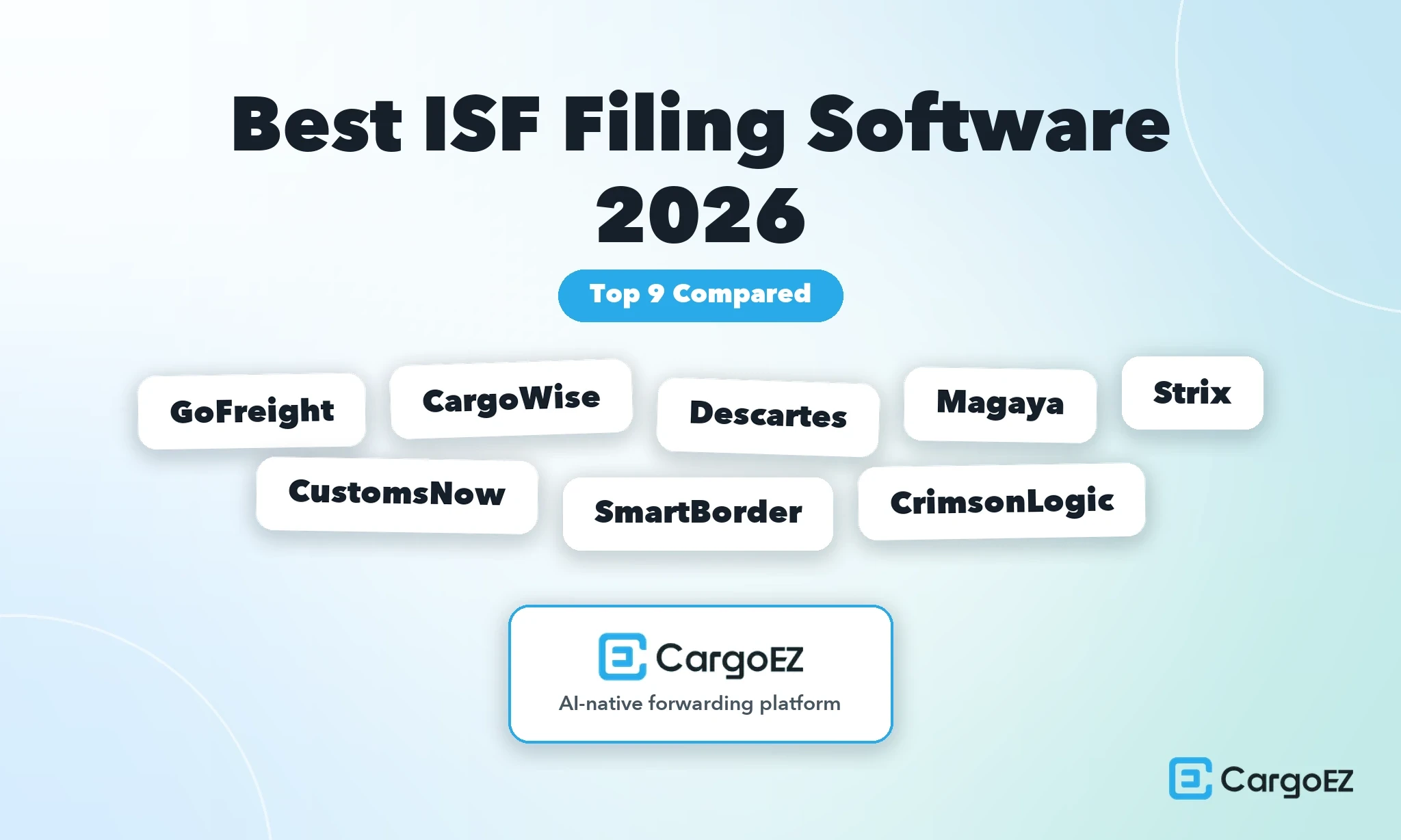
Comparing the top ISF filing software for freight forwarders in 2026: 1. CargoEZ, 2. GoFreight, 3. CargoWise, 4. Descartes, 5. Magaya, 6. Strix, 7. CustomsNow, 8. SmartBorder, 9. CrimsonLogic.
ISF, the Importer Security Filing or 10+2, is the cargo-security data you transmit to US Customs and Border Protection through ACE, and it must be filed at least 24 hours before your ocean container is loaded abroad. A late, wrong, or missing filing can cost $5,000 per violation, so the software has to get the data to CBP on time and correct.
The best ISF filing software depends on who you are. An independent importer self-filing a handful of shipments needs something different from a customs broker filing thousands, and a freight forwarder needs something different again. I write this for the freight forwarder who files ISF for import customers or provides the data, so I rank ISF filing software for freight forwarders first, and I mark the tools that really suit a self-filing importer or a customs broker instead. The best ISF 10+2 filing software direct to CBP for a forwarder keeps that data on the shipment you already run.
ISF filing software: the forwarder's shortlist
CargoEZ — best for ISF filing built into your forwarding platform, direct to CBP
GoFreight — best for a modern forwarding workflow with ISF tied in
CargoWise — best for an all-in-one global forwarding and customs system
Descartes — best for enterprise, high-volume ISF connectivity
Magaya — best for SMB forwarders wanting forwarding plus deep US customs
Strix — best for independent importers self-filing with ABI certification
CustomsNow — best for customs brokers managing many importer accounts
SmartBorder — best for flexible self-filing plus a broker service center
CrimsonLogic — best for a direct-to-CBP trade-compliance filer
The short version: if you are a forwarder and want ISF filed as part of the shipment you already run, a platform like CargoEZ or GoFreight keeps the 10+2 data on the same file, so it auto-populates and nothing is re-typed. If you are a self-filing importer or a customs broker, a dedicated ABI ISF filing software such as Strix, CustomsNow, or SmartBorder is built for that job. I rank the forwarder platforms first, then the dedicated filers.
What I looked for in an ISF filing tool
I judged each tool on the things that actually keep an ISF compliant and cheap to run:
Direct ACE and ABI connectivity — electronic transmission of the ISF to CBP, with filing acknowledgments, status, and error handling, plus amendments and cancellations.
ISF-specific functionality — ISF-10 support, 10+2 data collection and validation, deadline tracking, and an audit trail.
Deadline and discrepancy alerts — ISF deadline tracking and ISF deadline alert software flag missing or mismatched 10+2 elements, like bill-of-lading data or HTS codes, before the 24-hour pre-loading window, so you avoid the $5,000 penalty.
Auto-population and automation — the best ISF filing software with auto-population pulls the ISF data from the shipment or purchase order, with templates and bulk filing, rather than keying every field.
Scale and integration — multiple importer accounts, role-based access, and TMS, ERP, or forwarding-system integration by API or EDI.
Real reviews where they exist — I use G2 and Capterra ratings when a tool has enough, and I say plainly when a customs vendor is too niche to have a meaningful public score.
A note on scope. ISF software serves three different buyers: the self-filing importer, the customs broker, and the freight forwarder. This guide is written for the forwarder, so I frame the importer-first and broker-first tools honestly rather than pretending they are forwarder platforms. Customs brokers still file most ISFs in practice, and CBP itself notes that buying software for a single ISF is rarely cost-effective.
ISF filing software compared, side by side
Platform | Best for | Type | Starting price | Rating (G2 / Capterra) |
1. CargoEZ | ISF filing built into your forwarding platform, direct to CBP | Forwarding platform | Custom / quote | 4.8 / n/a (G2, 40) |
2. GoFreight | A modern forwarding workflow with ISF tied in | Forwarding platform | Quote (~$100-500/user) | 4.8 / 4.6 |
3. CargoWise | An all-in-one global forwarding and customs system | Forwarding platform | Per-transaction (enterprise) | 4.3 / 2.9 |
4. Descartes | Enterprise, high-volume ISF connectivity | Customs / GTM | Enterprise / quote | n/a (enterprise suite) |
5. Magaya | SMB forwarders wanting forwarding plus deep US customs | Forwarding platform | Custom / quote | 4.4 / 4.4 |
6. Strix | Independent importers self-filing with ABI certification | Dedicated ISF / ABI | ~$30 per entry | n/a (niche vendor) |
7. CustomsNow | Customs brokers managing many importer accounts | Dedicated ISF / ABI | Quote | n/a (niche vendor) |
8. SmartBorder | Flexible self-filing plus a broker service center | Dedicated ISF / ABI | Quote | n/a (niche vendor) |
9. CrimsonLogic | A direct-to-CBP trade-compliance filer | Customs / trade compliance | Quote | 4.5 / n/a (G2, 23) |
Ratings verified Aug — 2026. Most dedicated customs and ISF vendors are niche and have too few public reviews for a meaningful score, so I mark those "n/a" rather than invent a number. For Magaya, the figure is the Magaya platform.
How each tool handles the 10+2 filing
Yes = documented and strong; Partial = present but limited; n/d = not documented.
Platform | Direct ACE / ABI to CBP | ISF-10 + 10+2 validation | Deadline + discrepancy alerts | Amendment management | Auto-populate from shipment | Multi-importer accounts |
CargoEZ | Yes (ISF + AMS to ACE) | Yes | Partial | Yes | Yes (from the shipment file) | Yes |
GoFreight | Yes | Yes | Yes | Yes | Yes | Yes |
CargoWise | Yes | Yes | Yes | Yes | Yes | Yes |
Descartes | Yes (ISF-10 + ISF-5) | Yes | Yes | Yes | Yes (EDI / XML) | Yes |
Magaya | Yes (deep US ABI) | Yes | Partial | Yes | Yes | Yes |
Strix | Yes (ABI-certified) | Yes | Yes | Yes | Partial | Partial |
CustomsNow | Yes | Yes | Yes | Yes | Partial | Yes |
SmartBorder | Yes | Yes | Partial | Yes | Partial | Yes |
CrimsonLogic | Yes (direct to CBP) | Yes | Partial | Yes | Partial | Partial |
The pattern I see: the forwarding platforms (CargoEZ, GoFreight, CargoWise, Magaya) win on auto-population, because the 10+2 data already lives on the shipment, while the dedicated filers (Strix, CustomsNow, SmartBorder) and the enterprise customs tools (Descartes, CrimsonLogic) win on pure customs depth and high-volume, multi-account filing.
The 9 best ISF filing platforms, reviewed
1. CargoEZ — Best for ISF filing built into your forwarding platform, direct to CBP
I put CargoEZ first for forwarders because it files ISF from inside the same platform that runs the shipment, so the 10+2 data comes off the file you already built instead of being keyed into a separate customs tool.
Who it's for
freight forwarders who file ISF for their import customers, or provide the data, and want the filing to sit on the shipment record with quoting, booking, and operations.
Who it's not for
a customs broker filing thousands of entries a month, or an enterprise importer who needs a full standalone ABI customs-entry suite; that depth sits with Descartes, CargoWise customs, or a dedicated filer.
Features
ISF and AMS to ACE: file the Importer Security Filing and the AMS manifest directly to CBP's ACE system, in one place, with real-time CBP status updates.
One-click ISF from the shipment: the ISF-10 data auto-populates from the shipment file, so bill-of-lading parties, container, and HTS details do not get re-typed.
Error checks before you send: required-field validation catches gaps before transmission, which is where the 24-hour deadline and the $5,000 penalty bite.
Types of ISF: the module handles the common ISF filing types, and it sits inside the wider customs-compliance module alongside the rest of your customs work.
On the same record as everything else: because ISF lives with quoting, booking, billing, and tracking, the customs step is not a separate silo.
Quick facts | Detail |
Best for | ISF filing built into your forwarding platform, direct to CBP (US SMB and midmarket forwarders) |
Starting price | Custom quote |
Key features | ISF + AMS direct to ACE, one-click ISF from the shipment, auto-population, required-field validation, real-time CBP status |
Rating | G2 4.8/5 (40 reviews), 95% 5-star |
Free trial | Free trial, set up on the demo call |
What reviewers say
4.8/5 on G2 from 40 reviews, with users citing one connected flow from booking to customs to invoicing. If you want to see ISF filing on your own shipments, book a demo or call +1 (408) 834-7476.
2. GoFreight — Best for a modern forwarding workflow with ISF tied in
GoFreight is the modern US forwarding platform I reach for when ISF should ride along with the forwarding operation, since it pairs ABI and CBP connectivity with the rest of the shipment lifecycle.
Who it's for
small and mid US forwarders who want ISF filing, validation, deadline alerts, and status tracking tied to the booking and shipment they already manage.
Who it's not for
a dedicated customs brokerage that lives entirely in customs entry work and wants a filing-only tool without a forwarding platform around it.
Features
ABI and CBP connectivity: electronic ISF transmission with validation and filing status.
Deadline alerts and amendments: alerts for the 24-hour window, plus amendment handling if cargo or vessel details change.
Auto-population and audit: ISF data pulled from the shipment, with audit and reporting for compliance.
One workflow: ISF sits with quoting, booking, tracking, and billing on one platform.
Quick facts | Detail |
Best for | A modern forwarding workflow with ISF tied in |
Starting price | Quote (~$100-500/user) |
Key features | ABI/CBP connectivity, ISF validation, deadline alerts, status tracking, amendments, auto-population, audit and reporting |
Rating | G2 4.8/5 (92), Capterra 4.6/5 (25) |
Free trial | Demo |
What reviewers say
4.8/5 on G2 from 92 reviews, one of the larger recent review bases among forwarding platforms.
3. CargoWise — Best for an all-in-one global forwarding and customs system
CargoWise is the heavyweight I recommend to large forwarders and brokerages, because it treats ISF as one connected step inside a global forwarding and customs operating system rather than an isolated filing.
Who it's for
forwarders, NVOCCs, and large customs brokerages handling substantial volume across many offices, who want ISF wired into customs, documentation, and government connectivity.
Who it's not for
a small importer filing a handful of ISFs a month, where CargoWise is more expensive and complex than a dedicated ISF tool.
Features
Native customs connectivity: ISF and customs filings connect to CBP with native compliance across 60+ countries.
Integrated data: ISF draws on the same shipment, documentation, and party data as the rest of the platform.
Scale and governance: built for multi-entity, high-volume filing with control and audit.
End-to-end: customs sits with forwarding operations, finance, and messaging.
Quick facts | Detail |
Best for | An all-in-one global forwarding and customs system |
Starting price | Per-transaction (enterprise, opaque) |
Key features | Native ISF and customs filing, 60+ country compliance, integrated shipment data, multi-entity scale, audit |
Rating | G2 4.3/5 (35), Capterra 2.9/5 (32) |
Free trial | Demo |
What reviewers say
4.3/5 on G2 from 35, but 2.9/5 on Capterra from 32; I read both before recommending it.
4. Descartes — Best for enterprise, high-volume ISF connectivity
Descartes is my pick when ISF has to plug into an existing enterprise TMS or ERP at high volume, since its customs and compliance suite is built around dedicated ISF connectivity and data validation.
Who it's for
high-volume importers and enterprise logistics companies that already run a TMS or ERP and want ISF-10 and ISF-5 filing connected to it by EDI, XML, or flat file.
Who it's not for
a small importer doing a handful of filings, where a dedicated enterprise suite is overkill.
Features
ISF-10 and ISF-5: validations and electronic transmission for both filing types to CBP.
Deep customs content: robust commercial customs content and data validation via the Descartes Global Logistics Network.
Enterprise integration: EDI, XML, and flat-file connectivity into existing systems, with filing-status notifications.
High-volume ready: built for large, automated filing programs.
Quick facts | Detail |
Best for | Enterprise, high-volume ISF connectivity |
Starting price | Enterprise / quote |
Key features | ISF-10 + ISF-5 validation, EDI/XML/flat-file integration, deep customs content, status notifications, high-volume automation |
Rating | Reviewed on G2; enterprise customs suite (see note) |
Free trial | Demo |
What reviewers say
Descartes is a large, established customs and logistics vendor; its ISF sits inside the broader Descartes customs and compliance suite, which is reviewed on G2 but as a suite rather than a standalone ISF product, so I do not attach a single ISF score to it.
5. Magaya — Best for SMB forwarders wanting forwarding plus deep US customs
Magaya is my SMB pick when a forwarder wants forwarding and genuinely deep US customs, including ISF, inside one system, and it is strongest on US and Latin-America lanes.
Who it's for
small and midmarket forwarders that want ISF and US ABI filing alongside forwarding and a warehouse, on US-heavy import lanes.
Who it's not for
teams that want the most modern interface, since some reviewers describe the UI as dated.
Features
Deep US ABI and ISF: established US customs filing, including ISF, inside the platform.
Forwarding and warehouse: ISF sits with shipments, documents, and an integrated warehouse system.
Auto-population: ISF data draws from the shipment record.
Established suite: a mature platform with a large review base behind it.
Quick facts | Detail |
Best for | SMB forwarders wanting forwarding plus deep US customs |
Starting price | Custom quote |
Key features | Deep US ABI and ISF filing, forwarding and warehouse, auto-population from the shipment, US/FMC strength |
Rating | G2 4.4/5 (284), Capterra 4.4/5 (50) |
Free trial | Demo |
What reviewers say
4.4/5 on G2 from 284 and 4.4/5 on Capterra from 50; the figures are for the Magaya platform.
6. Strix — Best for independent importers self-filing with ABI certification
Strix is the self-filing tool I point importers to, a cloud, ABI-certified system that lets a company file its own ISF and entries with automated classification, at a low per-entry price.
Who it's for
independent importers that want to self-file with direct ACE integration, automated HTS classification, and optional licensed-broker support at about $30 per entry.
Who it's not for
a freight forwarder who wants ISF inside a forwarding platform, since Strix is built around the importer self-filing, not a forwarding workflow.
Features
ABI-certified self-filing: file ISF and entries directly to CBP as a self-filer.
Automated HTS classification: classification support built in to reduce errors.
Direct ACE integration: electronic transmission and status from CBP.
Optional broker support: licensed-broker help available when needed, priced per entry.
Quick facts | Detail |
Best for | Independent importers self-filing with ABI certification |
Starting price | ~$30 per entry |
Key features | ABI-certified self-filing, automated HTS classification, direct ACE integration, optional licensed-broker support |
Rating | No meaningful G2 or Capterra rating yet |
Free trial | Check the vendor |
What reviewers say
Strix is a niche customs-filing vendor without a meaningful public G2 or Capterra score, so I would confirm ISF fit and current pricing on a demo.
7. CustomsNow — Best for customs brokers managing many importer accounts
CustomsNow is the broker-focused filer I flag when a customs team runs many importer accounts, with a cloud dashboard built around repeatable ISF and ACE work.
Who it's for
customs brokers, 3PLs, and importers who want an intuitive, 24/7 cloud dashboard with template replication, copy functions, and automated CBP data validation.
Who it's not for
a forwarder who wants ISF as one module inside a forwarding platform rather than a dedicated customs-filing dashboard.
Features
Focused ISF and ACE workflow: a dedicated dashboard for filing ISF and entries to CBP.
Template replication and copy: reuse filings across recurring importer accounts to save keying.
Automated CBP validation: data checks before transmission.
Multi-account: built for teams filing across many importers.
Quick facts | Detail |
Best for | Customs brokers managing many importer accounts |
Starting price | Quote |
Key features | Dedicated ISF/ACE dashboard, template replication, copy functions, automated CBP validation, multi-importer accounts |
Rating | No meaningful G2 or Capterra rating yet |
Free trial | Check the vendor |
What reviewers say
CustomsNow is listed on G2 but without enough reviews for a meaningful score, so I would confirm fit and pricing on a demo.
8. SmartBorder — Best for flexible self-filing plus a broker service center
SmartBorder is the flexible option I mention for teams that mix self-filing with brokerage, since it offers a self-filing web portal alongside a dedicated service-center module for customs brokers.
Who it's for
self-filing importers who want an online portal, and customs brokers who want a service-center module, in flexible workflows.
Who it's not for
a forwarder looking for ISF built into a forwarding and operations platform.
Features
Self-filing portal: an online web portal for importers to file ISF and entries.
Broker service center: a dedicated module for customs brokers.
Flexible workflows: configurable to how the team files.
CBP connectivity: electronic transmission to CBP.
Quick facts | Detail |
Best for | Flexible self-filing plus a broker service center |
Starting price | Quote |
Key features | Self-filing web portal, broker service-center module, flexible workflows, CBP connectivity |
Rating | No meaningful G2 or Capterra rating yet |
Free trial | Check the vendor |
What reviewers say
SmartBorder is a customs-software product without a meaningful public G2 or Capterra score, so I would confirm ISF fit on a demo.
9. CrimsonLogic — Best for a direct-to-CBP trade-compliance filer
CrimsonLogic is the trade-compliance filer I include for forwarders and agents who want a direct-to-CBP tool, and it is one of the few dedicated customs vendors here with a real public rating.
Who it's for
freight forwarders, shipping agents, and ocean carriers who want a direct-to-CBP ISF and trade-compliance tool with responsive support.
Who it's not for
a team that needs the deepest ISF and AMS clarity, since some reviewers say the ISF and AMS side could be clearer.
Features
Direct-to-CBP filing: electronic ISF and trade-compliance transmission to CBP.
Built for agents: designed for ocean carriers, forwarders, and shipping agents.
Trade-compliance suite: ISF sits within a wider trade-compliance product.
Support: reviewers praise the responsive customer support.
Quick facts | Detail |
Best for | A direct-to-CBP trade-compliance filer |
Starting price | Quote |
Key features | Direct-to-CBP ISF, trade-compliance suite, agent and carrier focus, responsive support |
Rating | G2 4.5/5 (23) |
Free trial | 30-day trial (per vendor) |
What reviewers say
4.5/5 on G2 from 23 reviews; users praise the interface and support, though one noted the ISF and AMS side was not clear, so confirm that on a demo.
One more worth knowing: CargoTrans offers an importer-side ISF workflow that emphasizes pulling data from existing systems, 24-hour deadline alerts, and 10+2 data assembly, which suits importers and manufacturers rather than forwarders.
Picking the right ISF software for your operation
Start from who files. A forwarder wants ISF inside the forwarding platform (CargoEZ, GoFreight, Magaya); a customs broker wants a dedicated filer (CustomsNow); a self-filing importer wants an ABI tool (Strix, SmartBorder).
Insist on direct ACE and validation. An ISF software with ACE integration must transmit to CBP with acknowledgments, and validate the 10+2 data before it goes.
Demand deadline alerts. Alerts before the 24-hour pre-loading window are what keep you off the $5,000 penalty.
Check auto-population. If the ISF data can be pulled from the shipment or purchase order, you avoid re-keying and the errors that come with it.
Right-size the cost. For very low volume, a broker or a lightweight ISF filing software for small importers beats an enterprise suite; CBP notes that buying software for a single ISF is rarely worth it.
My verdict: the best ISF filing software for forwarders
For a freight forwarder, I would pick CargoEZ, because ISF is filed direct to CBP from inside the same platform that runs your quoting, booking, and operations, so the 10+2 data auto-populates and nothing is re-typed. I would choose GoFreight for a modern forwarding workflow with ISF tied in, CargoWise for a global forwarding-and-customs system at scale, Descartes for enterprise high-volume ISF connectivity, and Magaya for SMB forwarding with deep US customs. If you are a self-filing importer or a customs broker instead, look at Strix, CustomsNow, SmartBorder, or CrimsonLogic.
File your next ISF from the shipment. Book a CargoEZ demo or call +1 (408) 834-7476, and see the 10+2 data go straight to CBP without re-keying.
1. What is ISF filing software?
ISF filing software, also called importer security filing software or 10+2 filing software, collects the Importer Security Filing (10+2) data and transmits it electronically to US Customs and Border Protection through ACE filing, with validation, status, and amendments. For a forwarder it is usually a module inside the forwarding platform; for brokers and self-filing importers it is often a dedicated ABI tool.
2. When does ISF have to be filed?
The ISF must be filed at least 24 hours before the ocean container is loaded onto the vessel at the foreign port. Late, incomplete, or inaccurate filings can draw liquidated damages of $5,000 per violation, which is why deadline and discrepancy alerts matter.
3. Do freight forwarders file ISF or do customs brokers?
Customs brokers file most ISFs, but freight forwarders often file when authorized, or supply the 10+2 data. That is why a forwarder benefits from ISF and AMS filing software that lives on the shipment record, so the data is captured once and filed direct to CBP.
4. What is the best ISF software for a small importer?
For very low volume, using a customs broker or a lightweight, ABI-certified self-filing tool like Strix is usually more cost-effective than buying an enterprise platform, a point CBP makes as well.
Author

Don't forget to share this blog!