Switching From Magaya: 9 Best Alternatives and Competitors Compared in 2026
Author:
Pamela
Published On:
1 min read
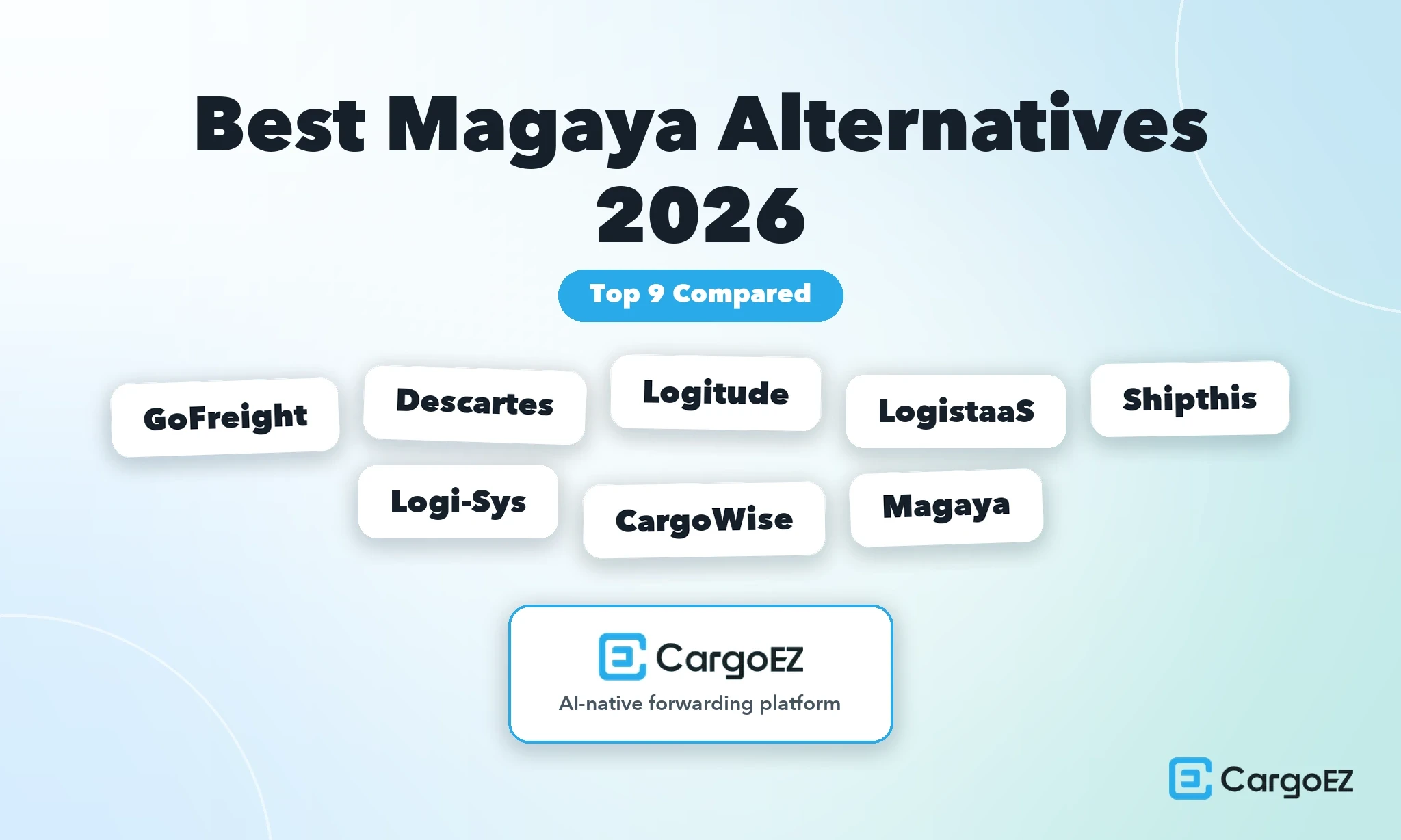
Comparing the top 9 best Magaya alternatives includes 1. CargoEZ, 2. GoFreight, 3. Descartes, 4. Logitude World, 5. LogistaaS, 6. Shipthis, 7. Logi-Sys, 8. CargoWise, and 9. Magaya Supply Chain.
Before you compare Magaya against anything else, establish which Magaya you are being quoted. Magaya Cargo System and Magaya Supply Chain both still sit on Magaya's own site, and they differ on interface, capability and price. A fair number of forwarders shopping for alternatives find their real complaint is that they are on the older one.
Magaya reviews split once you check the source. It holds 4.4 out of 5 on G2 across 309 reviews and 4.4 on Capterra across 51, but 1.9 on Trustpilot across 12, where the reviews describe leaving rather than using.
TLDR — My Top Picks
CargoEZ: Best for US small and midsize air and ocean forwarders wanting quote to cash, AMS and ISF filing and a full ledger on one record. Implementation in under one month. Modular subscription.
GoFreight: Best for forwarders wanting broad module coverage on a modern cloud platform. Implementation 4 to 8 weeks. Per-user subscription.
Descartes: Best for customs brokerage led operations needing high-volume AMS and ACAS filing, denied-party screening and trade content. Per-module, enterprise.
Logitude World: Best for smaller forwarders and consolidators wanting dashboards, automations and a digital portal at a published price. $75 per user per month, free trial.
LogistaaS: Best for quote-led forwarders and NVOCCs wanting freight CRM and quoting at the front. $45 per user per month, no transaction fees.
Shipthis: Best for mid-market forwarders and NVOCCs wanting every module on a single plan. $89 per user per month, 30-day free trial.
Logi-Sys: Best for forwarders consolidating operations, sales and accounting off spreadsheets. $80 per month, free trial.
CargoWise: Best for global enterprise networks running most of the 225+ module set across multiple entities and currencies. Per-transaction Value Pack.
Magaya Supply Chain: Best for operations where warehousing or customs brokerage is the business rather than a service attached to freight. Per-module subscription.
Top Magaya Alternatives at a Glance
The nine Magaya competitors below are the ones a US forwarder can realistically move to, and the table is the fastest way to eliminate products.
# | Platform | Best for | Starting price | Pricing model | Implementation | Rating |
1 | CargoEZ | US small and midsize air and ocean forwarders wanting quote to cash on one record | Custom quote | Modular subscription | Under 1 month, G2 average | 4.8/5 (40) G2 |
2 | GoFreight | US forwarders wanting a cloud native platform with accounting and QuickBooks built in | Custom quote | Per user subscription | 4 to 8 weeks, vendor stated | 4.8/5 (92) G2 |
3 | Descartes | Customs brokerage and compliance heavy operations | Not publicly disclosed | Per module, enterprise | Not documented | 4.6/5 (2,222) G2, seller level |
4 | Logitude World | Smaller forwarders wanting an approachable cloud platform with published pricing | $75 per user per month | Per user subscription, three tiers | Not documented, free trial available | 4.5/5 (40) Capterra |
5 | LogistaaS | Quote led SMB forwarders and NVOCCs | $45 per user per month | Per user subscription, no transaction fees | One-time implementation fee | 4.5/5 (33) Software Advice |
6 | Shipthis | Mid market forwarders and NVOCCs wanting all modules on one plan | $89 per user per month | Per user subscription, all modules included | Self-onboarding, 30-day free trial | 4.8/5 (13) Capterra |
7 | Logi-Sys | Forwarders wanting forwarding, CRM and accounting in one licence | $80 per month, free trial | Subscription | Free trial available | 4.7/5 (24) Software Advice |
8 | CargoWise | Global multi entity forwarders needing consolidated multi currency accounting | Not publicly disclosed | Per transaction, Value Pack | Not documented | 4.3/5 (35) G2 and 2.9/5 (32) Capterra |
9 | Magaya Supply Chain | Warehouse first and customs brokerage first operations | Not publicly disclosed | Per module and per user | Not documented | 4.4/5 (309) G2, 4.4/5 (51) Capterra, 1.9/5 (12) Trustpilot |
Capability matrix
These six capabilities are the ones that actually eliminate products for a forwarder leaving Magaya.
Platform | Native warehouse management | ACE certified ABI filing | AMS and ISF | Built in accounting ledger | Customer portal | Open API and EDI |
CargoEZ | Not documented | V2.0 | AMS and ISF in the shipment workflow, ISF-5 and ISF-10+2 | Full double-entry ledger | Yes, multi-language | QuickBooks API confirmed |
GoFreight | Not documented | Not documented | Security filing | Yes | Yes | QuickBooks connectivity |
Descartes | Not documented | Yes | Large AMS and ACAS network to CBP | Native GAAP-compliant general ledger | Real-time customer tracking | Global Logistics Network |
Logitude World | Not documented | Not documented | Not documented | Invoicing, full accounting not documented | Interactive digital portal | Limited API on Professional, full API on Enterprise |
LogistaaS | Not documented | Not documented | Customs module | Native accounting on the top plan | Customer Portal from the $85 plan | Not documented |
Shipthis | Warehouse Management included | Not documented | eAWB submission as a transactional add-on | Freight Accounting included | Yes | Not documented |
Logi-Sys | Warehouse management | Not documented | Not documented | Yes, integrated accounting | Not documented | Not documented |
CargoWise | Contract Warehouse Manager Value Pack | Yes | Customs across multiple regimes | Yes, multi-entity and multi-currency | Yes | Extensive, via eAdaptor and partners |
Magaya Supply Chain | Magaya WMS, a core strength | ACE certified ABI via ACELYNK | Yes | Yes, with QuickBooks Online extension | Yes | Carrier and customs connections documented |
A cell reading "Not documented" means the capability could not be substantiated from public documentation at the time of checking. It is a question to put to the vendor in a demo, not a confirmed absence. Several of these platforms almost certainly do more than their public material describes.
Why Forwarders Are Switching From Magaya in 2026
Five things to check before you renew.
Customs is a strength with rough edges. ACELYNK brought ACE certified ABI filing in 2020 that most platforms here lack (Magaya). Two 2025 reviewers still reported problems, on payment authorisation in March and PGA filings transmitting without error flagging in May.
Exit terms are the best evidenced concern. A May 2025 review says Magaya "will not allow companies to break contracts and forces to pay for the whole contract even when out of business." A November 2025 reviewer described misleading clauses and lawyers before termination.
Magaya pricing needs a sales call. No rate card, and the pricing URL 404s. SelectHub and ITQlick estimate around $300 per user per month, but those are third party estimates. Logitude World publishes $75, Shipthis $89, LogistaaS $45, Logi-Sys $80.
Data entry is where the hours go. Magaya automation covers quoting, dimensioning and document capture, but switchers most often cite re-keying between modules. Test extraction with five of your own real documents at every vendor.
Proportion. Magaya sells one platform to forwarders, NVOCCs, 3PLs, warehouses, couriers and customs brokers (Magaya). If you are only the first, you license warehouse and 3PL billing you never open.
How I Scored These 9 Magaya Competitors
Six criteria, in the order a forwarder switching from Magaya actually decides on them.
Freight integration. Whether inventory, pick and pack and bonded handling are native to the freight workflow or bolted alongside it. First, because it is the criterion that sends readers back to Magaya.
Interface and learning curve. How fast a new operator becomes productive, and how many screens a routine job touches.
Implementation timeline. Weeks, typical of mid market platforms, or six to twelve months through certified consultants, typical of enterprise rollouts. Whether a free trial lets you test before committing.
Connectivity, APIs and EDI. REST API quality, Cargo IMP and Cargo XML coverage, and how easily the platform reaches accounting systems, ERPs, rate sources and carriers.
Compliance and customs fit. Which filing types are native, and whether the platform is built for US workflows or multi country trade. AMS, ISF, AES and ABI are not interchangeable.
Pricing predictability. Whether the model is transparent and per-user, which scales with a number you control, or per-transaction and per-module, which scales with numbers your customers control. A published price scores higher than a custom quote, because it can be forecast.
Magaya Competitors and Alternatives Compared in Detail
1. CargoEZ
Best for
US small and midsize air and ocean forwarders who want quoting, operations, finance and filing on one shipment record.
Quick fact | Verified detail |
Starting price | Custom quote |
Pricing model | Modular subscription |
Implementation | Under 1 month, G2 average |
Rating | 4.8/5 from 40 reviews, G2 |
Compliance | SOC 2, ISO 27001, GDPR, TLS 1.2+, AES-256 |
CargoEZ is built around a single premise: the contact who receives a quote, the shipment that quote becomes, the invoice that shipment generates and the ledger entry that invoice posts to should all be the same record. Eight modules run on one login, covering contacts, leads, rates, freight, finance, chat, customs in beta and administration.
For a forwarder switching from Magaya, the relevant difference is where the platform's centre of gravity sits. Magaya organises around cargo in a facility. CargoEZ organises around a shipment moving between parties, with a real double entry ledger underneath it so job level profitability is visible without an export. The CRM is part of the same system rather than a connected one, which matters more than it sounds when the person quoting and the person operating are two different people.
AMS and ISF filing are built in rather than brokered out, covering ISF-5 and ISF-10+2, with denied party screening against OFAC and BIS lists. Direct ACE portal integration is a V2.0 item, as are road and door to door movements and spot rate procurement.
Pros
Quote, operations, finance and filing on one record, with no re entry between stages
Real double entry accounting rather than an export to a general ledger, with a QuickBooks API connection
AMS and ISF filing native, covering ISF-5 and ISF-10+2, plus a white labelled customer portal
Denied party screening against OFAC and BIS lists
Implementation reported under a month, against enterprise timelines measured in quarters
SOC 2 and ISO 27001 certified, which is not universal in this category
Cons
No public pricing, so a sales conversation is required to compare on cost
Road and door to door movements and spot rate procurement are V2.0
Direct ACE portal integration is V2.0, so a customs brokerage first operation will want a different fit
What users are saying
CargoEZ holds 4.8 out of 5 on G2, tied for the highest score in this comparison. Most of those reviews are five star. Gowtham G., a logistics coordinator at a mid market company, described the migration as "surprisingly smooth" in a review dated 29 September 2025.
Our Verdict
The strongest fit for a US forwarder whose business is moving air and ocean freight and whose frustration with Magaya is the interface, the re entry between stages or the cost of a system built around a facility they do not run. Verify two things in the demo: that AMS and ISF filing covers your exact lane mix, and whether the V2.0 roadmap items you need have dates attached.
2. GoFreight
Best for
US forwarders wanting a cloud native platform with accounting and QuickBooks built in.
Quick fact | Verified detail |
Starting price | Custom quote |
Pricing model | Per user subscription, vendor stated |
Implementation | 4 to 8 weeks, vendor stated |
Rating | 4.8/5 from 92 reviews, G2 |
GoFreight is the closest like for like replacement on this list. It is cloud native, built for US port operations, and designed from the start around the way a forwarding desk actually moves through a job rather than around a database schema. For a Magaya user, the transition is conceptually short: the same work, arranged differently.
The platform covers quoting through to invoicing with an accounting module and QuickBooks integration, container and air tracking, and a customer facing portal. Its own material puts implementation at four to eight weeks, which is a vendor claim rather than an independently verified figure.
GoFreight also publishes its own comparison content in this category, including its own Magaya alternatives article, so treat its claims about competitors the way you should treat ours: as a starting point to verify, not as a finding.
Pros
4.8 out of 5 from 92 reviews, the strongest combination of score and sample among the direct alternatives
Cloud native interface, consistently the reason reviewers cite for choosing it
Accounting module with QuickBooks integration built in
Container and air tracking with automated status updates
Per user pricing, so the bill tracks headcount rather than shipment volume
Cons
No public pricing, so the per-user rate cannot be compared without a sales conversation
Implementation and coverage figures come from the vendor rather than independent verification
Warehouse management depth is not documented publicly, which matters if you are switching from Magaya but keeping a facility
ACE certified ABI filing is not documented, so brokerage first operations will want a different fit
What users are saying
GoFreight holds 4.8 out of 5 from 92 reviews on G2. Reviewers most often cite the interface and the speed at which new staff become productive.
Our Verdict
Take this one seriously if the interface is your primary reason for switching and you do not run a significant warehouse operation. It is the most direct substitution available. Ask for the per-user rate in writing across a three-year term, and ask what the four-to-eight-week implementation assumes about your data migration.
3. Descartes
Best for
Customs brokerage first operations and forwarders whose compliance requirements span multiple countries.
Quick fact | Verified detail |
Starting price | Not publicly disclosed |
Pricing model | Per module, enterprise |
Implementation | Not documented |
Rating | 4.6/5 from 2,222 reviews, G2, seller level across all Descartes products |
Descartes is the alternative for the specific segment of Magaya users who chose it for ACELYNK rather than for freight. If customs brokerage is your business rather than an adjacent capability, the shortlist genuinely narrows to Descartes, CargoWise and staying put.
The Global Logistics Network operates one of the largest AMS and ACAS transmission networks to US Customs and Border Protection, alongside denied party screening, trade content and multi country filing. It also carries a native GAAP-compliant general ledger built for forwarders, which is rarer than it sounds in this category.
The trade off is proportion. Descartes is modular and priced per module, but the buying process, the implementation and the ongoing relationship are all enterprise shaped. A three person forwarding desk is not the customer this is built for.
Pros
One of the largest AMS and ACAS transmission networks to CBP, backed by Descartes trade content
Native GAAP-compliant general ledger purpose-built for forwarders
Denied party screening and trade content as first class capabilities
The clearest destination if ACELYNK filing is why you bought Magaya
Cons
The 4.6 out of 5 figure is seller level across the entire Descartes portfolio, not a product level score for the forwarding suite
No public pricing, and per module structures make total cost hard to model early
Enterprise implementation and sales cycle, which small forwarders will find heavy
Reviewers report a learning curve for new staff
What users are saying
The G2 figure of 4.6 out of 5 covers 2,222 reviews across all Descartes products and should be read as a company level signal rather than a verdict on any single suite. Ask for references specifically on the product you are being quoted.
Our Verdict
The right answer for a customs brokerage led operation switching from Magaya, and close to the only answer if you also file across multiple countries. Smaller forwarding desks with modest compliance needs will want a different fit. Insist on a product level reference and a written scope of the modules included in your quote.
4. Logitude World
Best for
Smaller forwarders who want a cloud platform they can run without a dedicated systems person, at a published price.
Quick fact | Verified detail |
Starting price | $75 per user per month, Smart plan |
Pricing model | Per user subscription, three published tiers |
Implementation | Not documented, free trial available |
Rating | 4.5/5 from 40 reviews, Capterra, 98% positive sentiment |
Logitude publishes its full price list, which puts it in a minority in this category and makes it one of the easiest platforms here to evaluate before talking to anyone. Smart at $75 per user per month covers the forwarding solution, invoicing, quotes, a digital portal, automations and up to five dashboards. Professional at $99 adds full CRM, an interactive portal, advanced task management, scheduled reports and limited API access. Enterprise is custom, from 30 users.
For a forwarder who bought Magaya expecting an all in one and ended up using perhaps a third of it, Logitude is the honest downsize. You will lose warehouse depth and customs filing scope. You will gain a system that a two or three person desk can actually operate, at a number you can see in advance.
Pros
Full public price list across three tiers, so total cost can be modelled before a sales call
Free trial available, which few platforms in this category offer
98% positive sentiment on Capterra, the highest in this comparison
Purpose-built for smaller forwarders rather than scaled down from an enterprise product
Cons
Full API access is reserved for the Enterprise tier, which starts at 30 users
US customs filing capability is not documented publicly, so AMS and ISF should be confirmed in the demo
Warehouse management is not documented publicly
Accounting depth is not documented beyond invoicing
What users are saying
Logitude World holds 4.5 out of 5 from 40 reviews on Capterra, with 98% positive sentiment, the highest in this comparison though on a sample of 40 rather than hundreds.
Our Verdict
The most transparent option on this list and a strong fit for a small desk that wants to know the bill before the conversation. Confirm AMS and ISF coverage and accounting scope against your own workflow, because those are the two areas the public documentation leaves open.
5. LogistaaS
Best for
Quote led SMB forwarders and NVOCCs who want a bill that does not move when volume does.
Quick fact | Verified detail |
Starting price | $45 per user per month, Sales Booster |
Pricing model | Per user subscription, explicitly no transaction fees |
Implementation | One-time implementation fee |
Rating | 4.5/5 from 33 reviews, Software Advice |
LogistaaS publishes that whether you handle 100 shipments or 10,000 in a month, the subscription price stays the same. For a forwarder who cannot get a number out of their incumbent at all, that is one of the most relevant sentences any vendor on this page has published.
The tiers are structured by function rather than seat count. Sales Booster at $45 is CRM only. Operations Engine at $65 adds shipments and finance. The $85 tiers add either a customer portal or a native accounting module. Sub-scores run ease of use 4.6, functionality 4.5, customer support 4.4 and value for money 4.2.
One note on sourcing: Software Advice lists an entry price of $35 per user per month, while LogistaaS's own page lists $45. The vendor's own figure is used here.
Pros
Explicit no-transaction-fee commitment, published by the vendor
Four published tiers, so the upgrade path and its cost are visible in advance
Native accounting module available on the top plan
Highest ease-of-use sub-score among the platforms publishing sub-scores
Cons
A one-time implementation fee applies and its amount is not published
Customer portal only arrives at the $85 tier
Warehouse management is not documented publicly, a real gap against Magaya
Some reviewers report long implementations, so ask for references at your size
What users are saying
LogistaaS holds 4.5 out of 5 from 33 reviews on Software Advice, with support at 4.4 and ease of use at 4.6.
Our Verdict
The clearest answer for a forwarder whose objection is that Magaya pricing is unknowable and moves with modules and seats. Get the implementation fee quoted before you compare monthly costs, and confirm customs and warehouse scope against your lanes.
6. Shipthis
Best for
Mid market forwarders and NVOCCs who want every module on a single plan and a genuine trial before committing.
Quick fact | Verified detail |
Starting price | $89 per user per month, Standard, all modules included |
Pricing model | Per user subscription |
Implementation | Self-onboarding at no cost, 30-day free trial, no card required |
Rating | 4.8/5 from 13 reviews, Capterra |
Shipthis takes the opposite approach to module pricing from Magaya. One Standard plan at $89 per user per month includes shipment management, CRM, tariff and rate, quotation, freight accounting and warehouse management, with future modules included automatically. There is no module upsell path, which removes an entire category of quote surprises, and it is the closest thing here to Magaya's breadth on a published number.
A few capabilities sit outside the plan and bill transactionally, specifically Track and Trace, Trade Messaging and eAWB submission. The review sample is the smallest here at 13.
Pros
All modules on one published per-user price, with future modules included
Warehouse management included, which few alternatives here match
30-day free trial with no credit card, the strongest evaluation offer in this comparison
Self-onboarding available at no additional cost
Cons
13 reviews is the smallest sample in this comparison, so the 4.8 carries less weight than the number suggests
Track and Trace, Trade Messaging and eAWB submission bill transactionally on top of the subscription
ACE certified ABI filing is not documented publicly
Open API connectivity is not documented publicly
What users are saying
Shipthis holds 4.8 out of 5 from 13 reviews on Capterra. Treat a 13 review sample as directional rather than conclusive, and ask for references from operations of your size.
Our Verdict
The best way to test a Magaya replacement without a procurement process, and the strongest candidate if you are keeping a warehouse function. Model the transactional add-ons against your monthly volume before comparing the headline price, since those are the line items that behave most like the model you are leaving.
7. Logi-Sys
Best for
Forwarders who want forwarding, CRM and accounting under a single licence with a published starting price.
Quick fact | Verified detail |
Starting price | $80 per month, free trial available |
Pricing model | Subscription |
Implementation | Free trial available |
Rating | 4.7/5 from 24 reviews, Software Advice and 4.6/5 from 17 on Capterra |
Logi-Sys, from Softlink Global, covers forwarding operations, CRM, accounting and warehouse capability in one system, which makes it structurally the closest to Magaya's all in one shape among the platforms publishing a price. For a forwarder who liked the breadth of Magaya and disliked the commercial relationship, that combination is the relevant one.
Sub-scores run ease of use 4.6, customer support 4.7 and functionality 4.6, with support the strongest dimension. The consistent criticism is reporting depth at the top end, where reviewers from larger organisations describe weakness in master reports and MIS dashboards.
Pros
Support is its highest-rated dimension at 4.7, unusual in this category
Published entry price and a free trial
Forwarding, CRM, accounting and warehouse capability in one licence
Customisable reporting scheduler singled out by reviewers as genuinely useful
Cons
Reviewers from larger organisations report weakness in master reports and MIS dashboards
Customisation is reported as expensive
Small combined review sample of 41 across both platforms
US customs filing is not documented publicly, a real gap against Magaya's ACELYNK capability
What users are saying
Logi-Sys holds 4.7 out of 5 from 24 reviews on Software Advice and 4.6 out of 5 from 17 on Capterra, a consistent picture across two independent samples, with support the strongest dimension at 4.7.
Our Verdict
A strong value option for a forwarder who wants Magaya's breadth on clearer commercial terms with responsive support. Larger or reporting-heavy operations should test the dashboard and MIS layer specifically before committing, since that is where the consistent criticism sits.
8. CargoWise
Best for
Global multi entity forwarders needing consolidated multi currency accounting.
Quick fact | Verified detail |
Starting price | Not publicly disclosed |
Pricing model | Per logistics transaction, under Value Pack |
Implementation | Not documented, typically delivered via certified partners |
Rating | 4.3/5 from 35 reviews, G2 and 2.9/5 from 32 reviews, Capterra |
CargoWise is on this list for one specific reader: the forwarder switching from Magaya because the business has grown past it, not because the platform frustrates them. With 225 plus modules, multi entity and multi currency consolidated accounting, land transport and a global customs footprint, it is the most capable system in this comparison by a wide margin.
It is also the one where the review platforms disagree most. CargoWise holds 4.3 out of 5 on G2 and 2.9 out of 5 on Capterra, on samples of roughly 35 and 32. Both are small and neither settles the question. G2's own comparison data scores CargoWise 6.4 on ease of setup where Magaya scores 8.2, so a Magaya user should expect implementation to get harder, not easier.
In December 2025 WiseTech moved the majority of CargoWise customers onto Value Pack pricing, replacing seat licences with per logistics transaction fees. The automation fee is designed to appear on your customer's invoice by default (CargoWise). Whether that suits you depends entirely on your customers.
Pros
The deepest functional coverage in this comparison, including land transport and global customs
Multi entity and multi currency consolidated accounting that nothing else here matches
Industry standard status, so agent networks are more likely to already run it
ACE certified customs capability alongside filing in dozens of other countries
Cons
Capterra rates it 2.9 out of 5 across 32 reviews, against 4.3 on G2 across 35
G2 scores it 6.4 on ease of setup where Magaya scores 8.2
Per transaction pricing means cost scales directly with shipment volume
Implementation typically runs through certified third party partners
You license 225 plus modules whether you run a handful or all of them
What users are saying
The platform split is the most notable thing in CargoWise's review record. It holds 4.3 out of 5 on G2 and 2.9 out of 5 on Capterra, on comparable sample sizes. Read both before drawing a conclusion.
Our Verdict
The right move only if you are switching from Magaya upward, into genuine multi entity global operations that need most of what CargoWise does. A forwarder leaving because Magaya feels heavy will find CargoWise heavier, and the setup scores say so. Model per transaction pricing against your projected volume, not your current one.
9. Magaya Supply Chain
Best for
Warehouse first operations and customs brokerage led businesses that need filing and freight on one system.
Quick fact | Verified detail |
Starting price | Not publicly disclosed |
Pricing model | Per module and per user |
Implementation | Not documented |
Rating | 4.4/5 from 309 reviews, G2, 4.4/5 from 51, Capterra, 1.9/5 from 12, Trustpilot |
Magaya belongs on its own alternatives list, because switching is not always the right decision. The Magaya WMS is the reason: warehouse management built into the forwarding and consolidation flow rather than bolted on, and the capability most likely to be quietly worse in whatever replaces it.
It has the largest review base of any forwarding-native platform in this comparison at over 300 G2 reviews, and both major platforms agree on the score, which is a useful consistency signal. Software Advice sub-scores run ease of use 4.5, functionality 4.4, customer support 4.3 and value for money 4.2, a consistent profile without a weak dimension. G2's comparison data rates it easier to set up than CargoWise, at 8.2 against 6.4.
Core modules cover shipping and freight forwarding, purchase order management, warehouse management, accounting and the Magaya Network, with extensions for container and air tracking, CRM, customs connections, denied party screening, QuickBooks Online and quote automation (Magaya). Alongside the WMS, the second capability most of this list does not match is ACE certified ABI filing following the ACELYNK acquisition in August 2020.
What sends people looking is rarely capability. It is proportion, the two product line question, and contract terms that some customers found difficult on the way out.
Pros
Magaya warehouse management system integrated with the freight workflow, including 3PL billing and bonded handling
ACE certified ABI filing through ACELYNK, matched here only by Descartes and CargoWise
Largest independent review base in this comparison, at 309 G2 reviews
Consistent sub-scores with no weak dimension, and rated easier to set up than CargoWise at 8.2 against 6.4
The Magaya Network, useful when your agents are already on it
Cons
Two product lines still sit side by side, so establish which you are being quoted
No published pricing and no free trial, so evaluation requires a sales process
Per module and per user pricing means the quoted entry price may not cover the workflow you need
Reviewers in 2025 describe contract balances pursued after downsizing or closure
Warehouse depth you pay for whether or not a forwarding desk runs it
What users are saying
The picture depends on which platform you read. Magaya holds 4.4 out of 5 on G2 across 309 reviews and 4.4 out of 5 on Capterra across 51, two independent samples in agreement, with no weak sub-score. On Trustpilot it holds 1.9 out of 5, but from only 12 reviews, and the profile notes no recent review solicitation. The four positive Trustpilot reviews all date to 2018 and are marked invited.
Our Verdict
The default choice if warehousing or brokerage is part of the business rather than an occasional service, and the capability case for staying is real. If neither is, the per module structure means you may pay for breadth you will not use, which is the problem that prompted the search. Ask for the module list on the quote, and get the contract term and exit clause in writing before renewal.
Which Magaya Alternative Fits Your Operation
Match the reason you are switching to the platform most likely to solve it. If none of the left hand column describes you, the honest answer may be that you do not need to move.
If you are switching because... | Start with | Why |
The interface slows the desk down and new staff take too long | CargoEZ, GoFreight | Both are cloud native platforms designed around forwarding workflow, and reviewers on both cite fast onboarding |
Data is re entered between quoting, operations and invoicing | CargoEZ | Quote, shipment, invoice and ledger entry sit on one record, with the CRM in the same system |
You cannot predict what the platform will cost next year | Logitude World, LogistaaS, Shipthis, Logi-Sys | The four platforms here that publish a real number, from $45 to $89 |
You need to test before committing | Shipthis, Logitude World, Logi-Sys | The three platforms offering a free trial, Shipthis at 30 days with no card |
Customs filing is your business, not a side capability | Descartes | Multi country filing depth and ACE certified capability at a scale nothing else here matches |
You are paying for warehouse depth you never use | CargoEZ, GoFreight, LogistaaS | Forwarding first platforms without the warehouse weight priced in |
You want the same breadth on clearer commercial terms | Shipthis, Logi-Sys | Both cover forwarding, accounting and warehouse capability at a published price |
The business has grown into multi entity, multi country work | CargoWise | Consolidated multi currency accounting, at the cost of complexity and a lower setup score |
Storage, handling and fulfilment are a real revenue line | Stay with Magaya | The Magaya WMS running on the same records as the freight is genuinely hard to replace |
Switching From Magaya: What a Migration Actually Moves
Migration plans focus on shipments. Magaya holds more than shipments, and the unscoped parts are where timelines overrun. Five things to price before you sign.
Accounting history and open items. Few migrations move a full ledger. The usual approach is to close as of a date, move balances rather than transactions, and keep read only access to history. Agree which, and for how long, before the timeline is set.
Customs entry history and ABI filer records. If you file through ACELYNK these are regulatory records with retention obligations, not just data. The most commonly missed item in this category.
The partner and agent directory. Years of contacts, addresses, notices and routing preferences. Rebuilding it by hand turns a four week migration into a twelve week one. Ask whether contacts export with relationships intact or as a flat list.
Document archives on closed jobs. Bills of lading, arrival notices, commercial invoices, customs paperwork. Confirm they come across attached to their jobs, not as a bulk dump.
Magaya Network relationships. If agents exchange data with you through it, leaving means renegotiating that exchange. Map which counterparties are affected, since some need lead time of their own.
The Bottom Line on Replacing Magaya
Across these nine Magaya competitors, most forwarders I speak to do not have a Magaya problem. They have a proportion problem. The platform was built with a warehouse at its centre, and if your revenue comes from moving freight rather than storing it, you are paying for weight you do not use and working around an interface shaped by someone else's priority.
For that reader I would recommend CargoEZ first, because quoting, operations, filing and a real ledger sit on one shipment record rather than four connected ones. If the interface alone is what wears you down, I would look at GoFreight. If it is cost predictability, I would start with Logitude World, LogistaaS, Shipthis or Logi-Sys, the four here that will tell you a price before you talk to them.
If customs brokerage is genuinely your business, I would not move without looking hard at Descartes, and I would be honest that the list is shorter than it appears. And if storage and handling are a real revenue line, I would stay with Magaya. That is not a concession, it is the right answer for that operation.
See it against your own shipments. If you are the forwarding-first reader this article describes, a demo on your own lanes and documents will settle this faster than another comparison table. Book a CargoEZ demo.
1. What are the best Magaya alternatives in 2026?
The nine platforms most often shortlisted by US forwarders switching from Magaya are CargoEZ, GoFreight, Descartes, Logitude World, LogistaaS, Shipthis, Logi-Sys, CargoWise and Magaya itself. CargoEZ and GoFreight are the closest direct replacements for forwarding first operations, Descartes for customs brokerage led businesses, and CargoWise for forwarders growing into multi country work.
2. Who are Magaya's primary competitors?
In the US small and midsize forwarding market, Magaya competes most directly with CargoEZ, GoFreight, Logitude World, LogistaaS, Shipthis and Logi-Sys. At the enterprise end it competes with CargoWise and Descartes, both of which also match its ACE certified customs filing capability.
3. Why are forwarders switching from Magaya in 2026?
The most common reasons are proportion and commercial terms rather than missing features. Magaya is built with warehouse management at its centre, which is weight a freight only desk pays for without using. Reviewers in 2024 and 2025 have also raised Magaya support difficulty during setup, and contract terms that were hard to exit.
4. How much does Magaya cost?
Magaya does not publish pricing, and Magaya pricing is per module and per user with no free trial listed. Aggregators including SelectHub and ITQlick estimate a starting point around $300 per user per month, but those are third party estimates rather than Magaya figures. One Trustpilot reviewer in January 2024 put their own contract at "$1k+ per month." Ask for a quote at your current headcount and at double it.
5. Does Magaya include warehouse management?
Yes, and the Magaya WMS is its strongest capability. Warehouse management is built into the forwarding and consolidation flow rather than bolted on, covering receiving, picking, shipping, inventory and 3PL billing on the same records as the shipments. Among the alternatives here only Shipthis, Logi-Sys and CargoWise document comparable warehouse capability.
6. What is the difference between Magaya Cargo System and Magaya Supply Chain?
Magaya Supply Chain is the current cloud platform and Magaya Cargo System is the earlier product, and both still appear on Magaya's own site. Because capability, interface and pricing differ between them, establish in writing which product a quote covers before comparing it against anything else.
7. Is there a no-code alternative to Magaya?
If you mean a platform you can configure without developers, Logitude World, LogistaaS and Shipthis are the closest, and all three publish pricing so you can evaluate before committing. Shipthis offers self-onboarding and a 30-day trial with no card. Every platform in this comparison is configured rather than coded, but API level work still needs technical help at most of them.
8. Which Magaya alternatives handle US customs filing?
Descartes and CargoWise both offer ACE certified customs filing at comparable or greater scope. CargoEZ files AMS and ISF natively, covering ISF-5 and ISF-10+2, with direct ACE portal integration on the V2.0 roadmap, and GoFreight includes security filing. For Logitude World, LogistaaS, Shipthis and Logi-Sys, filing capability is not publicly documented and should be confirmed in a demo.
9. How long does it take to migrate off Magaya?
It depends far more on what you are moving than on which platform you move to. A freight only desk with clean contact data can move in weeks. An operation with live warehouse inventory, open accounting items and ABI filer records should plan in months, and should run both systems in parallel through at least one full month end close.
10. What should I ask a vendor about data migration?
Ask seven things: how historical shipment data is exported and in what format, whether warehouse inventory transfers with its locations and bonded status intact, what happens to customs entry history and ABI filer records, whether the partner and agent directory comes across, what happens to open accounting files mid migration, who performs the migration and at what cost, and how long you can run both systems in parallel. Get the answers in writing before signing, because exit costs and data copy charges are usually discovered late.
Author

Don't forget to share this blog!