Best Freight Forwarding ERP Software (2026): Top 8 for Forwarders
Author:
Pamela
Published On:
1 min read
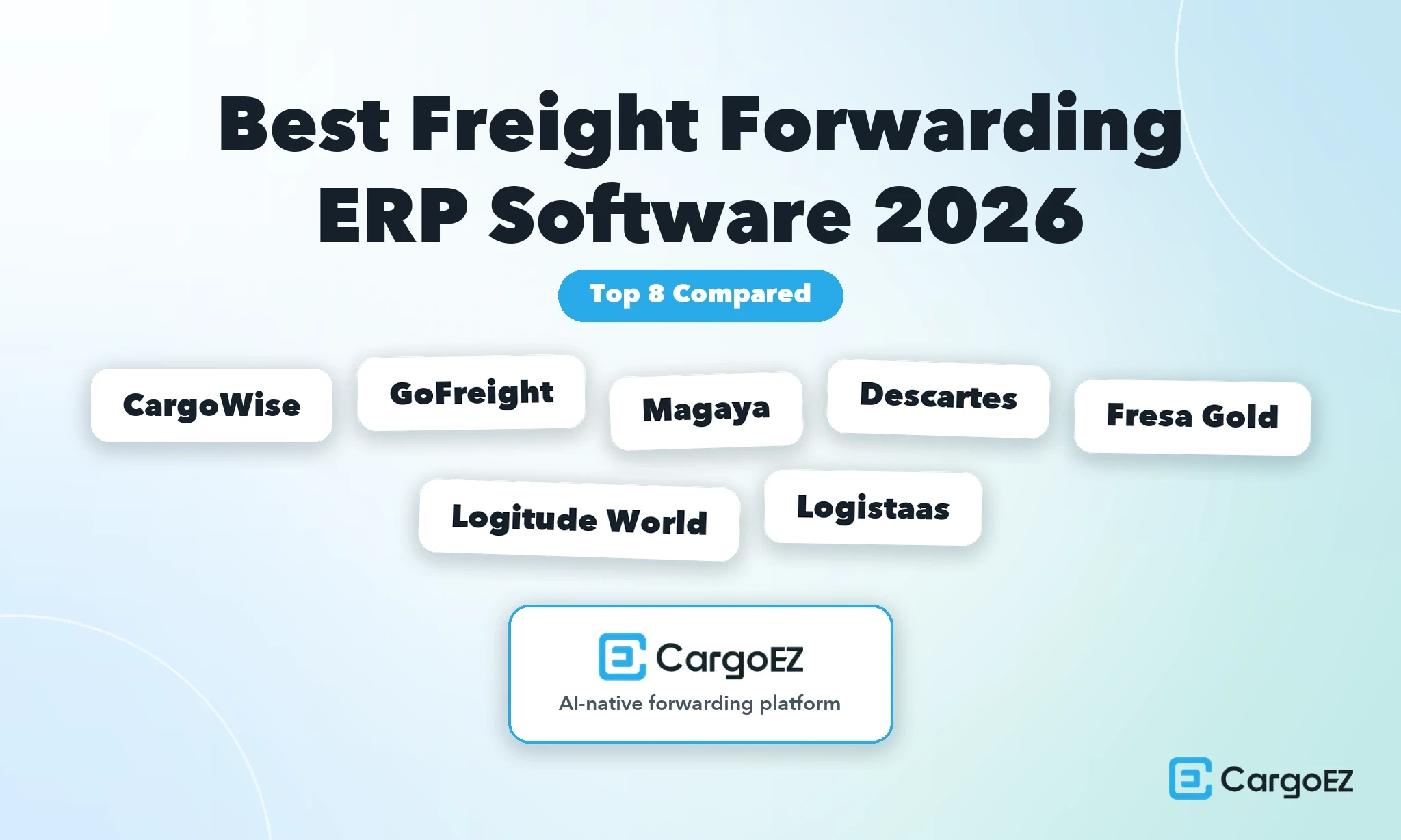
Best Freight Forwarding ERP Software (2026): Top 8 for Forwarders
CargoEZ — best for the all-in-one freight forwarding ERP for US SMB and midmarket forwarders
CargoWise — best for large, multi-entity global forwarders that need group consolidation
GoFreight — best for modern mid-market forwarders and NVOCCs that want a clean cloud system
Magaya — best for forwarders that also run a warehouse or CFS
Descartes — best for compliance-heavy forwarders that want a native GAAP ledger
Fresa Gold — best for SMB forwarders and NVOCCs that want ERP-grade finance at a low per-user price
Logitude World — best for small forwarders that want a simple cloud system with published pricing
Logistaas — best for budget-conscious small and mid forwarders
Do you actually need a freight forwarding ERP?
An ERP is a bigger, longer-lived buy than an ops tool, so it is worth asking whether you need one yet. Plenty of forwarders run fine for years on an ops or TMS tool plus a separate accounting package. You have outgrown that split stack when:
You re-key the same jobs from your ops tool into QuickBooks, Xero, or Tally to keep the books.
The sync between the two breaks, lags, or needs a person to babysit it.
You cannot see job profit without a spreadsheet, because your operations cost and your finance cost sit in different systems.
You have more than one branch, entity, or currency and cannot pull a single consolidated P&L.
Month-end close drags because nothing posts to the general ledger on its own.
If two or three of those sound like your month, an ERP will earn its keep. If none do, an ops tool plus an accounting link is probably enough for now.
What actually makes it a freight forwarding ERP
Do not shop these as generic ERPs. For a forwarder, the system has to run the whole freight chain, and the back end of that chain is what turns it from an ops tool into an ERP:
Front of the chain, table stakes: quotation and rate management, booking, HBL/MBL, documentation, customs, and shipment tracking.
Back of the chain, the ERP part: vendor and carrier billing, customer invoicing, accounting, job profitability, and the customer portal.
The front of that chain is table stakes, and plenty of ops tools do it well. The back half is the ERP part: a native general ledger, billing and invoicing that post to it, job profitability that rolls into your financial statements, and multi-entity consolidation, all in one system. That is what I weighted this comparison toward.
How I evaluated these ERP systems
I ranked each system on the evidence, for a US forwarder whose owner or controller is deciding whether to run the whole business on one system of record. I scored every tool on the freight-forwarding module chain above, with most of the weight on the ERP back end:
Native general ledger: a real GL (chart of accounts, journal entries, statements), or a QuickBooks link?
Billing and invoicing: vendor/carrier billing and multi-currency customer invoicing that post straight to the ledger.
Profitability: per-shipment cost, revenue, and margin that roll into the financial statements on their own.
Multi-entity and multi-currency: consolidation across branches, entities, and currencies, with a real period close.
Freight front end: quoting, booking, HBL/MBL, documentation, customs, and tracking built in, not bolted on.
Proof: current G2 and Capterra ratings and review counts (checked October 2026; check again before you buy).
Best freight forwarding ERP software at a glance
Platform | Best for | Starting price | Rating (G2 / Capterra) |
1. CargoEZ | The all-in-one freight forwarding ERP for US SMB and midmarket forwarders | Custom / quote | 4.8 / n/a (G2, 40) |
2. CargoWise | Large, multi-entity global forwarders that need group consolidation | Per-transaction (Value Packs) | 4.3 / 2.9 |
3. GoFreight | Modern mid-market forwarders and NVOCCs that want a clean cloud system | Quote (per user) | 4.8 / 4.6 |
4. Magaya | Forwarders that also run a warehouse or CFS | ~$300/user/mo (est.) | 4.4 / 4.2 |
5. Descartes | Compliance-heavy forwarders that want a native GAAP ledger | Modular / quote | 4.2 / n/a |
6. Fresa Gold | SMB forwarders and NVOCCs that want ERP-grade finance at a low per-user price | ~$60/user/mo | 4.8 / n/a |
7. Logitude World | Small forwarders that want a simple cloud system with published pricing | $75-$99/user/mo | 4.6 / 4.5 |
8. Logistaas | Budget-conscious small and mid forwarders | $35-$55/user/mo | n/a / 4.7 |
Ratings verified Aug — 2026. "n/a" means too few reviews to be meaningful on that platform.
How the 8 compare on the ERP back end
This is the part most "ERP" roundups skip. Here is where each system actually sits on the modules that separate an ERP from an ops tool. Treat it as a directional summary and confirm the detail on a demo.
Platform | Native general ledger | Job costing and profit | Multi-currency | Multi-entity consolidation | Customer portal |
CargoEZ | Native | Per job and customer | Yes | Multi-branch (SMB/mid) | Yes |
CargoWise | Native | Real-time to the GL | Yes | Deep (intercompany netting) | Yes |
GoFreight | Native AR/AP and billing | Yes | Yes | Limited | Yes (strong) |
Magaya | Native | Per shipment | Yes | Lighter | Yes |
Descartes | Native (GAAP) | Yes | Yes | Yes | Yes |
Fresa Gold | Native | By job and branch | Yes | Branch-level | Yes |
Logitude World | Via QuickBooks link | Cost and P&L reports | Yes | Limited | Yes (strong) |
Logistaas | Invoicing + AR/AP | Basic | Yes | Limited | Yes |
The short version: CargoEZ, CargoWise, Magaya, Descartes, and Fresa Gold run a real native ledger; GoFreight has solid native billing and AR/AP; Logitude leans on a QuickBooks link for the ledger; and Logistaas keeps finance to invoicing and AR/AP.
The 8 best freight forwarding ERP systems in 2026
1. CargoEZ: the best all-in-one freight forwarding ERP for US forwarders
CargoEZ is the system I would give a US forwarder who wants to stop paying the "two-system tax." It runs the full freight chain and closes the books in the same place, so operations, billing, and the ledger are one dataset.
Snapshot | Detail |
Best for | The all-in-one freight forwarding ERP for US SMB and midmarket forwarders |
Starting price | Custom quote (monthly to annual billing) |
Setup time | About one week (guided onboarding) |
Rating | G2 4.8/5 (40 reviews), 95% 5-star |
Free trial | Free trial, set up on the demo call |
Type | Freight-native ERP (ops + finance + CRM) |
Modules
Forwarding front end: rate management with FMC tariffs, booking, HBL/MBL, documentation, AMS/ISF and eAWB, and cargo tracking.
Billing and invoicing: vendor and carrier billing plus multi-currency customer invoicing with automatic exchange rates, posted straight to the ledger.
Accounting and general ledger: chart of accounts, journal entries, AR/AP with aging, bank reconciliation, P&L, balance sheet, trial balance, and period locking to freeze closed months.
Profitability: revenue, cost, and margin tracked per shipment and per customer, rolling into the financial statements.
Customer portal: self-service quotes, tracking, documents, and invoices, all on one platform.
Pricing
custom and quote-based. Most teams go live in about a week with guided onboarding, which is fast for an ERP.
What users say
4.8/5 on G2 from 40 reviews, with 95% at five stars.
"The finance module provides clear and valuable insights, making financial tracking simple." (Veera, Director)
A real result: the forwarder Air7Seas cut manual effort by about 60% after moving multi-branch accounting into CargoEZ, and one VP, Doug Roderick, reports sales and customer-service performance up 33% over roughly four years of use.
Pros
A real forwarder-native general ledger, not a QuickBooks link. Billing, invoicing, and job profit post to the same ledger, so you can retire a separate accounting tool.
One record from quote to ledger, so per-shipment margin is native and month-end is faster.
Cons
It is right-sized for SMB and midmarket forwarders, so a global group needing deep statutory consolidation across dozens of entities may still weigh CargoWise.
You start with a demo rather than a self-serve signup, though the team sets up a free trial on that call.
See it on your own books. Book a CargoEZ demo and walk one real job from quote to booking to invoice to the P&L. Want to talk first? Call +1 (408) 834-7476.
2. CargoWise: the enterprise freight forwarding ERP for global consolidation
CargoWise is the benchmark for large, multi-country groups. If you need to consolidate a real group P&L across many entities and currencies, nobody matches its depth. It is also a heavy, expensive build.
Snapshot | Detail |
Best for | Large, multi-entity global forwarders that need group consolidation |
Starting price | Per-shipment "Value Pack" fees (~$9.95 to $19.95 each) |
Setup time | 6 to 12+ months; partner-led |
Rating | G2 4.3/5 (35), Capterra 2.9/5 (32) |
Free trial | Demo |
Type | Enterprise freight-native ERP |
Modules
Forwarding front end: full multimodal operations, customs, and documentation across 190+ countries in one database.
Billing and invoicing: native multi-currency invoicing with cash books and cost centers.
Accounting and general ledger: native GL and AR/AP with real-time job costing posted to the ledger by accounting rules.
Profitability and consolidation: built-in intercompany netting for group consolidation across entities and currencies, the deepest in this list.
Customer portal: track-and-trace and document access for clients.
Pricing
per-shipment Value Pack fees since December 2025, and current customers report costs up 20% to 50%. Budget for a long, partner-led rollout.
What users say
4.3/5 on G2 (35) but only 2.9/5 on Capterra (32). Read both sides.
Pros
The deepest finance in the category for global groups: intercompany netting and multi-entity consolidation few forwarding systems even attempt.
One database across 190+ countries, so a large group truly runs on one system.
Cons
The steep learning curve and 6 to 12+ month rollout are the top complaints, and support draws heavy criticism on Capterra.
For a single-country SMB or midmarket forwarder it is far more system, and cost, than the job needs.
3. GoFreight: the best modern freight forwarding ERP for mid-market forwarders
GoFreight is the cloud-native pick for forwarders who want a clean, modern system with real accounting behind it, minus the heavy enterprise rollout.
Snapshot | Detail |
Best for | Modern mid-market forwarders and NVOCCs that want a clean cloud system |
Starting price | Custom quote (per user) |
Setup time | 4 to 8 weeks (vendor); about 2 months (G2 average) |
Rating | G2 4.8/5 (92), Capterra 4.6/5 (25) |
Free trial | Demo |
Type | Freight-native ERP (cloud) |
Modules
Forwarding front end: quoting, booking, HBL/MBL, documentation, and tracking, with a strong customer portal and carrier integrations.
Billing and invoicing: native billing with multi-currency customer invoicing.
Accounting and general ledger: a native AR/AP and accounting module, so revenue, cost, and profit are tracked in-platform rather than exported.
Profitability: job-level revenue and cost visible without a spreadsheet.
Multi-entity: limited compared with CargoWise, so very large groups may outgrow it.
Pricing
per-user and quote-based; no public price card, so you will need a demo.
What users say
4.8/5 on G2 from 92 reviews.
"GoFreight is very user friendly, and I am quick in the system." (Janko Wille, CEO, Allround Forwarding Midwest, via G2)
Pros
A modern, easy interface with native accounting behind it, so finance is not a separate tool.
Fast onboarding and strong support scores, plus a well-liked customer portal.
Cons
Multi-entity consolidation is lighter than CargoWise, and ISF filing is not on by default.
No public pricing, so you cannot benchmark cost without a demo.
4. Magaya Supply Chain: the best freight forwarding ERP for warehouse-plus-forwarding
If you run forwarding and a warehouse or CFS, Magaya is the natural fit. It has genuine embedded accounting off one shipment record, plus a full warehouse system in the same tool.
Snapshot | Detail |
Best for | Forwarders that also run a warehouse or CFS |
Starting price | ~$300/user/mo (third-party estimate) |
Setup time | 30 to 90 days (vendor guidance) |
Rating | G2 4.4/5 (290), Capterra 4.2/5 (26) |
Free trial | Demo |
Type | Freight ERP with built-in warehouse system |
Modules
Forwarding front end: quoting, booking, operations, and ACE-certified ABI customs, plus a built-in warehouse, inventory, and CFS system.
Billing and invoicing: native billing with multi-currency.
Accounting and general ledger: a real native ledger with AR/AP, not an export to QuickBooks.
Profitability: a P&L per shipment file, since operations cost and finance cost share one record.
Consolidation: lighter on statutory multi-entity consolidation than CargoWise or Descartes.
Pricing
about $300/user/month by third-party estimate; Magaya does not publish a price, so confirm on a demo.
What users say
4.4/5 on G2 from 290 reviews, one of the larger review counts here. Reviewers praise the integrated inventory and flag a dated interface.
Pros
Real embedded accounting tied to the shipment record, plus the only genuine warehouse system in this list.
A deep, steady review base over 20+ years in market.
Cons
Lighter multi-entity consolidation, so large groups may outgrow it.
Reviewers report a dated interface and some lag at busy times.
5. Descartes Forwarder Enterprise: the freight forwarding ERP for compliance-heavy operations
Descartes suits forwarders that want a native, GAAP-compliant ledger inside a compliance-first suite, backed by the largest logistics trade network.
Snapshot | Detail |
Best for | Compliance-heavy forwarders that want a native GAAP ledger |
Starting price | Modular / custom quote |
Setup time | About 2 months (G2 average) |
Rating | G2 4.2/5 (69) |
Free trial | Demo |
Type | Modular freight-native ERP |
Modules
Forwarding front end: forwarding operations plus deep customs and trade compliance on a large B2B EDI network.
Billing and invoicing: integrated billing tied to the ledger.
Accounting and general ledger: a native GAAP-compliant general ledger purpose-built for forwarders.
Profitability: margin and cost KPI analytics across the shipment and the financials.
Modular: you add the accounting, receivables, and reporting pieces you need rather than a fixed bundle.
Pricing
modular and quote-based. One common mix-up: Descartes Aljex is a freight-broker tool, a different product. Do not shortlist it here.
What users say
4.2/5 on G2 from 69 reviews; users cite strong central control and a dated look.
Pros
A true native GL plus the deepest customs and trade compliance in this list.
Modular, so you buy the finance depth you need.
Cons
Modular also means more integration work and harder contracts than a single all-in-one.
Reviewers describe it as feature-heavy with a dated interface.
6. Fresa Gold: ERP-grade forwarding finance at a small-business price
Fresa Gold gives a small or mid forwarder real embedded accounting without an enterprise price tag. It is the value pick for ERP-grade finance.
Snapshot | Detail |
Best for | SMB forwarders and NVOCCs that want ERP-grade finance at a low per-user price |
Starting price | From ~$60/user/mo |
Setup time | A few weeks (scope-based) |
Rating | G2 4.8/5 (181) |
Free trial | Demo |
Type | Freight-native ERP (embedded finance) |
Modules
Forwarding front end: air, sea, and NVOCC job management, documentation, and tracking.
Billing and invoicing: job-linked billing, proforma, collections, and multi-currency invoicing.
Accounting and general ledger: a central general ledger with automatic postings from AR and AP, plus balance sheet and P&L with drill-down.
Profitability: cost and revenue tracked by job, shipment, and branch.
Tax and controls: VAT/GST and statutory compliance with bulk posting and audit trails.
Pricing
starts around $60/user/month, then quote for the full scope.
What users say
4.8/5 on G2 from 181 reviews, and it won a Capterra Best Ease of Use badge in 2025.
"The system is user-friendly, covers all key areas like operations, accounts, and documentation, and provides accurate reports." (Capterra reviewer)
Pros
Genuine native-ledger ERP finance (GL, AR/AP, statements, job costing) at a per-user price an SMB can afford.
Strong, high-volume G2 score and a real ease-of-use track record.
Cons
Very large groups may want CargoWise or Descartes for heavier consolidation.
The Capterra listing splits Fresa Gold from the lighter Fresa XPress, so confirm you are buying the full ERP tier.
7. Logitude World: the simplest freight forwarding ERP for small teams
Logitude is my pick when a small forwarder says "just tell me the price." It covers the full lifecycle with a standout client portal, and publishes its per-user price.
Snapshot | Detail |
Best for | Small forwarders that want a simple cloud system with published pricing |
Starting price | $75-$99/user/mo |
Setup time | A few days (vendor guidance) |
Rating | G2 4.6/5 (94), Capterra 4.5/5 (40) |
Free trial | 7-day free trial |
Type | Cloud freight forwarding platform |
Modules
Forwarding front end: full shipment lifecycle with a strong, live-tracking client portal and wizard-driven setup.
Billing and invoicing: invoicing with multi-currency and AR/AP management.
Accounting and general ledger: the deeper ledger runs through a QuickBooks integration, not a native GL. This is the key caveat that keeps it out of the top ERP tier.
Profitability: cost and P&L reports, lighter than the native-ledger tools.
Customer portal: one of the best in this list for client self-service.
Pricing
SMART at $75/user/month and Professional at $99/user/month, with published pricing that is rare here.
What users say
4.6/5 on G2 (94) and 4.5/5 on Capterra (40).
"The software is really complete, easy to use, and helps us save a lot of time." (Logitude reviewer, via Capterra)
Pros
Easy, fast to deploy, published pricing, and a genuinely strong customer portal.
Good support scores and a clean lifecycle for a small team.
Cons
The general ledger depends on a QuickBooks link, so it is not a self-contained ERP.
Reviewers note thin accounting reports and paid API integrations.
8. Logistaas: the budget freight forwarding ERP for small and mid forwarders
Logistaas is a lean, modern option for a small forwarder who wants the core forwarding chain and a price they can see up front.
Snapshot | Detail |
Best for | Budget-conscious small and mid forwarders |
Starting price | $35/user/mo (CRM), $55/user/mo (TMS), billed annually |
Setup time | Weeks (scope-based) |
Rating | Capterra 4.7/5 (G2 4.5/5 from only 2 reviews) |
Free trial | Free trial available |
Type | Cloud freight forwarding platform |
Modules
Forwarding front end: HBL/MBL, quotations, operations, tracking, and document AI that reads bills of lading, air waybills, and invoices.
Billing and invoicing: customer invoicing with AR/AP and multi-currency.
Accounting and general ledger: finance stays at the invoicing and AR/AP level rather than a deep native GL, so it is ERP-lite on the back end.
Profitability: basic cost and margin visibility.
Customer portal: client access to quotes, bookings, and tracking.
Pricing
$35/user/month for the CRM plan and $55/user/month for the TMS plan, billed annually. Among the clearest prices in the category.
What users say
4.7/5 on Capterra. G2 shows 4.5/5 but from only 2 reviews, so lean on the Capterra sample.
"LogistaaS provides a very user-friendly interface and efficient workflow." (Capterra reviewer)
Pros
Public, low entry pricing, built-in document AI, and a clean forwarding workflow.
Steady Capterra performance and helpful support.
Cons
Finance is lighter than the native-ledger tools, so it may not replace your accounting system on its own.
The G2 sample is thin, and one reviewer reported a slow rollout, so scope onboarding before you sign.
Running a general ERP instead? NetSuite, SAP, and the freight-plugin route
Some forwarders do not want a freight-native ERP at all. If freight is one part of a larger trading, manufacturing, or 3PL business, you may already run a general corporate ERP and want to add freight to it. That is a real, separate path:
NetSuite (Oracle): the canonical corporate ERP, with enterprise-grade multi-entity finance (G2 4.1/5 from 4,780 reviews). No freight out of the box.
SAP Business One: a mid-market general ERP with strong core finance (G2 4.3/5 from 542 reviews). Freight comes from add-ons.
Microsoft Dynamics 365: the other common general ERP forwarders extend for logistics.
You bolt freight on through an integration layer or plugin, for example FreightPOP on top of NetSuite (freight invoice audit, carrier-rate comparison, order consolidation). That gets you corporate-grade finance, but you manage two systems and pay for the freight layer, and you are live in months, not weeks.
My rule of thumb: if freight is your business, start with a freight-native ERP above. Choose a general ERP plus a freight plugin only when freight is a smaller part of a bigger company that already needs a corporate ERP.
One more boundary: QuickBooks, Xero, and Tally are ledgers, not ERPs. If you only need to keep the books, see the accounting software guide. If you mainly need day-to-day operations rather than the finance backbone, start with freight management software or the full freight forwarding software guide.
How to choose a freight forwarding ERP
When you compare these, work down the module chain and weight the back end:
Native ledger or a link? Confirm there is a real general ledger in the system, not just a QuickBooks export.
Does billing post to the ledger? Vendor/carrier billing and customer invoicing should hit the GL, not a separate tool.
Is job profit native? Per-shipment margin should roll into your P&L on its own.
Multi-entity and multi-currency. If you have branches or entities, check consolidation, currencies, and period close.
Freight front end. Quoting, booking, HBL/MBL, customs, and tracking should be built in, not an add-on.
Total cost to go live. Add licenses, implementation, and any freight plugin. The sticker price is rarely the real number.
A quick shortlist by shape of business: enterprise or multinational, CargoWise or Descartes; 50 to 500 people, GoFreight, Magaya, or CargoWise; small forwarder, Logistaas, Logitude World, or Fresa Gold; forwarder plus warehouse, Magaya; all-in-one for a US SMB, CargoEZ.
Best freight forwarding ERP for small forwarders
If you are a small or growing US forwarder, my shortlist is CargoEZ and Fresa Gold. Both give you a real native ledger and job costing without an enterprise rollout, and both are priced for a lean team.
Consider Logitude World or Logistaas if a low, published price and a simple setup matter more than a deep native ledger. Step up to GoFreight, Magaya, or CargoWise as you add branches, entities, or heavier consolidation.
Final take: the best freight forwarding ERP for most forwarders
For most US small and midmarket forwarders, my pick is CargoEZ, because it runs the whole freight chain and a real native ledger in one system, tracks profit per job, and goes live in about a week.
Choose CargoWise or Descartes for enterprise multi-entity consolidation, Magaya if a warehouse is core, GoFreight for a modern cloud system, and Fresa Gold, Logitude World, or Logistaas when budget and a simple setup lead. Go with a general ERP like NetSuite or SAP only if freight is one part of a larger company.
Ready to run the freight and the books in one system? Book a CargoEZ demo or call +1 (408) 834-7476, and I will walk one real job from quote to booking to invoice to the P&L.
1. What is freight forwarding ERP software?
It is one system that runs the whole freight chain and the books together: quoting, booking, HBL/MBL, documentation, customs, tracking, billing, invoicing, and a native general ledger with job profitability, so finance is part of the same record as the freight.
2. What is the difference between a freight forwarding ERP and freight management software?
Freight management software runs the day-to-day operation (booking, tracking, documents, billing). An ERP adds the finance backbone: a native general ledger, job costing posted to your statements, and multi-entity consolidation. If you mainly need operations, see freight management software.
3. Which ERP modules matter most for a freight forwarder?
The full chain matters, but the modules that separate an ERP from an ops tool are the back end: vendor/carrier billing, customer invoicing, a native general ledger, job profitability, and multi-entity consolidation.
4. Do freight forwarders use an ERP or a TMS?
A TMS moves the freight; an ERP runs the business, including finance, in one system of record. Many forwarders start on a TMS or ops tool and move to an ERP when re-keying into separate accounting becomes the bottleneck.
5. Does a freight forwarding ERP replace QuickBooks?
A true ERP with its own native ledger (CargoEZ, CargoWise, Magaya, Descartes, Fresa Gold) can replace QuickBooks. Tools that run the ledger through a QuickBooks link (like Logitude) do not.
6. How much does a freight forwarding ERP cost?
Most are quote-based. Freight-native options range from about $35 to $99/user/month (Logistaas, Logitude) and around $60/user/month (Fresa Gold) up to custom enterprise pricing (CargoWise, Descartes). General ERPs usually cost more once licenses and a freight plugin are counted.
Author

Don't forget to share this blog!