How Technology Is Shaping Logistics and Freight Forwarding Business
Author:
Pamela
Published On:
1 min read
What if managing global trade felt effortless instead of exhausting? Imagine managing shipments without endless emails, manual documentation, or last-minute surprises. A world where the cargo moves across borders seamlessly and updates arrive in real time. There is no guesswork, and decisions are data-driven.
This vision is no longer in the near future. Technology has already reshaped the logistics industry. According to StartUs Insights, over 70% of logistics innovation efforts focus on automation, data analytics, and real-time visibility, highlighting why freight forwarders are moving toward intelligent systems for smarter planning, greater transparency, and faster response.
From Traditional Forwarders to Digital Freight Platforms
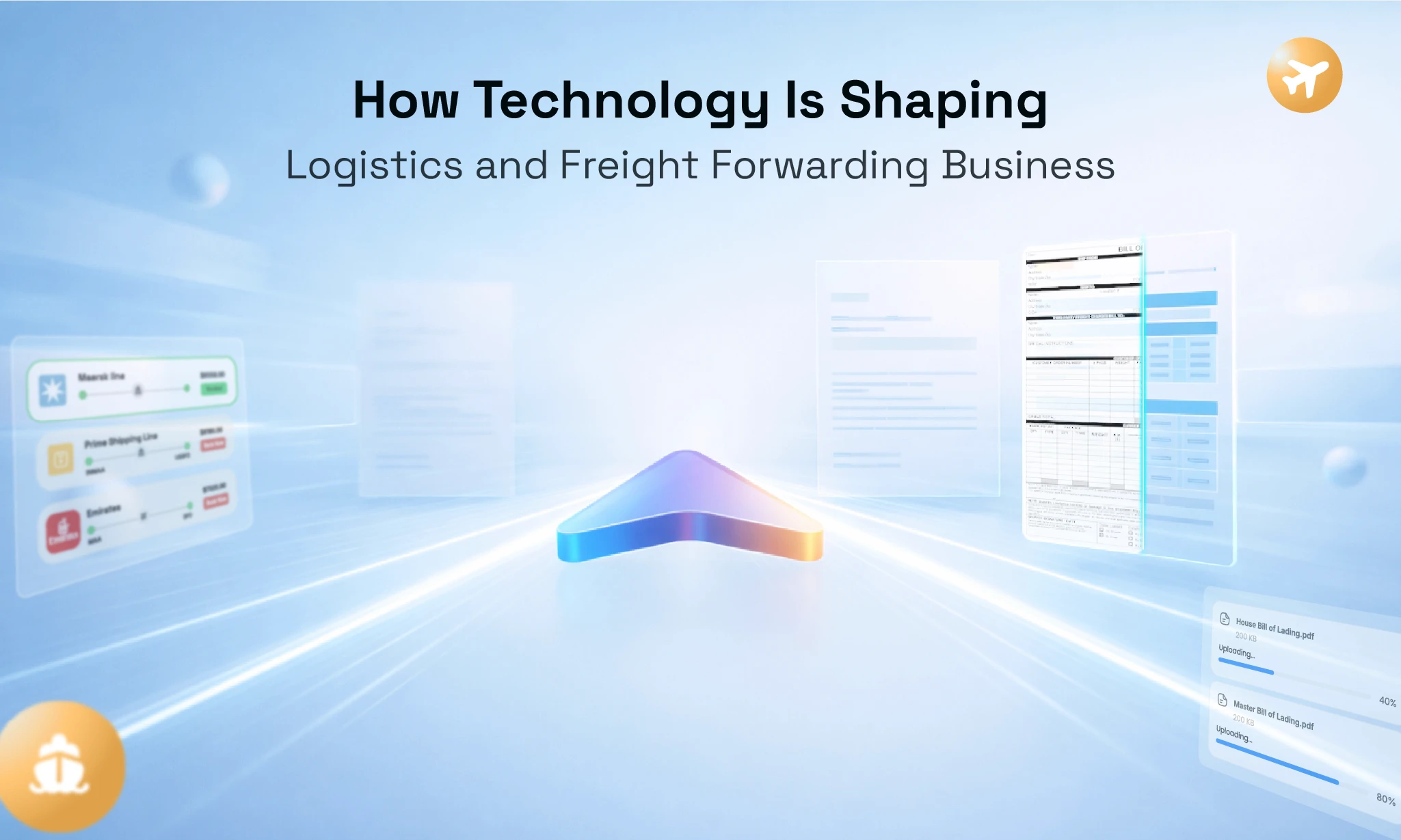
A decade ago, freight forwarding depended heavily on paper documents, emails, and spreadsheets. Rate requests took days, shipment tracking required constant follow-ups, and information lived in disconnected systems. Today, cloud-based digital platforms connect shippers, carriers, and partners in real time. Freight forwarding has shifted from a reactive, manual process to a data-driven, always-connected operation built for speed, visibility, and scale.
This change becomes evident when you look at how everyday freight forwarding tasks are managed now compared to the past.
Aspect | Traditional Freight Forwarding | Digital Freight Platforms |
Rate Management | Manual emails and spreadsheets | Instant digital rate discovery |
Booking Process | Phone calls and email confirmations | Online booking in minutes |
Documentation | Paper-based, courier-dependent | Automated digital documents |
Shipment Tracking | Manual follow-ups with carriers | Real-time tracking and alerts |
Visibility | Limited and delayed | End-to-end, real-time visibility |
Decision Making | Experience-based, reactive | Data-driven and predictive |
Scalability | Limited by headcount | Scales without added overhead |
What Is the Role of Technology in Freight Forwarding?
Technology plays a central role in modern freight forwarding by transforming how shipments are planned, executed, and monitored across the supply chain. What was once a paper-heavy, reactive process is now becoming data-driven, automated, and highly connected.
At its core, technology helps freight forwarders improve speed and accuracy. Digital platforms automate tasks such as rate management, booking, documentation, and invoicing, reducing manual effort and minimizing errors. This enables teams to respond more quickly to customer inquiries and manage higher shipment volumes without incurring increased operational costs.
Visibility is another critical area where technology makes a significant impact. Real-time tracking systems, powered by IoT and integrated carrier data, provide forwarders with continuous insight into shipment location and status. This visibility enables proactive issue resolution, better exception management, and more reliable delivery timelines.
Technology also enhances decision-making through analytics and artificial intelligence. By analyzing historical and real-time data, freight forwarders can forecast demand, optimize routes, manage capacity, and anticipate disruptions before they impact operations. This shift from reactive problem-solving to predictive planning improves both efficiency and resilience.
Beyond operations, technology strengthens collaboration across the logistics ecosystem. Integrated systems allow seamless data exchange between shippers, carriers, customs authorities, and partners, creating transparency and trust while reducing communication gaps.
In essence, technology is no longer just a support function in freight forwarding. It is the backbone that enables efficiency, scalability, and consistent service quality in an increasingly complex global trade environment.
Key Technologies Transforming Logistics and Freight Forwarding
As freight forwarding continues to evolve, several core technologies are driving this transformation. Each plays a distinct role in improving efficiency, visibility, and control across the supply chain.
Artificial Intelligence and Machine Learning
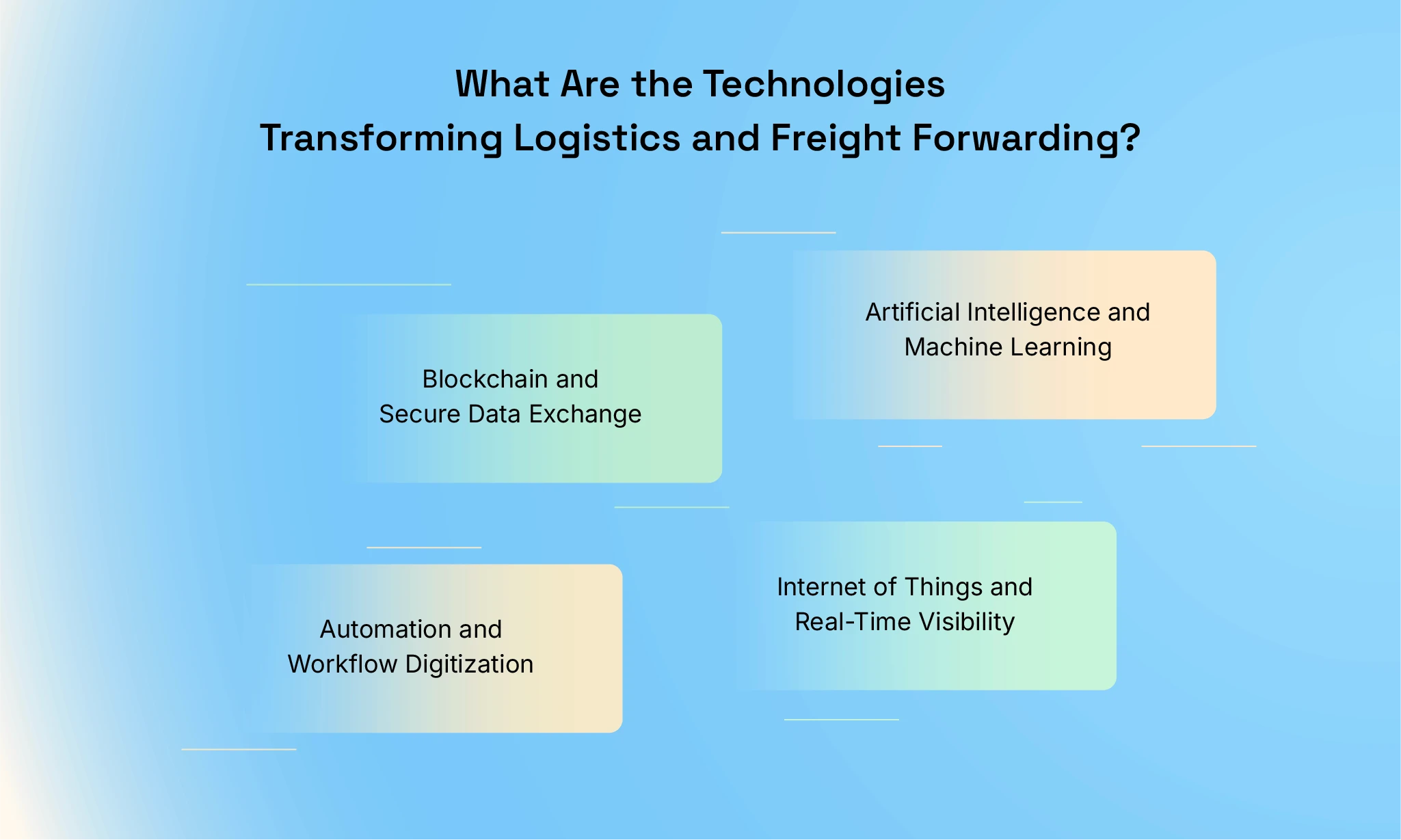
AI and machine learning are changing how freight forwarders plan and operate. These technologies analyze large volumes of historical and real-time data to identify patterns, predict delays, and recommend optimal routes or carriers. AI-powered systems can also automate rate benchmarking, detect anomalies in shipment data, and support demand forecasting. This allows teams to make faster, more informed decisions while reducing reliance on manual judgment.
Internet of Things and Real-Time Visibility
IoT devices such as GPS trackers, sensors, and telematics systems are redefining shipment visibility. Forwarders can now monitor cargo location, temperature, and humidity in real time across modes of transport. This level of insight helps prevent losses, ensures compliance for sensitive goods, and enables proactive communication with customers when disruptions occur.
Blockchain and Secure Data Exchange
Blockchain technology is gaining attention for its ability to create secure, tamper-proof records across multiple stakeholders. In freight forwarding, it supports transparent documentation, faster approvals, and improved trust between parties. By reducing disputes and ensuring data integrity, blockchain has the potential to streamline customs clearance and cross-border trade processes.
Automation and Workflow Digitization
Automation is eliminating repetitive manual tasks that slow down operations. From document generation and compliance checks to invoicing and status updates, automated workflows reduce errors and free up teams to focus on higher-value activities. For many companies, the backbone of this transition is freight forwarding software, which centralizes these automated processes into a single interface. For freight forwarders managing growing volumes, this type of specialized software is critical to scaling operations without increasing overhead.
Impact on Customer Experience and Business Performance
Technology is not only transforming internal operations but also reshaping customer expectations. Shippers now expect faster quotes, real-time tracking, transparent pricing, and proactive updates. Digital tools enable freight forwarders to deliver a more consistent and reliable customer experience while improving service levels.
From a business perspective, technology-driven operations lead to better cost control, improved margin visibility, and higher operational resilience. Forwarders can respond faster to disruptions, adapt to market changes, and maintain service continuity even during periods of uncertainty.
Managing Volatile Costs with Data and Automation
Digital platforms give forwarders and shippers unprecedented ability to compare carrier rates, optimize mode selection, and identify cost-saving opportunities in real time. Instead of relying on quarterly rate negotiations and static contracts, companies can respond dynamically to market conditions.
During the port congestion crisis of 2021– 2022, forwarders with strong analytics capabilities identified opportunities to shift ocean freight from congested West Coast US ports to Gulf or East Coast alternatives. The analysis balanced cost, transit time, and reliability decisions that would have been impossible without real-time data on conditions across the network.
Shippers increasingly demand transparent breakdowns of all charges, including base rates, fuel surcharges, demurrage, detention, and ancillary fees. Modern platforms visualize these components clearly, reducing disputes and building trust. When customers understand exactly what they’re paying for, relationships improve even when costs rise.
Sustainability Metrics and Greener Freight Choices
Technology enables more sustainable logistics in multiple ways. Route optimization and load consolidation reduce empty miles and improve asset utilization. Modal shifts moving cargo from air to ocean, or from truck to rail, can dramatically cut emissions on appropriate lanes. Reducing fuel consumption directly reduces both costs and environmental impact.
Some logistics companies use digital twins, virtual replicas of their networks, to simulate the emissions impact of different routing scenarios. Before committing to a change, they can model how shifting from one port to another or adding a rail leg would affect both costs and carbon footprint. These tools turn sustainability from a compliance checkbox into a strategic planning capability.
The Human Element in a Digital-First Industry
While technology is becoming the foundation of modern freight forwarding, human expertise remains essential. Complex shipments, exception handling, regulatory challenges, and relationship management still require experienced professionals. Technology enhances human decision-making rather than replacing it, enabling teams to work smarter, faster, and with greater confidence.
Looking Ahead
As global trade continues to grow in complexity, the role of technology in logistics and freight forwarding will only expand. Companies that invest in digital platforms, data-driven decision-making, and connected ecosystems will be better positioned to adapt, compete, and grow.
In this new era, success in freight forwarding is no longer defined by who moves cargo from point A to point B, but by who can do it with speed, visibility, and intelligence.
Conclusion
Digital platforms, AI, IoT, blockchain, and automation have collectively reshaped how the logistics industry operates. What seemed cutting-edge in 2020 is now table stakes. Freight forwarders who have not embraced these changes face growing pressure from competitors offering faster quotes, better visibility, and more reliable execution.
The future of logistics belongs to companies that invest thoughtfully in technology while keeping customers and relationships at the center. The organizations best positioned to succeed are those that have built strong digital foundations while preserving the human expertise that technology can enhance but never fully replace. In international trade and global supply chains, this combination of technological capability and relationship strength will define competitive success over the next decade.
Frequently Asked Questions (FAQs)
1. What is digital freight forwarding?
Digital freight forwarding refers to the use of advanced technology platforms to automate and streamline traditional freight forwarding processes.
What is the ROI on digital freight forwarding tools for small businesses? Small-to-mid-sized forwarders typically see a payback period of 18–24 months through reduced labor costs, fewer manual errors, and increased win-rates on instant quotes.
Can traditional forwarders compete with "Digital-Only" giants?
Yes. By joining digital networks and adopting plug-and-play SaaS tools, traditional forwarders can match the tech capabilities of giants while maintaining the personalized service and local expertise that digital-only firms often lack.
2. How does technology improve logistics and freight forwarding?
Technology enhances logistics by enabling real-time shipment tracking, automating manual tasks to reduce human error, optimizing routes to minimize fuel consumption and transportation costs, and providing predictive analytics for better decision-making. It also improves supply chain resilience and customer satisfaction through greater transparency and faster response times.
3. What role does artificial intelligence (AI) play in freight forwarding?
AI analyzes vast amounts of data to forecast demand, optimize delivery routes, automate rate benchmarking, and detect anomalies. It helps logistics providers make informed decisions quickly, reduce operational costs, and enhance overall efficiency.
4. What benefits do digital freight platforms offer to businesses?
Digital freight platforms offer faster shipment bookings, real-time visibility of cargo, reduced manual errors, cost savings through optimized operations, and seamless integration with other supply chain management tools. They help businesses remain competitive in a rapidly evolving logistics landscape.
5. How is sustainability addressed through technology in logistics?
Technology enables greener logistics by optimizing routes to reduce fuel consumption and emissions, facilitating modal shifts to more sustainable transport methods, and providing data for tracking and managing carbon footprints. This supports corporate social responsibility and regulatory compliance.
6. Will automation replace human roles in freight forwarding?
While automation streamlines many repetitive tasks and reduces manual errors, human expertise remains essential for managing complex shipments, regulatory compliance, and relationship management. Technology enhances human roles rather than replacing them entirely.
7. What is the future outlook for technology in logistics?
The future of logistics will see increased adoption of AI, automation, digital twins, autonomous vehicles, and blockchain technology. These innovations will further improve operational performance, supply chain resilience, and customer satisfaction, helping businesses stay ahead in a competitive market.
Author

Don't forget to share this blog!