Handling Peak Season Pressure in Freight Forwarding
Author:
Pamela
Published On:
1 min read
Peak seasons bring opportunities and pressure in equal measure for freight forwarders. While increased demand means more business, it also brings a heavier workload, tighter timelines, and countless sleepless nights.
Managing this surge effectively is what drives sustainable growth. Successful freight forwarders do not rely on reactive firefighting. They anticipate demand, leverage predictive analysis, and use advanced technology to stay in control. This blog outlines the key strategies that help freight forwarders handle peak season pressure while maintaining efficiency, accuracy, and customer trust.
What is Peak Season, and When Does it Occur?
The peak season is a period of significant increase in shipping demand. The major reason for such a surge is due to holidays, consumer behavior changes, promotional events, or seasonal changes.
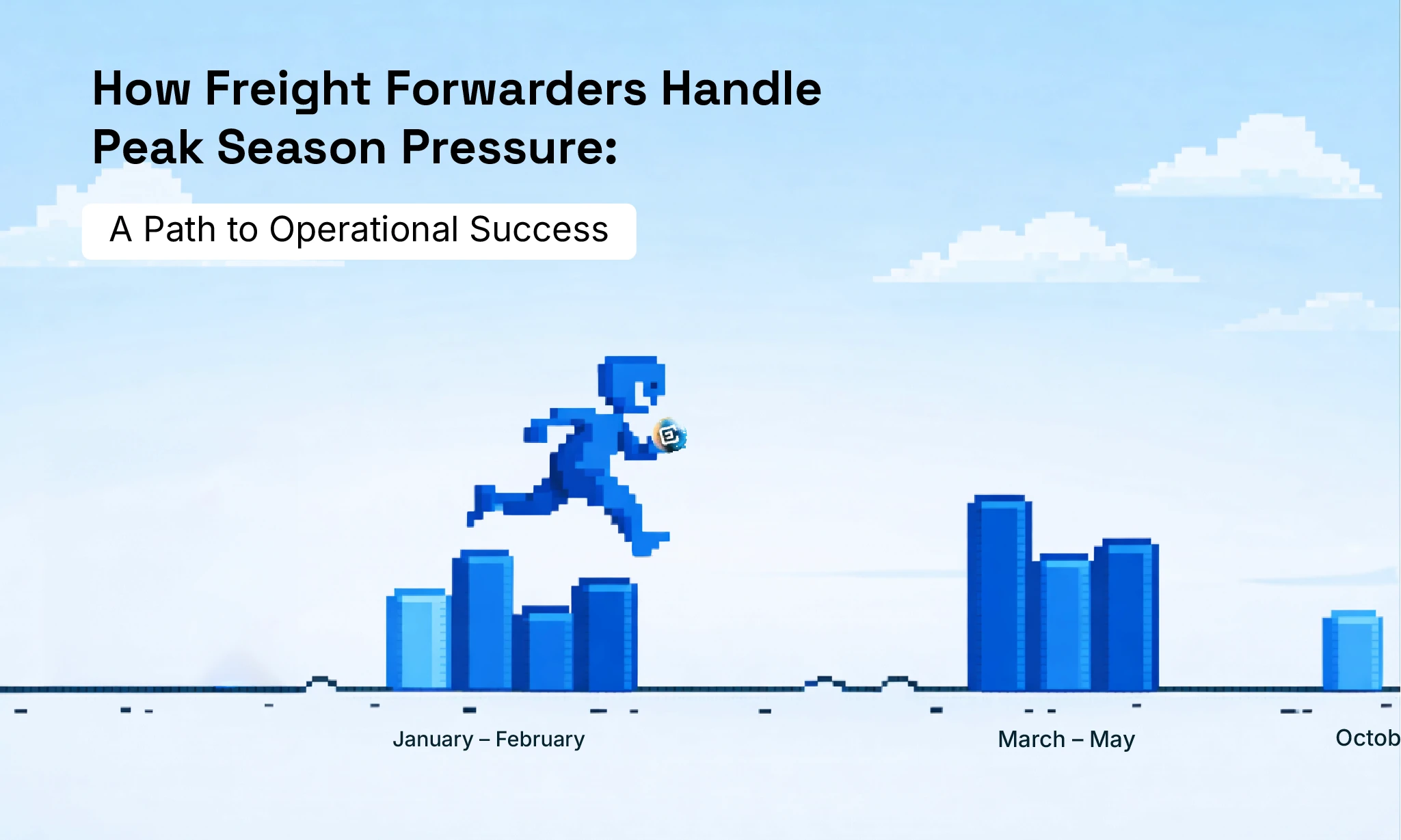
The global peak season surges are outlined below.
Month | Reason for surge |
January – February | Post-holiday restocking, Lunar New Year factory shutdowns, and pre-holiday rush |
March – May | Inventory replenishment, spring retail demand, and manufacturing ramp-ups |
October – December | E-commerce peak, festive season demand, year-end inventory push |
Year-End (Dec) | Port congestion, capacity shortages, and rate volatility due to new year |
Shifting from Firefighting to Forward Planning
Peak season failures are rarely caused by demand alone. Industry studies show that over 60% of logistics disruptions during peak periods stem from poor planning and limited visibility, not capacity shortages. Reactive operations increase costs, slow decision-making, and erode customer trust.
Leading freight forwarders tend to shift planning backed by data. It is important to analyze the historical shipment volumes, customer forecast and behavior, and market signals. As a result of such tracking, forwarders can anticipate the demand surge approximately 8-12 weeks in advance. This gives them adequate time to plan their strategies and avoid last-minute surprises.
Such type of approach cannot be carried out by a single person. It requires cross-functional alignment, like sales, operations, and documentation teams. Additionally, such alignment reduces execution errors during high-volume shipment periods.
This type of approach provides shared visibility, which aligns all the teams together and also helps them act faster, before any big escalations can occur. The outcome of such practices protects service levels during peak season and improves long-term customer relationships.
Strategic Priorities for Peak Season Execution
Standardizing Processes to Reduce Complexity
During peak season, operational complexity grows exponentially. Research shows that organizations with high standardized core processes achieve 20-30% higher operational efficiency and significantly lower error rates during demand spikes or surges.
Standardization replaces individual-driven execution with repeatable, system-driven workflows. When booking, documentation, approvals, and shipment milestones follow defined processes, teams spend less time correcting errors and more time executing shipments smoothly.
For leadership teams, standardized processes provide visibility, control, and scalability, ensuring predictable outcomes even under peak season pressure.
Technology as an Operational Enabler
During peak season, technology shifts from being a support function to a core operational layer. Freight forwarders managing high volumes rely on integrated freight management software that consolidates booking, documentation, carrier data, and shipment milestones into a single operational view. This centralized architecture eliminates data silos and gives teams real-time visibility into shipment status, exceptions, and dependencies across modes and regions.
Real-time visibility is powered by system-to-system integrations with carriers, ports, airlines, and tracking providers. Automated milestone updates replace manual follow-ups, allowing operations teams to monitor deviations as they occur rather than after service levels are impacted. This enables earlier intervention, faster decision-making, and more accurate customer communication during high-demand periods.
Automation further reduces operational strain by handling high-volume, repeatable tasks such as booking confirmations, document generation, status updates, and exception alerts. According to IBM research, AI integration helps cut repetitive and or manual tasks, which led to an increase of 65% increase in the organizations adopting AI.
The table below outlines the impact of automation on business, supported by data from Systems and Teams and ProfileTree.
Metric / Statistic | Value / Percentage | Impact on Workflow |
Companies with at least one fully automated function | Over 40% | Indicates widespread adoption improving efficiency |
Organizations experimenting with or implementing automation | Over 70% | Shows active engagement in automation |
Companies using automation for end-to-end visibility | Over 75% | Enhances process transparency and control |
Businesses automating repetitive tasks | Over 50% | Saves significant time and reduces manual errors |
ROI from automation in the first year | 30% to over 300% | Reflects labor/time savings and accuracy gains |
Increase in sales productivity from marketing automation | 14.5% | Demonstrates improved efficiency in marketing |
Businesses using automation tools daily | 78% | Shows broad usage to ease daily work |
Data-Driven Decision Making Under Pressure
Peak season demands fast, informed decision-making. When freight operations rely on delayed or fragmented data, teams are forced into reactive execution, increasing the risk of delays and cost overruns. Real-time operational visibility enables forwarders to prioritize shipments, allocate capacity efficiently, and address exceptions before they disrupt workflows.
Data analytics plays a critical role in managing demand volatility. According to a leading freight forwarding company with over 200 years of industry experience, analytics-driven inventory management helps predict demand fluctuations, reduce overstocking and stockouts, and improve planning accuracy, often lowering inventory holding costs by more than 20%.
By centralizing shipment, capacity, and inventory data, freight forwarders gain better control during high-volume periods. This approach supports proactive planning, cost optimization, and service reliability, allowing peak season operations to remain stable and predictable despite increased pressure.
Strengthening Carrier and Partner Collaboration
Peak-season success relies heavily on effective collaboration among internal teams and external partners. When shipment volumes surge and capacity becomes constrained, siloed communication slows decisions and increases operational risk. Strong collaboration enables faster alignment on capacity, schedules, and priorities during high-pressure periods.
Insights from Deloitte highlight the importance of collaboration at the leadership level. CXOs noted that improved collaboration sped decision-making, mitigated risk, and drove greater innovation. Notably, two-thirds of respondents whose organizations removed silos before the pandemic reported managing the disruptions of 2020 better than their peers.
Technology was a critical enabler of this shift. Deloitte found that only 22% of organizations had the technologies needed to support remote collaboration before the pandemic, while 42% developed and adopted these tools out of necessity. For freight forwarders, integrated digital platforms are now essential to maintain visibility, coordination, and operational stability throughout peak season.
Protecting Customer Experience During High Demand
During high-demand periods, customer experience is increasingly defined by shipment visibility and digital capability. According to Newage Software Solutions, 50% of shippers said end-to-end online visibility plays a critical role in business planning, while over 30% evaluate freight forwarders based on digital readiness.
Forwarders using advanced technology gain a clear advantage, with 15% of shippers confirming they award more projects to digitally enabled partners, and only 5% indicating that visibility is not a priority. The commercial impact is equally clear. 80% of shippers are willing to pay more to work with forwarders offering stronger supply chain visibility and technology, while 45% have stopped assigning projects to forwarders with inadequate technological support.
These insights reinforce that protecting customer experience during peak demand depends on customer-centric operations, complete end-to-end visibility, and collaboration-driven solutions enabled by modern software platforms.
Peak Season Pressure: What Shippers Should Expect in 2026
Peak season pressure in 2026 is expected to intensify as global trade volumes grow amid ongoing capacity constraints and operational volatility. According to industry outlooks from leading logistics analysts, container demand is projected to rise steadily, while port congestion, carrier schedule reliability, and labor availability remain inconsistent across major trade lanes.
At the same time, shippers are facing shorter order cycles and higher service expectations, leaving little room for delays or reactive planning. Technology readiness will be a key differentiator.
Studies indicate that shippers with real-time visibility tracking, predictive analytics, and digitally connected partners are significantly better positioned to manage demand surges. In 2026, forwarders and shippers that rely on manual coordination or fragmented systems are likely to face higher costs, lower service reliability, and strained customer relationships.
As peak seasons become longer and less predictable, proactive planning, data-driven decision-making, and collaboration-enabled platforms will be critical to maintaining operational stability and customer trust.
Starting in late July, ocean container bookings tighten as shippers push holiday inventory toward distribution centers. By August, the back-to-school rush is in full swing. September through November sees the heaviest holiday build-up. And December brings the final push, and post-Christmas returns that strain reverse logistics networks.
Conclusion
Operational success during peak season is not about working harder under pressure. It is about working smarter with systems, insights, and teams aligned for scale. By strengthening collaboration, leveraging automation, and embedding resilience into daily operations, freight forwarders can transform peak season from a stress point into a strategic advantage, deepening customer trust and supporting long-term, sustainable growth.
Frequently Asked Questions (FAQs)
1. How can freight forwarders protect margins during peak season?
Margin protection comes from real-time rate management, automated cost capture, reduced rework, and faster exception resolution. Visibility into true shipment costs allows forwarders to make informed commercial decisions under pressure.
2. Why is peak season becoming more difficult to manage each year?
Peak season pressure is intensifying due to tighter carrier capacity, frequent schedule disruptions, and shorter booking lead times. Demand volatility combined with limited visibility across shipments increases operational complexity and amplifies execution risk.
3. What are the biggest operational risks during peak season?
The most common risks include capacity shortages, rate volatility, delayed documentation, manual data errors, and limited exception visibility. These issues often lead to missed milestones, higher costs, and reduced customer service levels.
4. How does technology help freight forwarders handle peak volumes?
Modern freight forwarding software centralize shipment data, automate documentation, and provide real-time milestone tracking. This enables teams to manage by exception, reduce manual coordination, and maintain throughput even when volumes spike.
5. Which operational capabilities matter most during peak season?
Critical capabilities include automated booking workflows, real-time capacity and rate visibility, exception management dashboards, and integrated document automation. Together, these capabilities reduce response times and improve operational predictability.
6. How does automation impact service levels during peak demand?
Automation minimizes manual errors, accelerates execution, and ensures data consistency across systems. This leads to faster turnaround times, fewer delays, and more reliable customer communication during high-volume periods.
7. What KPIs should freight forwarders track during peak season?
Key metrics include on-time milestone performance, booking-to-departure cycle time, documentation accuracy rate, cost variance against quoted rates, and exception resolution time.
8. Can peak season performance be standardized or is it always reactive?
With the right systems and processes, peak season performance can be planned and standardized. Scenario planning, historical data analysis, and predefined escalation workflows enable proactive execution instead of reactive firefighting.
Author

Don't forget to share this blog!