Top 10 Features Every Freight Forwarding Software Must Have
Author:
Divya Murugan
Published On:
1 min read
Freight forwarding has undergone significant changes in the past few years. Customers now expect Amazon-style tracking, carriers update rates every other day, and compliance rules continue to become more complex.
In the middle of all this chaos, freight forwarding software is supposed to be your superhero.
But here’s the real question:
Which features actually matter, and which are just marketing fluff?
Let’s communicate this in a clean and simple style using plain language and avoiding extra technical complexity.Just the 10 features that truly move the needle for global freight forwarders.
MUST-HAVE FEATURES (your non-negotiables)
Before looking at fancy add-ons, freight companies need a strong foundation. These are the features no forwarding business can operate without.
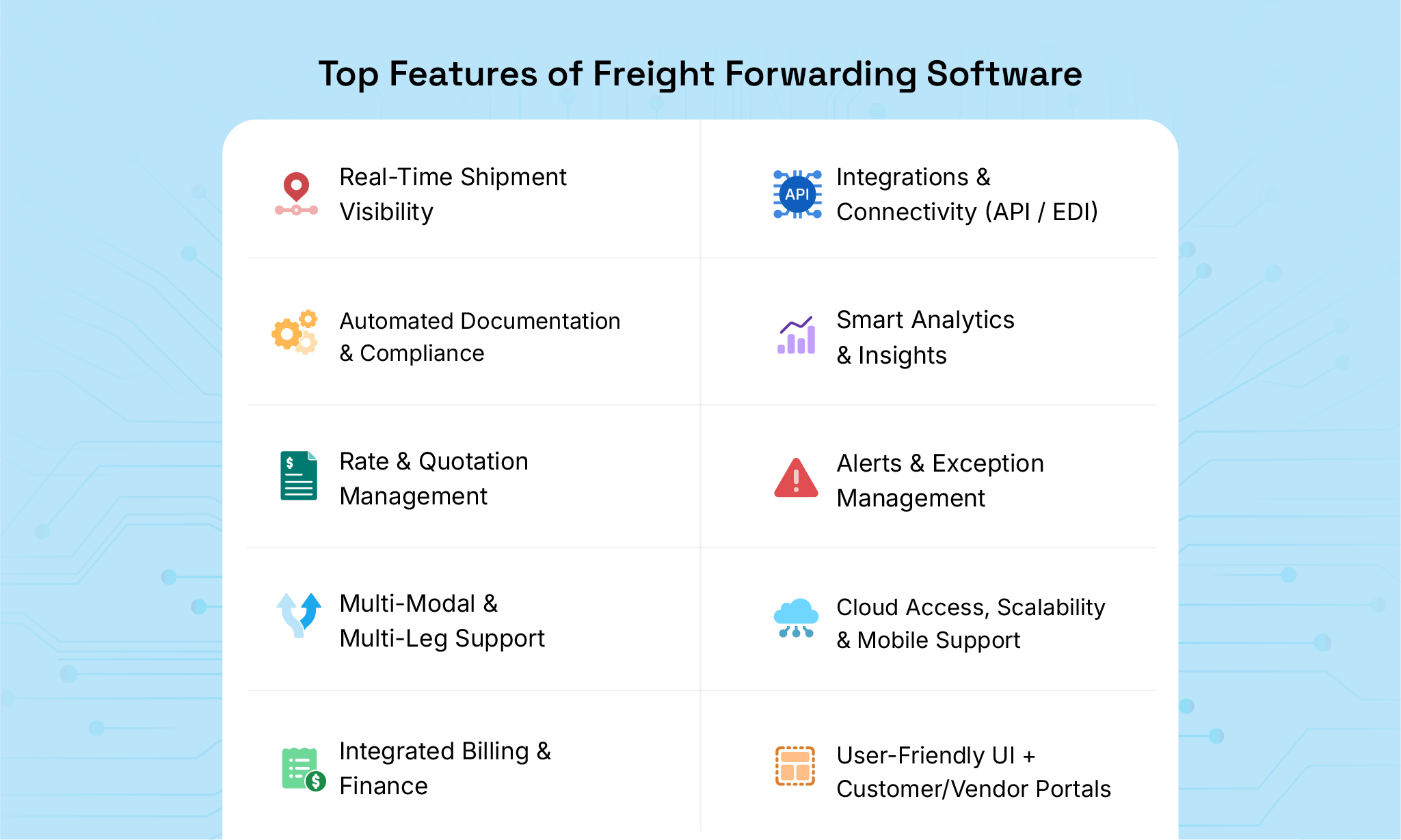
1. Real-Time Shipment Visibility
Think of this as the “Live Location” button for your cargo.
You, your customer, and sometimes even their customer need to know:
Where is the shipment right now?
Has it departed?
Is it delayed?
Have customs cleared it?
Why it matters:
Visibility = peace of mind + fewer angry calls + proactive problem-solving.
Example: If a vessel is rerouted due to weather, real-time visibility alerts you instantly, so you can inform customers before they ask, adjust delivery windows, and coordinate with truckers early.
Companies using visibility tools report up to 40% fewer customer service calls because clients can self-check status.
2. Automated Documentation & Compliance
Let’s be honest, forwarding is basically:
50% cargo + 50% paperwork.
A good system should handle BLs, AWBs, invoices, packing lists, certificates, declarations…
And keep everything audit-friendly and compliant.
Why it matters:
One document mistake = shipment stuck + penalties + stress.
With countries updating rules constantly (like ICS2 in EU or AMS in the US), manual compliance becomes risky. Automated systems stay updated so your team doesn’t have to track every regulation.
Automating documentation can cut processing time per file by 30–50%.
3. Rate & Quotation Management
Freight rates change so often that using Excel feels like torture.
Your software should let you:
Upload rate sheets easily
Create quotes quickly
Convert quotes to bookings with a click
Why it matters:
Speed wins deals. Accuracy protects your margin.
Carriers release GRI, BAF, PSS, and seasonal surcharges at unpredictable times. A good system automatically adjusts these, so your quotes remain accurate.
Faster quoting means you close more deals, and customers often choose the first accurate quote they receive.
4. Integrated Billing & Finance
Running operations in one system and accounts in another is a recipe for mismatched numbers.
Your ideal software should handle:
Customer invoices
Vendor bills
Cost allocations
Profit per file
Why it matters:
You can see your margin per shipment, no more guessing.
When operations and accounts are synced, your team will never miss a charge, a detention fee, or a taxable line item again.
Most forwarders lose a 3–7% margin due to missed billing; this feature eliminates that.
5. Multi-Modal & Multi-Leg Support
A forwarder’s life isn’t simple:
Air + Road
Sea + Rail
Transshipments
Split shipments
Your software must handle all routing complexities without making your team cry.
Why it matters:
No hacks, no workarounds — just clean workflows.
Multi-leg shipments can become complicated with multiple carriers, transit points, and handovers. A strong system maps this visually and keeps documentation and milestones aligned.
No more maintaining separate files for air + road. Everything ties into a single shipment record.
6. Integrations & Connectivity (API / EDI)
Your software should talk to:
Airlines
Shipping lines
Customs systems
ERPs
WMS
Transport partners
Why it matters:
The forwarding world is one big ecosystem, and disconnected software equals a disconnected business. When researching the best freight forwarding software for your specific niche, the deciding factor is often how well the platform plugs into your existing tech stack.
Imagine your AWB auto-updating from the airline, or customs release statuses appearing inside your shipment file; that’s the power of API/EDI. High-quality software fits into your ecosystem; it shouldn’t force you to change the tools you already use.
Imagine your AWB auto-updating from the airline, or customs release statuses appearing inside your shipment file; that’s the power of API/EDI.
Good software fits into your ecosystem; it shouldn’t force you to change tools you already use.
NICE-TO-HAVE FEATURES (your growth boosters)
These aren’t mandatory… but once you use them, you’ll never go back.
7. Smart Analytics & Insights
Imagine instantly knowing:
Which customers give you the most profit
Which carriers delay the most
Your average lead time
Cost per kg / CBM
Why it matters:
Analytics make you smarter, faster, and more competitive.
Analytics help you stop margin leakage, negotiate better rates with carriers, and identify the lanes where you lose money, insights that manual reporting can never provide.
If a carrier frequently delays shipments, analytics show that pattern. You can then renegotiate terms or switch providers.
8. Alerts & Exception Management
Instead of “We didn’t know,” you now get:
Delay alerts
Demurrage warnings
Documentation expiry notifications
Customs hold updates
Why it matters:
Most money in forwarding is lost in exceptions.
Catching them early = savings + customer trust.
Missed free days or demurrage costs can wipe out profit on an entire shipment. Alerts notify you hours or days earlier so you can act before charges apply.
9. Cloud Access, Scalability & Mobile Support
Forwarding is global.
Your system should be too.
Access from anywhere
Support global teams
Add users/branches easily
Mobile-friendly dashboards
Why it matters:
The right system grows with you, so you don’t have to keep replacing it.
With cloud systems, onboarding new branches or overseas partners becomes seamless, no servers, no installations, no downtime.
A team member in Dubai and another in India can work on the same file in real time.
10. User-Friendly UI + Customer/Vendor Portals
A clean interface means your team doesn’t need two months of training.
Portals let customers:
Track shipments
Download docs
View invoices
Submit queries
Why it matters:
Great UX reduces support calls and improves customer experience.
A smooth customer portal also acts as a sales advantage. Clients feel like they’re working with a modern forwarder, not someone still using spreadsheets.
Vendor portals allow airlines, co-loaders, and transporters to upload docs and updates directly, reducing your coordination time.
In Summary
If you’re evaluating freight forwarding software, always start with this question:
“Does this make my operations easier and my customers happier?”
The 6 Must-Have features keep your foundation strong.
The 4 Nice-To-Have features push your business ahead of competitors.
Get these 10 right — and your operations instantly become faster, smarter, and far more scalable.
Frequently Asked Questions (FAQ)
1. What is freight forwarding software?
Freight forwarding software is a digital platform that helps forwarders manage shipments, documents, operations, rates, invoicing, and customer communication, all in one system.
2. Why is shipment visibility important?
Because stakeholders expect real-time updates.
Visibility reduces uncertainty, prevents missed deadlines, and helps teams manage delays proactively.
3. How does freight software improve profitability?
It reduces manual work, prevents billing errors, tracks margins per shipment, automates compliance, and identifies unprofitable lanes/customers using analytics.
4. What integrations should a good freight system support?
The essential ones are:
Airline & carrier APIs
Customs systems (like ACE, ICS2, etc.)
Port community systems
ERP & accounting tools
WMS & transport systems
5. What are the most common mistakes when choosing software?
Choosing a system that isn’t flexible
Ignoring integration capabilities
Buying more features than needed
Not considering future scalability
Selecting outdated, non-cloud systems
6. Does every freight forwarder need analytics?
If you care about lead times, margin leakage, carrier performance, or profitability, then yes.
Analytics are no longer optional.
7. Are customer portals important?
Absolutely. They reduce the time spent answering basic questions and give clients instant access to tracking, documents, invoices, and updates.
Don't forget to share this blog!


