ROI Calculator: Is Freight Software Worth It for Your Business?
Author:
Pamela
Published On:
1 min read
Freight forwarding is more than moving goods from point A to point B—it’s a complex operation involving inventory tracking, documentation compliance, shipment scheduling, client communication, and real-time problem-solving. Manual processes can work for small-scale operations, but as your business grows, inefficiencies multiply, errors creep in, and costs spiral out of control.
As businesses scale, the complexity of managing shipments, routes, documentation, and client communications grows exponentially. This is where freight software enters the picture.
Freight software automates many of these processes, providing centralized control, visibility, and reporting capabilities.
But the question remains: does it justify the investment?
ROI-or Return on Investment, offers a clear lens through which businesses can evaluate the tangible and intangible benefits of implementing such a system.
This blog will dive deep into ROI in freight forwarding software, the key metrics used to evaluate it, the calculation methods, real-world examples, and why CargoEZ can be your ideal partner for freight software excellence.
Understanding ROI in Freight Forwarding Software
ROI is a universal metric used across industries to measure the efficiency and profitability of an investment. In freight forwarding, ROI assesses how implementing software solutions impacts your operational efficiency, cost savings, revenue growth, and overall business performance.
Unlike simple cost savings, ROI considers both direct and indirect benefits. For freight software, these benefits may include:
Reduced manual work: Automation cuts down the hours spent on paperwork, data entry, and shipment tracking.
Fewer errors and compliance risks: Software reduces costly mistakes in documentation and customs filings.
Faster processing times: Streamlined operations lead to quicker shipment approvals and delivery times.
Better customer satisfaction: Real-time visibility and accurate updates improve client relationships, potentially increasing repeat business.
Data-driven insights: Analytics help identify inefficiencies, optimize routes, and make strategic decisions.
Understanding ROI in this context helps freight businesses answer critical questions:
Will the software pay for itself over time?
How quickly can I expect to see returns?
Which operational areas will benefit the most?
By answering these questions, businesses can move beyond anecdotal claims of “efficiency” to measurable, evidence-based decisions.
Key Metrics Used in Freight Software ROI Calculations
When calculating ROI for freight software, certain key metrics provide a clearer picture of the value being generated. These metrics are both financial and operational, reflecting the broad impact software has on a business.
1. Operational Cost Savings
One of the primary drivers of ROI is the reduction in operational costs. Freight forwarding software automates repetitive tasks such as:
Manual entry of shipment details
Generating invoices and reports
Tracking shipments and inventory
By reducing time spent on these tasks, businesses can redeploy staff to higher-value work, ultimately lowering labor costs. Additionally, automation minimizes human errors that could result in fines, lost shipments, or delays, adding another layer of cost savings.
2. Increased Shipment Volume and Revenue
Freight software can increase your throughput without requiring additional resources. By optimizing routes, automating processes, and providing better shipment visibility, companies can manage more shipments with the same workforce, driving revenue growth.
3. Error Reduction and Compliance Efficiency
Compliance errors in freight forwarding, like incorrect customs filings or missed deadlines can be expensive. Freight software ensures that documentation adheres to industry standards, reducing risk and saving costs associated with penalties or shipment delays.
4. Time Savings
Time is a critical metric often underestimated in ROI calculations. Faster processing times for bookings, documentation, and shipment tracking directly translate into cost efficiency and improved service levels. For example, reducing the average processing time from 2 hours per shipment to 30 minutes can dramatically increase daily operational capacity.
5. Customer Retention and Satisfaction
Freight software often includes customer-facing portals for tracking shipments, generating reports, and receiving notifications. Happier clients are more likely to stay loyal, increasing lifetime customer value, which indirectly contributes to ROI.
6. Analytics and Strategic Decision-Making
Advanced freight software provides data-driven insights. Identifying inefficient routes, optimizing inventory, and forecasting demand allow businesses to make informed strategic decisions, potentially increasing profit margins and reducing waste.
These metrics combine to offer a holistic view of the value of freight software, far beyond the initial investment cost.
Metric | Manual Process | With CargoEZ |
Booking Time | 30-45 Mins (Emails/Calls) | 5 Mins (Digital Integration) |
Tracking Updates | Manual portal hopping | Automated Milestone Alerts |
Document Accuracy | High Risk (Manual Entry) | Low Risk (Data Mapping) |
Scalability | Linear (More shipments = More staff) | Exponential (Software handles volume) |
How ROI is Calculated: Formula Explained
ROI is typically calculated using a simple formula:
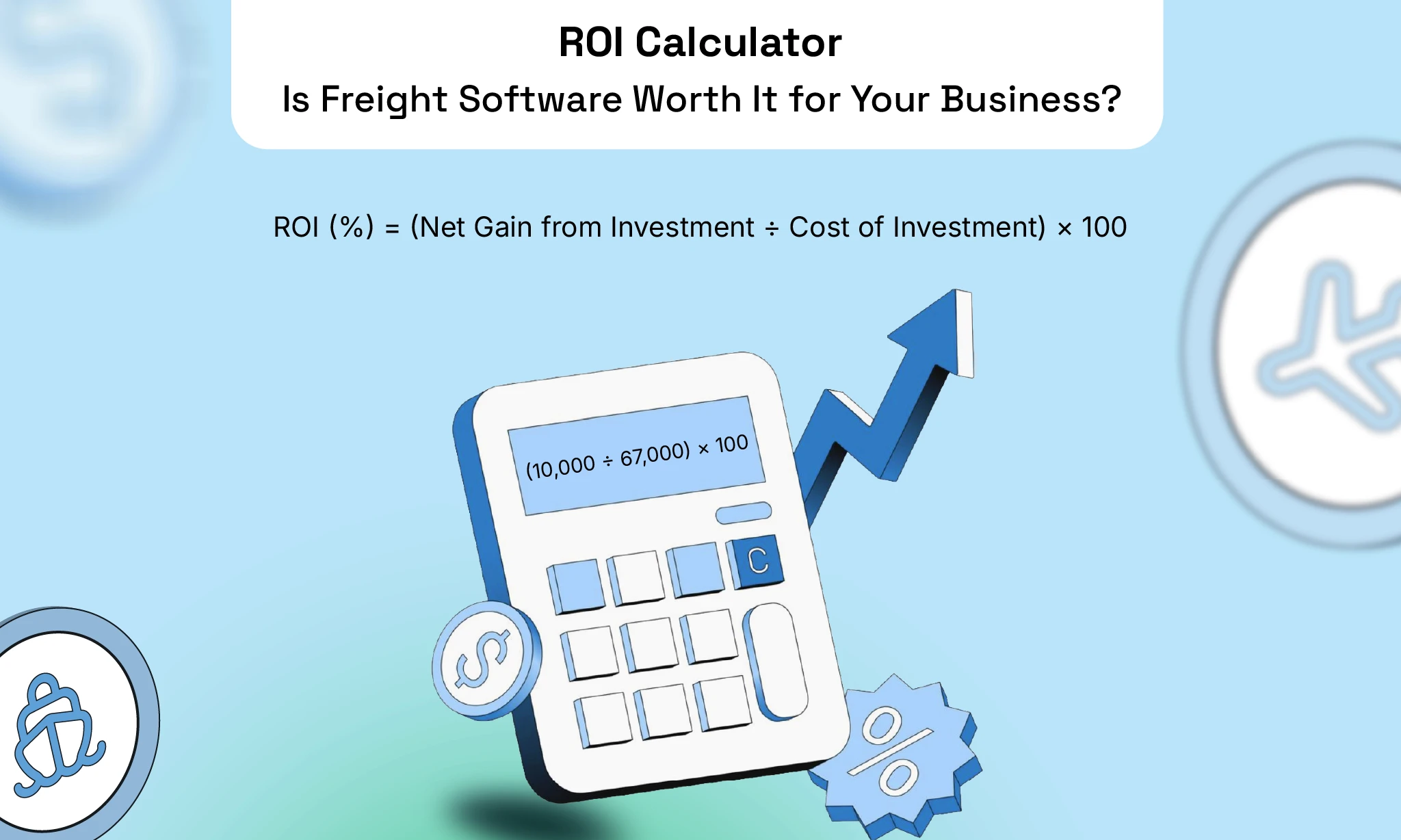
ROI (%) = (Net Gain from Investment ÷ Cost of Investment) × 100
Here’s how it works in the context of freight software:
Net Gain from Investment: This includes all measurable financial benefits, such as cost savings, increased revenue, reduced penalties, and labor efficiency gains over a specified period.
Cost of Investment: This includes software licensing, implementation costs, training, and ongoing maintenance fees.
Example:
Imagine your company spends $50,000 annually on manual freight operations. You implement freight software at a cost of $20,000 per year, and it reduces operational costs by $40,000 annually.
Net Gain = $40,000
Cost of Investment = $20,000
ROI (%) = (40,000 ÷ 20,000) × 100 = 200%
A 100% ROI means that the software essentially pays for itself within a year while providing additional operational benefits.
It’s important to note that ROI should account for both quantitative gains (cost savings, revenue increase) and qualitative gains (customer satisfaction, employee productivity, risk reduction), even if the latter is harder to measure numerically.
Step-by-Step: How to Use an ROI Calculator for Freight Software
Using an ROI calculator helps business leaders quantify the financial benefits of freight software. Here’s a step-by-step guide:
Step 1: Gather Baseline Data
Before calculating ROI, collect current operational data, including:
Number of shipments processed per month
Average processing time per shipment
Labor costs associated with shipment management
Costs due to errors, fines, or delays
Customer churn rates
This baseline data will allow you to estimate the improvements and savings the software can provide.
Step 2: Estimate Software Costs
Include all direct and indirect costs:
Software licensing/subscription fees
Implementation costs (setup, data migration)
Employee training
Ongoing maintenance and support
Step 3: Quantify Benefits
Estimate the savings or gains from implementing the software:
Reduction in labor hours and associated costs
Decrease in errors and penalties
Increased shipment capacity and potential revenue
Improved customer retention and reduced churn
Step 4: Input Data into the ROI Calculator
Many freight software vendors provide ROI calculators. Input your baseline data, estimated costs, and expected benefits. The calculator will provide a percentage ROI and projected payback period.
Step 5: Analyze Results
Interpret the ROI calculation to make an informed decision:
ROI > 100% → Strong financial justification for software adoption
ROI 50–100% → Potentially worthwhile; consider qualitative benefits
ROI < 50% → Reevaluate costs, expected benefits, or alternative solutions
Real-World Examples
To illustrate the practical impact of freight software, let’s explore a few real-world scenarios:
Example 1: Small and Mid - Sized Freight Forwarder
A small freight forwarding company was handling around 60 shipments per month using spreadsheets, email, and manual documentation processes. Their operations team of three staff members spent significant time on booking confirmations, shipment tracking, document preparation, and customer updates.
After implementing freight management software, several operational improvements were observed within the first year:
Processing time per shipment decreased by 50%, allowing the team to manage tasks faster.
Documentation errors dropped by nearly 70%, reducing the risk of compliance issues and shipment delays.
Operational workload decreased, allowing the company to operate efficiently with one fewer operations role.
Shipment capacity increased by about 20%, enabling the business to handle more shipments without hiring additional staff.
Financial Impact
These improvements generated measurable financial benefits through labor savings, reduced penalties, and additional revenue from increased shipment capacity.
Total annual benefit: $45,000
With an annual freight software investment of $20,700, the company calculated its ROI as:
ROI (%) = ((45,000 − 20,700) ÷ 20,700) × 100
ROI ≈ 117% in the first year
Example 2: Logistics Enterprise
A large logistics enterprise wanted better visibility across its global operations. Freight software implementation provided:
Real-time shipment tracking
Automated reporting for compliance and auditing
AI-driven route optimization
This led to:
40% reduction in fuel costs
30% faster shipment delivery times
25% improvement in customer satisfaction scores
Although the software cost was significant ($150,000/year), the ROI exceeded 200% within two years due to operational efficiency and revenue gains.
Example 3: Small Freight Broker
Even small freight brokers benefit. By reducing manual work through software:
Bookings and invoices are automated
Customer inquiries handled via automated portals
Errors in documentation dropped drastically
The ROI in such cases may seem smaller numerically but qualitative benefits better client relationships and fewer compliance risks—provide long-term strategic value.
Why CargoEZ is Your Ideal Partner for Freight Software Excellence
When evaluating ROI for freight software, vendor choice matters. CargoEZ offers a comprehensive platform designed for businesses of all sizes:
Automation that saves time: From AWB management to costing, CargoEZ automates key workflows, reducing manual errors and freeing up staff for higher-value tasks.
Real-time visibility: Track shipments end-to-end, giving your clients confidence and improving satisfaction.
Scalable solutions: Whether you’re handling a handful of shipments or thousands, CargoEZ grows with your business.
Data-driven insights: Analytics and reporting help you optimize routes, reduce costs, and make informed decisions.
Seamless integration: CargoEZ works with your existing systems, minimizing disruption during implementation.
With CargoEZ, businesses don’t just invest in software, they invest in operational excellence, efficiency, and growth. The ROI isn’t just about cost savings; it’s about creating a business that can scale reliably and sustainably.
Conclusion
Investing in freight software is no longer optional for businesses aiming to remain competitive, it’s a strategic necessity. But with significant upfront costs, the decision must be data-driven.
An ROI calculator is your best tool to evaluate the tangible and intangible benefits of freight software. By understanding key metrics like cost savings, error reduction, processing time, and customer satisfaction, and applying a structured ROI calculation, businesses can make informed investment decisions.
Real-world examples show that whether you’re a small broker or a global enterprise, freight software can deliver substantial returns—financially and operationally. And with a trusted partner like CargoEZ, your business is positioned to unlock the full potential of freight automation, visibility, and efficiency.
Author

Don't forget to share this blog!