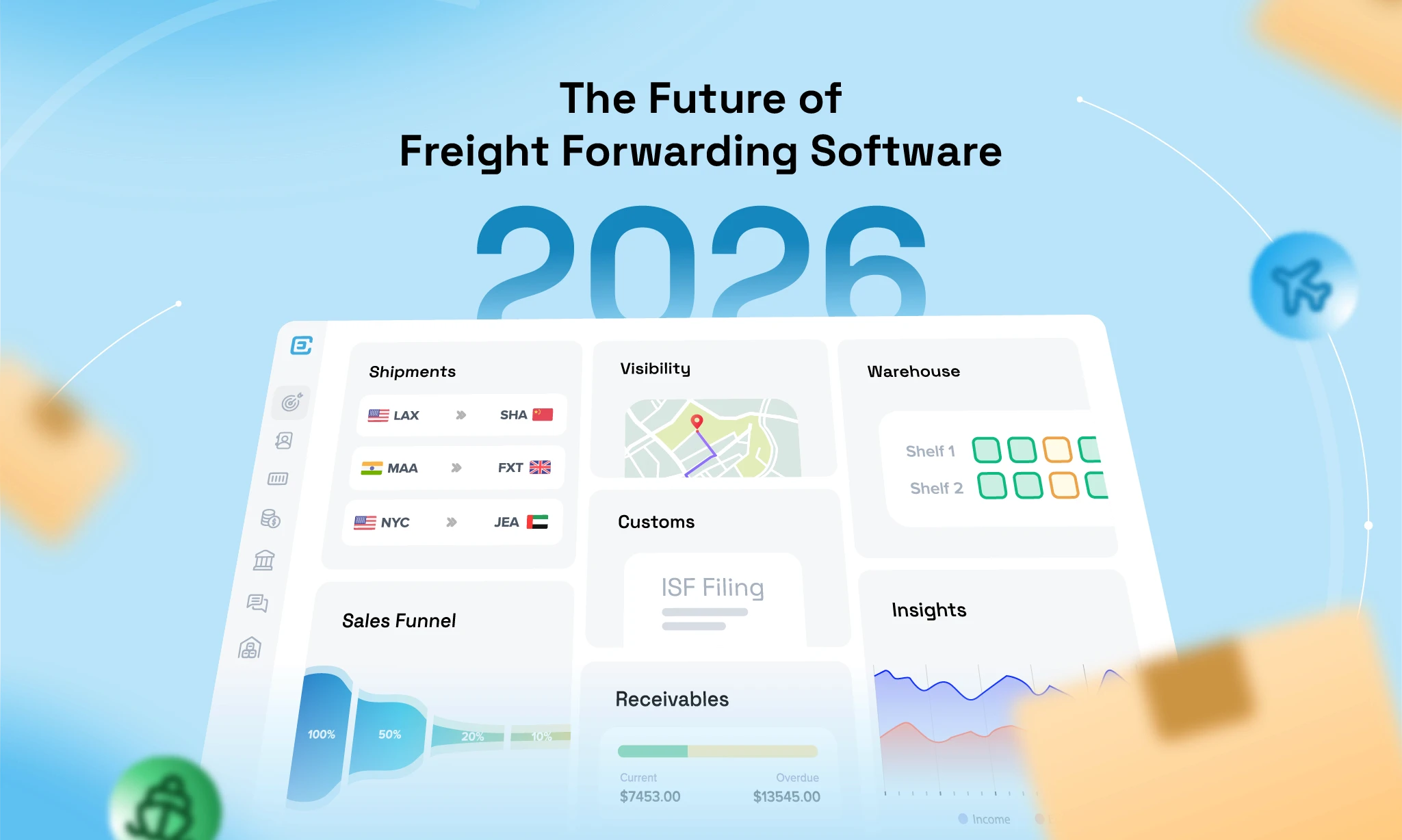
The Future of Freight Forwarding Software 2026
Author:
Divya Murugan
Published On:
1 min read
According to industry estimates, over 60 percent of shipment delays are linked to information gaps, not physical disruptions. The cargo often keeps moving, but the data does not.
For a long time, freight forwarding ran on experience, intuition, and a lot of spreadsheets. That approach worked when trade lanes were simpler and customer expectations were lower. Today, it feels like trying to manage global logistics with yesterday’s tools.
If you have ever waited for a shipment update that never arrived, chased documents across emails, or explained a delay without fully knowing the reason, you already understand the problem.
Freight forwarding software is no longer just a support tool. It is becoming the nervous system of global trade.
This shift is not sudden. It is the result of years of pressure building quietly in the background.
The Real Drivers Behind Freight Forwarding Complexity
Complexity Factor | Operational Impact | Customer Impact |
Multiple carriers | Manual coordination | Missed updates |
Disconnected systems | Data duplication | Conflicting information |
Regulatory variation | Compliance risk | Delays & uncertainty |
Why This Problem Is Getting Worse, Not Better
Here is the uncomfortable truth. The logistics world is not slowing down to give anyone time to catch up.
• Customer expectations are shaped by real-time apps in every other industry
• Regulations are becoming more complex, not simpler
• Margins are tightening while service expectations rise
• Talent is harder to find and harder to retain
When systems are slow, people compensate by working harder. They stay late, double-check everything, and rely on tribal knowledge. This works until it does not.
I once spoke with an operations manager who said, “Nothing is broken, but everything feels heavy.” That sentence captures the moment many freight teams are in right now.
Software that looks ahead instead of backward
The future of freight forwarding software is not about digitizing paperwork. That phase is already behind us.
The next generation of platforms focuses on three things:
Pillar | What It Replaces | What It Enables |
Anticipation | Reactive tracking | Early risk mitigation |
Connection | Email-driven coordination | Shared real-time view |
Intelligence | Gut decisions | Data-backed actions |
Instead of asking, “What happened?” the system begins to answer, “What is likely to happen next, and what should we do about it?”
That is a fundamental change.
1. From Data Entry to Decision Support
Freight forwarding software is no longer designed only to record information. Its primary role is shifting toward helping teams make better decisions under uncertainty.
Modern platforms analyze patterns across shipments, routes, carriers, and seasons to surface risks early. Instead of reacting to delays after they happen, forwarders receive guidance on what is likely to happen next and what options are available. Ultimately, the best freight forwarding software today acts as a predictive partner, moving beyond static spreadsheets to offer dynamic, actionable insights that safeguard margins.
This decision-support layer increasingly draws on multiple capabilities.
Artificial intelligence helps identify patterns humans would miss. Secure data frameworks improve trust across partners. Downstream visibility, including last-mile movement, ensures decisions reflect the full journey. Environmental volatility adds another variable that software must now account for.
The result is not automation for its own sake. It is clearer judgment, earlier intervention, and less operational stress.
2. Real Time Visibility Becomes the Default, Not a Premium Feature
Visibility used to mean tracking numbers and periodic status updates. The future version is continuous awareness.
Forwarders and customers increasingly expect to see the same thing at the same time. Location, milestones, exceptions, and documentation should live in one shared view.
This matters because transparency changes behavior.
When everyone sees the same data, conversations become calmer and more constructive.
Instead of asking, “Why did this happen?” people start asking, “What is the best next step?”
3. Automation That Reduces Cognitive Load, Not Just Labor
Automation in freight forwarding is often misunderstood. The goal is not speed alone.
The real value is mental clarity.
Automated document processing, rate management, invoicing, and compliance checks reduce the constant context switching that exhausts operations teams. When fewer things compete for attention, mistakes drop naturally.
One forwarder described it this way: “I finally stopped worrying about what I might have missed.”
This shift allows teams to handle significantly higher shipment volumes, in some cases scaling operations many times over without adding headcount.
4. Software as a Collaboration Layer
Freight forwarding has always been collaborative, but coordination was manual. Phone calls, emails, follow-ups, and reminders filled the gaps between systems.
Future software acts as a shared workspace rather than a private database. Shippers, agents, carriers, and internal teams work from the same source of truth.
This reduces friction, but more importantly, it changes relationships. Trust increases when information flows freely and predictably.
5. Predictive and Scenario-Based Planning
One of the most transformative changes ahead is simulation.
Advanced platforms are beginning to model supply chains digitally and test scenarios before they happen. What if a port slows down? What if fuel costs spike? What if demand shifts unexpectedly?
This allows forwarders to move from reactive problem-solving to proactive planning.
The difference between those two mindsets is the difference between surviving and leading.
6. Sustainability Moves From Reporting to Action
Environmental reporting is no longer enough. Customers and regulators want to see measurable action.
Freight forwarding software is starting to integrate emissions tracking, route optimization, and load efficiency into everyday decision-making.
The future is not about choosing between profit and responsibility. It is about building systems where both improve together.
Features Freight Forwarders Should Prioritize in 2026
You do not need to chase every trend. What matters is whether your software supports better decisions under pressure.
Instead of asking what features exist, ask what they enable.
Early risk visibility
Can your system surface potential delays, compliance issues, or capacity constraints before they escalate?Decision support, not just data storage
Does the software help your team understand what to do next, or does it only show what already happened?Shared, real-time visibility
Are internal teams, partners, and customers working from the same information at the same time?Scalability without complexity
Can shipment volumes grow without adding manual work or increasing operational stress?Trust and transparency by design
Does your platform reduce follow-ups, disputes, and uncertainty for customers?
Technology creates value only when it makes people more effective. Features matter, but outcomes matter more.
How to Know If Your Freight Software Is Already Outdated
Many systems still function, but quietly hold teams back.
Your software may be outdated if:
Problems are discovered after customers raise them
Teams rely on emails, spreadsheets, or personal memory to fill gaps
Data lives in multiple systems that rarely agree
Scaling volume requires adding headcount
Explaining delays feels harder than solving them
The most important shift is not technical. It is cultural.
Forwarders are beginning to expect their systems to think with them, not just store information for later. Software is becoming a partner in judgment, not a tool for record keeping.
Those who recognize this early gain resilience. Those who delay often feel pressure build quietly until change becomes unavoidable.
Conclusion
The future of freight forwarding software is not flashy. It is thoughtful.
It is quieter operations, clearer decisions, fewer surprises, and stronger trust. In a world where global trade keeps getting more complex, that kind of stability becomes a competitive advantage.
Frequently Asked Questions (FAQs)
1. Is freight forwarding software only for large companies
No. Cloud-based platforms have made advanced tools accessible to small and mid-sized forwarders. In fact, smaller teams often benefit the most because automation frees limited resources.
2. Will software replace freight forwarders
No. Relationships, negotiation, and experience still matter deeply. Software supports decision-making and execution. It does not replace human judgment.
3. How long does it take to see value after implementation
Most companies see operational clarity within weeks, not months. The deeper predictive benefits grow over time as the system learns from data.
4. Is integration with existing systems difficult
Modern platforms are designed to integrate with accounting systems, carrier APIs, and customer portals. The key is choosing software built for interoperability from the start.
5. What is the biggest mistake companies make when choosing freight software
Focusing only on features instead of workflows. The best system is the one that fits how your team actually works and how you plan to grow.
Don't forget to share this blog!