Freight Forwarding Software and Supply Chain Efficiency
Author:
Divya Murugan
Published On:
1 min read
Let’s start with a truth every freight forwarder knows.
Cargo rarely gets delayed because people are careless.
It gets delayed because information arrives late, incomplete, or scattered.
By the time someone realizes a container is stuck, free time is already ticking away. By the time finance notices a missed charge, the invoice is already sent. By the time a customer asks for an update, the team is already firefighting.
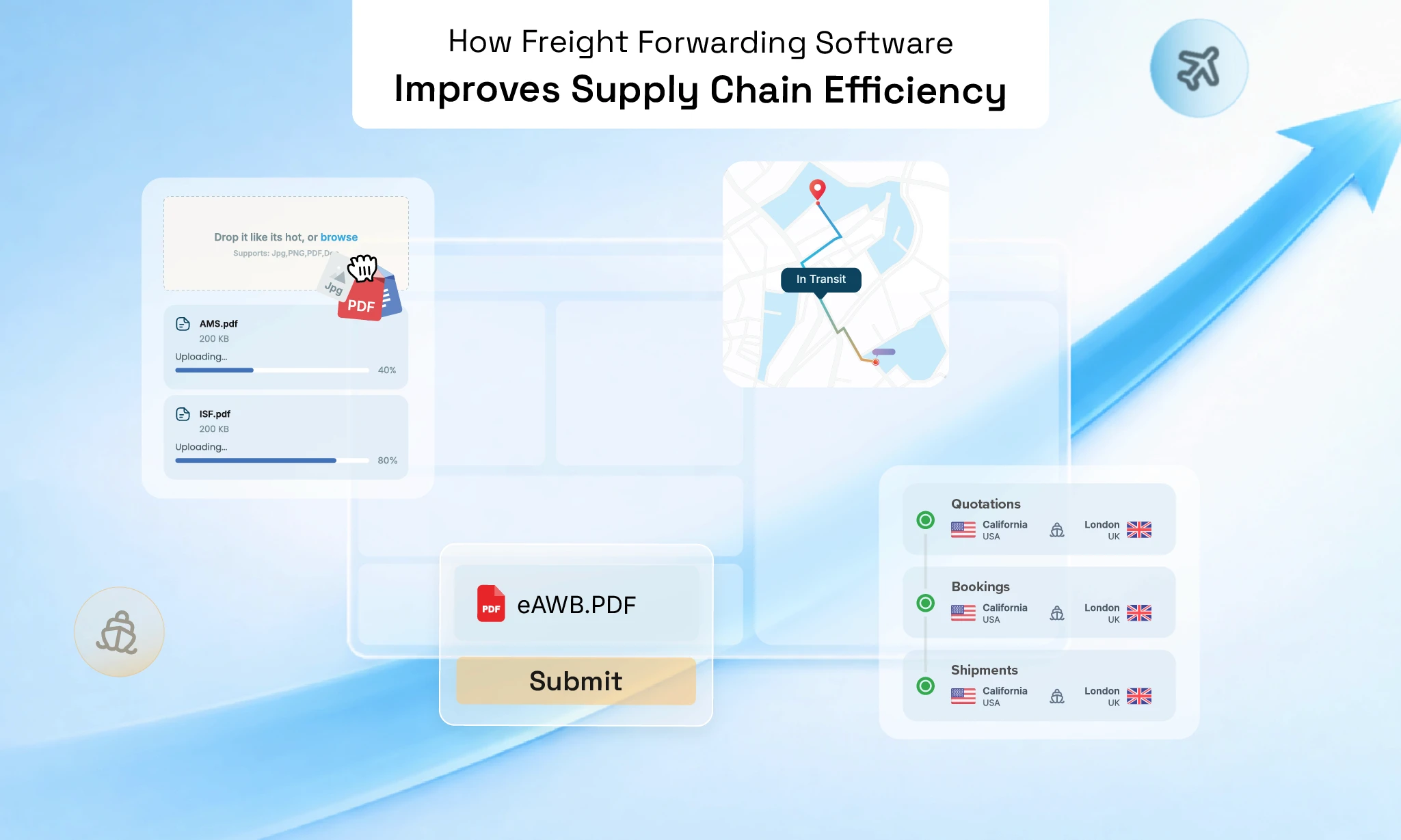
Freight forwarding software improves supply chain efficiency by centralizing shipment data, automating routine workflows, and providing real-time visibility, so teams can act faster, reduce errors, cut costs, and prevent problems before they escalate.
Freight forwarding software exists to break this cycle. Not by adding complexity, but by restoring something the supply chain desperately needs: clarity.
The real bottleneck in freight forwarding is not movement
Freight forwarding software restores visibility by addressing four critical gaps:
1. Centralized shipment data
Every shipment has one digital record that includes booking details, documents, milestones, costs, and communication. Teams stop chasing updates and start working from a single source of truth.
2. Real-time visibility for internal teams and customers
Updates are no longer locked inside inboxes. With built-in customer portals, shippers receive live status updates, ETAs, and delay notifications without needing to email or call, reducing follow-ups and improving trust.
3. Route optimization and proactive planning
Freight forwarding software uses live schedules, transit times, and delay signals to help teams select better routes and adjust plans when disruptions occur, before delays cascade downstream.
4. Predictive alerts instead of reactive firefighting
The system flags risks such as vessel delays, missed cutoffs, or free-time expiry early, giving teams time to act instead of react.
Freight forwarding software fixes the visibility problem by giving every shipment one digital home, and every team a clear, shared view of what is happening next.
One shipment, one screen, one source of truth
Ships move. Trucks move. Planes move.
What often does not move smoothly is information.
According to a McKinsey study, companies with poor supply chain visibility experience up to 20 percent higher operational costs due to delays, expediting, and inefficiencies.
In many forwarding teams today, shipment data is technically available—but practically unusable. Updates sit across emails, Excel trackers, carrier portals, and personal inboxes. Each handover introduces delay, and by the time information is aligned, free time has already started counting down or a routing decision has already been missed.
Freight forwarding software restores visibility by turning fragmented updates into a single, live operational view. Instead of reacting to emails and status checks, teams see what has changed, what is at risk, and what needs action—while the shipment is still in motion.
Real-time visibility that prevents “surprise problems.”
Traditional tracking answers one question: where is my container now?
Modern freight forwarding software answers a better one: what is about to go wrong?
Real-time logistics visibility has been shown to improve on-time delivery performance by up to 25 percent, according to research on digital supply chain systems.
Source:
Here is a simple example.
A vessel delay is announced.
Without a system, the update sits in an email.
With freight software, the delay triggers alerts, updates ETAs, and flags downstream risks automatically.
That difference is not technology for the sake of technology. That is time saved, penalties avoided, and customer trust preserved.
Documentation that stops stealing your team’s time
Every freight forwarder knows this pain.
The same shipment data is typed into the bill of lading. Then again, into the invoice. Then again, into customs documents. And once more, when something changes.
Manual documentation is one of the biggest drains on operational efficiency.
Industry estimates show that automation can reduce document processing time by 40 to 60 percent in logistics operations.
Freight forwarding software solves this by capturing shipment data once and reusing it everywhere. When a detail changes, it updates across documents automatically.
Less typing. Fewer errors. Faster clearance.
Your team spends more time managing shipments and less time correcting PDFs.
How freight forwarding software improves cost visibility and margin control
One of the quietest problems in freight forwarding is revenue leakage.
Charges missed
Costs recorded late
Margins are reviewed only after billing
According to Deloitte, logistics companies lose 1 to 5 percent of revenue annually due to poor cost visibility and manual billing processes.
Source:
Freight forwarding software connects operations and finance in real time. As the shipment moves, costs and charges move with it.
This is exactly where CargoEZ’s value stands out. Cost clarity is not a finance feature. It is an operational advantage.
When teams see margin impact while the job is active, decisions improve immediately.
From firefighting to foresight with predictive alerts
The most mature freight systems do something powerful. They warn you before money is lost.
Examples include alerts for:
Free time about to expire
Detention risk approaching
Missing documents before the cutoff
Delays that affect downstream delivery
Instead of reacting to penalties, teams act early.
According to industry analysis, proactive exception management can reduce demurrage and detention costs by up to 30 percent.
This is not automation replacing people. It is automation giving people a head start.
Collaboration without chasing updates
In many forwarding offices, sales, operations, and finance work with different data sets. That is how confusion starts.
Freight forwarding software creates a shared operational view. Everyone sees the same shipment status, costs, and documents.
Sales can quote with confidence.
Operations can plan without guessing.
Finance can bill without chasing confirmations.
The supply chain becomes calmer, not louder.
Better visibility creates better customer conversations
Customers do not expect perfection. They expect honesty and timely updates.
Freight forwarding software enables proactive communication. Instead of saying “we are checking,” teams can say “here is what changed and what we are doing next.” That shift alone changes the tone of customer conversations—from reactive explanations to informed updates.
The impact is measurable. Studies show that improved supply chain transparency can increase customer satisfaction by up to 22 percent.
A practical example comes from a Singapore-based logistics provider that implemented AI-powered warehouse management and route optimization as part of its digital transformation. By enhancing visibility across operations and delivery planning, the company reduced overall operational costs by 30% and decreased order picking time by 48%. The result was not only faster execution but also clearer and more reliable communication with customers, delivering a reported 267 percent return on investment within 12 months.
When customers receive timely updates backed by real data, trust builds quickly. Over time, that trust becomes a competitive advantage.
Conclusion
Freight forwarding software does not magically move ships faster. What it does is remove confusion, delays in decision-making, and silent margin loss.
It improves supply chain efficiency by:
Centralizing shipment information
Enabling real-time and predictive visibility
Automating documentation
Bringing cost control into operations
Aligning teams around a single source of truth
This is exactly where CargoEZ fits. Not as a complex system that needs weeks of training, but as a practical platform that gives teams control without slowing them down.
Efficiency follows clarity. Always.
Frequently Asked Questions (FAQs)
1. What makes freight forwarding software different from basic tracking tools?
Freight forwarding software connects tracking, documents, costs, and workflows in one system. Tracking alone shows location. Software shows impact and next actions.
2. Can small freight forwarders benefit from freight software?
Yes. Smaller teams often benefit faster because even a few hours saved per shipment makes a visible difference.
3. How fast can teams see results after implementation?
Many teams see operational improvements within weeks, especially in visibility, documentation time, and internal coordination.
4. Is freight forwarding software only for operations teams?
No. Sales, finance, and customer service all benefit because they work from the same real-time data.
Don't forget to share this blog!