Automate Your Bill of Lading with Freight Forwarding Software
Author:
Aashinya
Published On:
1 min read
Every shipment begins and ends with documentation, and the bill of lading (BoL) sits at the center of it all. When BoLs are handled manually, each document typically takes 20–40 minutes to prepare and achieves an average accuracy of around 95%. As a result, teams often spend hours re-entering data, correcting discrepancies, and chasing approvals.
Automating Bills of Lading with freight forwarding software reduces processing time with 92% accuracy, eliminates repetitive manual work, allowing teams to focus on higher-value and essential administrative tasks. This blog examines the key aspects of Bills of Lading, their significance in freight forwarding, and how automation streamlines the entire process.
What is a Bill of Lading and Why is it Important?
A bill of lading is one of the most important documents in freight forwarding and global trade. It serves as an official record of shipment and is issued by the carrier to acknowledge receipt of goods from the shipper.
Depending on the mode of transport and business requirements, freight forwarders may issue different types of bills of lading, including House Bill of Lading, Master Bill of Lading, and Sea Waybill.
What Does Bill of Lading Automation Mean?
Traditionally, preparing a bill of lading involves repetitive data entry, physical documentation, emails, and constant back-and-forth between shippers, carriers, freight forwarders, and consignees. These manual steps not only slow down operations but also increase the risk of errors, delays, and compliance issues.
Manual BoL processing isn't just slow, it's a liability. According to the World Economic Forum, documentation issues account for 20% of total trade costs.
The 21% Delay Factor: One in five shipment delays is caused by manual data errors (typos in weights, missing HS codes, or incorrect notify parties).
The Version Control Nightmare: When BoLs live in email threads, the risk of printing the wrong "Draft" for the carrier is massive.
The Courier Drain: Waiting for physical "Originals" to be signed and couriered adds days to your cash flow cycle.
With BoL automation, shipment details are captured once and automatically populated across all required bill of lading fields. The document can be generated instantly, validated for accuracy, and shared with all relevant stakeholders in real time through a centralized system.
How Freight Forwarding Software Automates the Bill of Lading?
Modern freight forwarding software goes beyond just workflow automation. It helps embed intelligent technologies that eliminate manual documentation. The technical backbone of automating the bill of lading is briefed below.
Optical Character Recognition (OCR) & AI-Based Data Extraction
In real-world operations, bill of lading data does not always originate inside the system. It often arrives as scanned PDFs, emails, or carrier-issued documents. OCR combined with AI enables freight forwarding software to read, interpret, and digitize this unstructured data automatically.
Advanced OCR engines extract key fields such as:
Shipper and consignee details
Container and package information
Vessel, voyage, and routing data
HS codes, weights, and descriptions
AI models then validate and map this data to the correct shipment records. This reduces manual data entry, accelerates document processing, and minimizes human errors, especially in high-volume operations.
Intelligent Data Validation and Exception Handling
Automation is not just about extraction but accuracy. AI-driven validation rules cross-check bill of lading data against booking details, commercial invoices, and carrier requirements.
The system automatically flags:
Missing or inconsistent fields
Mismatches between booking and B/L data
Trade compliance or formatting issues
Instead of discovering errors at the carrier or customs stage, teams can resolve them proactively within the platform.
Electronic Bill of Lading (eBOL) Enablement
Freight forwarding software increasingly supports Electronic Bills of Lading (eBOL), replacing paper-based documents with legally recognized digital equivalents.
eBOL capabilities include:
Secure digital issuance and transfer
Controlled access and authentication
Faster endorsement and release processes
Reduced dependency on physical courier services
This not only accelerates trade documentation but also improves security, traceability, and compliance with emerging global trade standards.
API-Based Carrier & Platform Integrations
Automation is strengthened through direct integrations with carriers, port systems, and trade platforms via APIs. Instead of manually recreating documents, bill of lading data can be exchanged electronically in standardized formats.
This enables:
Direct carrier submission of B/L data
Real-time status updates and confirmations
Faster amendments and approvals
Seamless coordination across global agents
Version Control, Audit Trails & Compliance Readiness
Every automated Bill of Lading carries a complete digital audit trail. The system records who created, modified, approved, or released the document and when.
This ensures:
Full traceability for audits and disputes
Compliance with trade, customs, and internal controls
Easy retrieval of historical versions when needed
Secure Document Management & Access Control
Bills of Lading are stored in centralized, cloud-based repositories with role-based access controls. Encryption and permission management ensure that sensitive trade documents are accessible only to authorized stakeholders.
Why Automate Your Bill of Lading with Freight Forwarding Software?
The bill of lading sits at the center of freight operations, yet it is often one of the most manually handled documents. As shipment volumes increase and compliance requirements become more complex, manual processes create inefficiencies that slow down operations and increase risk. Automating this process is no longer just about convenience; it is about operational resilience and scalability.
Decreases human errors and rework: By automatically pulling data from shipment records, freight forwarding software minimizes manual data entry and ensures consistency across documents.
Accelerates documentation processes: Automated bill of lading enables teams to generate accurate documents in minutes, rather than hours, allowing freight forwarders to handle more shipments in less time.
Operational visibility: Centralized document management ensures that operations, finance, and customer service teams always access the latest version of the bill of lading, reducing internal confusion and external miscommunication.
Scalability: Automation solutions are scalable, capable of handling large volumes of BOL documents without compromising efficiency or accuracy.
Benefits of Automating BOLs
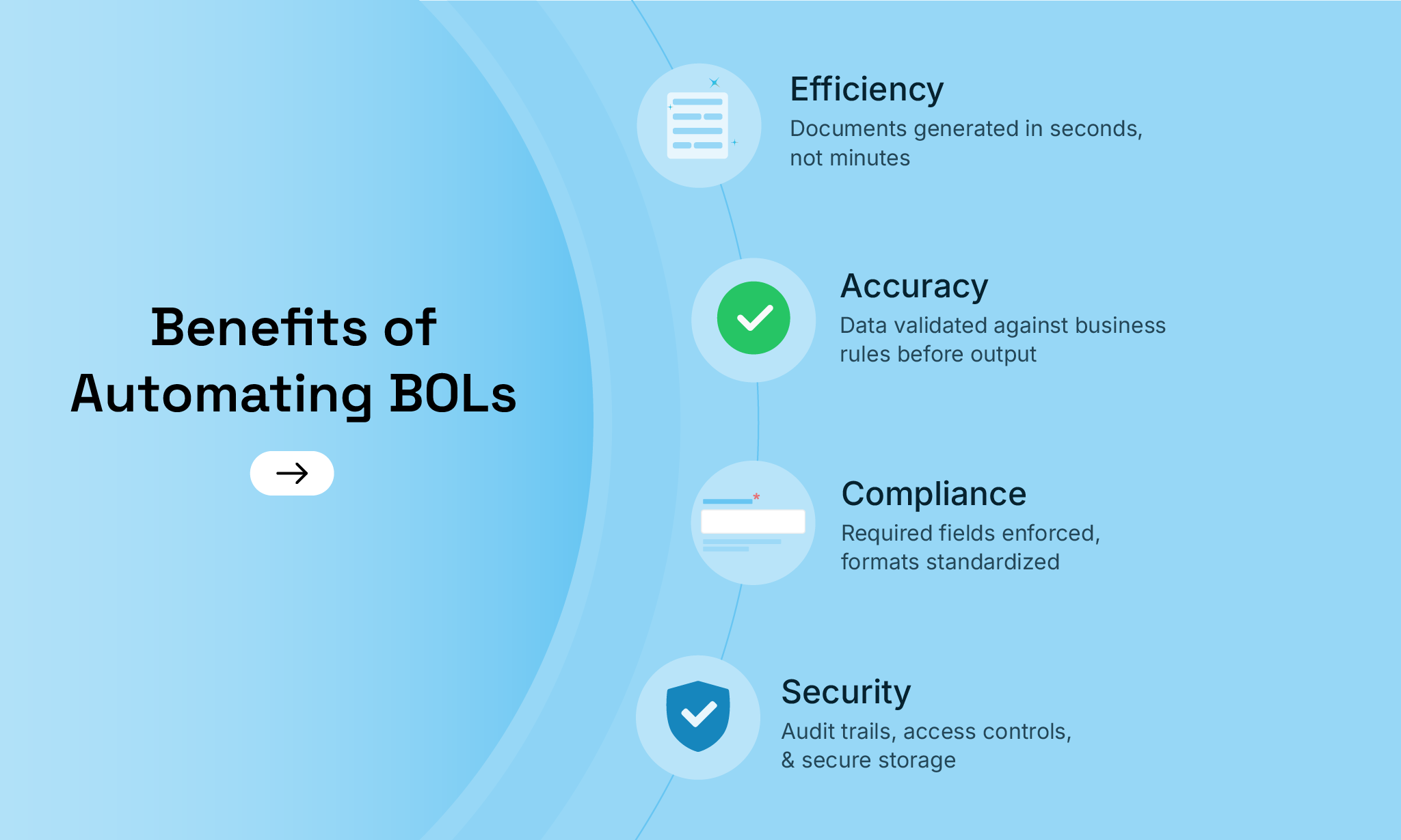
Efficiency: Documents generated in seconds, not minutes
Accuracy: Data validated against business rules before output
Compliance: Required fields enforced, formats standardized
Security: Audit trails, access controls, and secure storage
What to Look for in Freight Forwarding Software for BoL Automation
Not all freight forwarding software delivers the same level of bill of lading automation. To truly eliminate manual effort and reduce risk, it is important to evaluate solutions based on capabilities that support accuracy, compliance, and scalability.
Customizable Bill of Lading templates
The software should offer configurable BoL templates that align with different carriers, trade lanes, and customer requirements. This ensures standardization while allowing flexibility for various shipment types without manual formatting.
Multi-modal support
A strong solution must support Bills of Lading across air, ocean, and road freight. Multi-modal support ensures consistency in documentation even as shipment complexity increases.
Seamless integration with shipment and invoicing modules
BoL automation works best when it is tightly integrated with booking, operations, and invoicing data. This allows information to flow automatically across documents, reducing duplication and mismatches.
Secure and centralized document management
The software should provide secure storage, easy retrieval, and controlled sharing of Bills of Lading. Centralized access improves collaboration while ensuring data security and audit readiness.
Choosing software with these capabilities ensures that Bill of Lading automation delivers long-term operational value rather than just digitizing existing manual processes.
Transitioning from Manual to Automated BoL Management
Moving from manual processes to automation is a strategic shift, and it often comes with understandable concerns around disruption and adoption.
Common concerns while switching
Freight forwarders often worry about data migration, process changes, and team adoption. There may also be concerns about maintaining compliance and continuity during the transition phase.
How modern software simplifies adoption
Today’s freight forwarding software is designed to fit into existing workflows with minimal disruption. Automated BoL systems leverage existing shipment data, reduce the need for re-training on complex documentation rules, and provide intuitive interfaces that ease adoption.
Importance of training and change management
Successful automation depends on user confidence. Structured onboarding, clear documentation, and phased rollouts help teams adapt quickly. When users understand how automation reduces their daily workload, adoption becomes significantly smoother.
With the right approach, transitioning to automated BoL management becomes a productivity upgrade rather than an operational challenge.
Conclusion
Bill of lading automation is no longer optional for freight forwarders operating in a fast-paced, compliance-driven environment. Manual processes increase risk, slow down operations, and limit scalability as shipment volumes grow.
Freight forwarding software enables accurate, faster, and more controlled management by embedding documentation directly into operational workflows. The result is fewer errors, better visibility, and more efficient use of human resources.
As the industry continues to move toward digitization, automating the bill of lading is a foundational step toward building smarter, more resilient, and paperless freight operations.
Frequently Asked Questions (FAQs)
1. Why should I automate my bill of lading with freight forwarding software?
Automating your bill of lading reduces manual data entry errors, speeds up document processing, improves compliance with shipping regulations, and enhances overall efficiency in freight forwarding operations.
2. What types of Bills of Lading can be automated?
Freight forwarding software can automate all major types of Bills of Lading, provided the required data is available digitally or can be extracted using OCR and AI.
3. How does freight forwarding software improve bill of lading accuracy?
Freight forwarding software pulls shipment data directly from operational records, validating information against business rules to ensure accuracy and consistency, thereby minimizing human error.
4. Can automated bill of lading systems handle multiple modes of transport?
Yes, modern freight forwarding software supports multi-modal formats, including air waybills, ocean freight, and road transport documents, ensuring standardized documentation across shipment types.
5. Is bill of lading automation secure?
Yes, automated systems provide secure, centralized document storage with access controls and audit trails, reducing the risk of fraud and unauthorized access.
6. How does bill of lading automation help with compliance?
Automation enforces compliance by using standardized templates and built-in validations to ensure all required fields are completed correctly, helping logistics companies avoid compliance violations and fines.
7. Can I integrate bill of lading automation with my existing systems?
Yes, freight forwarding software often integrates seamlessly with enterprise resource planning (ERP), transportation management systems (TMS), and invoicing modules to streamline document workflows.
8. How much does Bill of Lading automation actually cost?
The cost of bill of lading automation depends on the freight forwarding software model rather than a fixed per-document fee. In most modern platforms, B/L automation is included as part of the core operations or documentation module.
Costs are typically influenced by:
Shipment volume
OCR and AI usage for document extraction
Carrier and eBOL integrations
Level of customization and compliance rules
Don't forget to share this blog!


