The Bill of Lading (BoL): A Complete Guide
Author:
Pamela
Published On:
1 min read
In global logistics, the Bill of Lading (BoL) is more than a shipping document. It is a core legal instrument that serves as a receipt of goods, a contract of carriage, and, in many cases, a document of title. Errors or inconsistencies in a BoL can disrupt the flow of a shipment, leading to operational delays, commercial disputes, and additional costs such as demurrage. Ensuring accuracy and proper execution of the BoL is therefore critical to smooth and compliant cargo movement.
What is a Bill of Lading (BoL)?
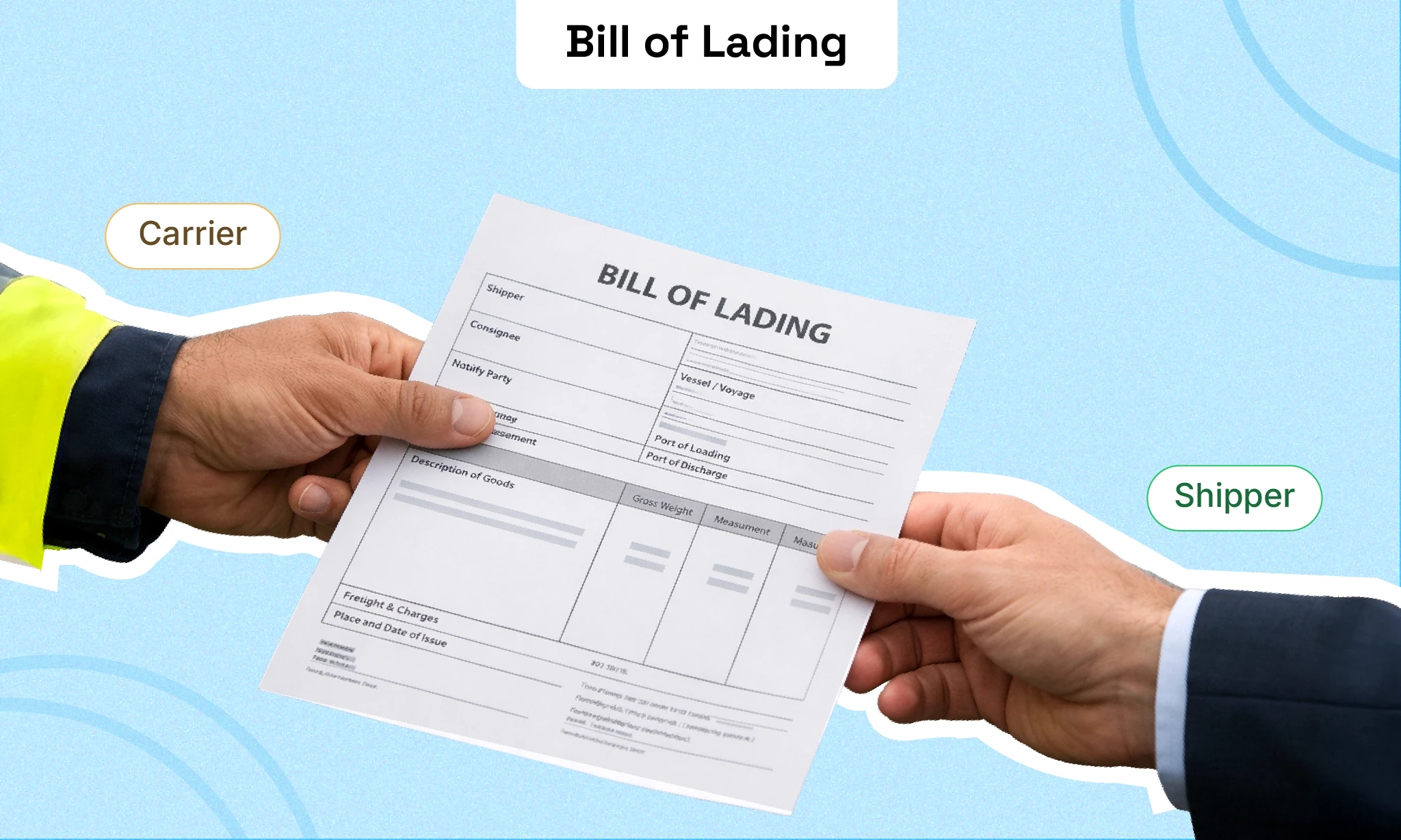
A Bill of Lading is a legally binding document issued by a carrier to a shipper that serves as the source of truth for a shipment, acting as a key legal record specifying all essential details required for the transport of goods. The document contains detailed information about the shipment, including the description of the goods, quantity, destination, and the parties involved such as the shipper, carrier, and consignee.
For example, it might list "10 pallets of electronics, shipped from New York to Hamburg, consigned to ABC Importers." Additionally, it serves as evidence that the carrier has received the goods as described and states the terms of the shipment.
The Role of Bill of Lading: The Three-Part Definition
The bill of lading serves three main functions:
Receipt: Issued by the carrier to the shipper, confirming that the goods have been received for shipment.
Contract of Carriage: Serves as an evidence of the contract between the shipper and the carrier, detailing the responsibilities and obligations of each party.
Document of Title: The document acts as proof of ownership for the goods being shipped. An individual or an entity holding the bill of lading has the right to receive the goods when they arrive. Additionally, the document allows transfer of ownership from one party to another while the shipment is in transit.
It also protects the buyer's right in the international trade and confirms the transaction is valid and ensures that the goods are handed to the correct party.
HBL vs. MBL: Why the Distinction Matters for Your Bottom Line
If you work with a 3PL or Freight Forwarder, you will encounter two types:
Master Bill of Lading (MBL): Issued by the vessel operator to the forwarder.
House Bill of Lading (HBL): Issued by the forwarder to a supplier.
Strategist’s Tip: Always ensure your HBL is backed by a reputable, insured forwarder. If the forwarder goes bankrupt while your goods are at sea, the vessel operator (MBL holder) may not recognize your HBL without significant legal hurdles.
Clean vs. Claused (Dirty) Bills: The Financial Trap
A "Clean" BoL states that the cargo was received in good condition. A "Claused" or "Dirty" BoL contains notes about damage (e.g., "three pallets wet," "crates broken"). If you are shipping under a Letter of Credit, a bank will often reject a Claused BoL, freezing your payment immediately.
The Critical Difference: Negotiable vs. Non-Negotiable BoL
The major difference between bills of lading comes down to whether ownership of goods can be transferred while they are in transit. The two main types of bills of lading are negotiable bills of lading and non-negotiable bills of lading.
A negotiable bill of lading allows ownership of the goods to be transferred while the cargo is still in transit. This usually happens through endorsement and is common in international trade, especially when goods may change buyers before reaching the final destination.
A non-negotiable, or straight, bill of lading works differently. It names a specific consignee and does not allow ownership transfer.
This makes it a safer choice when the buyer is fixed and payment arrangements are already settled.
Both types serve important purposes. One supports ownership transfer and trade finance, while the other acts as clear proof of shipment when payment and delivery terms are straightforward. Choosing the right bill of lading helps avoid disputes, delays, and unnecessary risk in global trade.
Aspect | Negotiable Bill of Lading | Non-Negotiable Bill of Lading |
Ownership transfer | Can be transferred during transit | Cannot be transferred |
Consignee | To order or transferable | Fixed, named consignee |
Common use | Trading and resale of goods | Direct delivery to the buyer |
Risk level | Higher flexibility, higher risk | More secure and controlled |
Role in trade | Enables ownership change | Acts mainly as proof of shipment |
Dissecting the BoL: Key Data Fields and Why They Matter
A bill of lading includes essential shipment details such as the names and addresses of the shipper and consignee, description and quantity of the cargo, shipment date, payment terms, special instructions, and the carrier’s details. This information helps ensure accurate delivery, smooth customs clearance, and legal compliance.
The document must be signed by the relevant parties, such as the shipper and carrier, to be valid and serve as proof of shipment and contractual agreement. The lading is typically issued after the cargo is loaded or received by the carrier, marking the official documentation of the shipping process. Missing or incorrect information can lead to delivery delays or disputes.
Mandatory Data Fields
The mandatory fields in a bill of lading include:
Shipper’s name and address
Consignee’s name and address
Description and quantity of goods
Packaging type and weight
Place of receipt and delivery
Vessel or carrier details
Payment terms and conditions
Special instructions for handling or delivery
The shipper is responsible for ensuring the accuracy of the information provided in the bill of lading, as any errors can affect the legal obligations and accountability of the parties involved in the transportation and delivery of the goods.
How to Read a Bill of Lading
Reading a bill of lading starts with reviewing the shipment details. This section lists the shipper, consignee, notify party, cargo description, quantity, weight, and destination. Even small errors here can lead to customs issues, delivery delays, or payment disputes.
Next, identify the type of bill of lading issued. Determine whether it is negotiable or non-negotiable, as this affects who has the legal right to claim the goods. This distinction is especially important in international trade and credit-based transactions.
Then, examine the terms and conditions. These outline the responsibilities and liabilities of the carrier, along with any limitations related to loss, damage, or delay.
Finally, check the dates, signatures, and endorsements. These confirm that the carrier has received the cargo and that the document is legally valid.
Understanding each section of a bill of lading helps ensure smooth cargo movement, accurate documentation, and secure trade transactions.
Essential Types of Bills of Lading and Their Use Cases
Bills of lading come in different forms, each designed to serve specific shipping, delivery and ownership requirements.
Straight Bill of Lading: It is a non-negotiable bill issued to a named consignee. This type is commonly used when the goods are shipped directly to the buyer and ownership transfer cannot be done during transit. This makes it suitable for domestic and prepaid shipments.
Order Bill of Lading: A negotiable bill that allows transfer of ownership through endorsement.
Bearer Bill of Lading: It is a negotiable bill that does not name a specific consignee. Ownership transfer simply occurs by handing over the original document.
Charter Party Bill: A specialized bill of lading used in maritime shipping that defines the contractual relationship between the shipowner and the charterer and sets the terms and conditions for carrying bulk or project cargo.
Sea Waybill: It is a non-negotiable document that serves as a receipt and contract of carriage. It enables faster delivery to the named consignee without the requirement of the original document.
Types Based on Execution/Format
A bill of lading can be issued either in physical or electronic form. A paper bill of lading is a traditional printed document that confirms the receipt of goods and outlines the contract of carriage and represents ownership.
An electronic bill of lading is a digital or e-bill format. It provides the same functionality as that of the traditional one. However, e-bills are widely used due to faster processing, reduced paperwork, improved security, and greater operational efficiency.
The electronic format replicates the core functions of a paper bill of lading while maintaining legal validity under maritime law. A lading software is commonly used to create, manage, and securely store electronic bills of lading, helping streamline documentation and reduce manual errors in shipping operations.
Types Based on Transportation Mode
Bills of lading vary based on the mode of transport used to move goods from origin to destination.
Ocean Bill of Lading: Commonly used for sea freight and is issued by the shipping line. It serves as a contract of carriage, a receipt for goods, and in some cases, a document of title.
Air Waybill: Used for air freight and it acts as a contract of carriage and a receipt for goods but does not transfer ownership of the cargo.
Inland or Trucking Bill of Lading: Typically used for overland shipments and often issued by a freight forwarder.
Multimodal Bill of Lading: Used when a shipment involves more than one mode of transport, this bill covers the entire journey under a single contract of carriage.
Tracking the Bill of Lading (BoL Tracking)
Tracking a bill of lading involves monitoring the shipment status using the bill of lading number and related shipping information. In modern logistics, the tracking process is done by digital platforms and an electronic data interchange system that integrates directly with carriers and shipping lines.
These platforms enable real-time shipment updates and seamless data sharing among the shippers, freight forwarders, consignees, and customs authorities. An effective bill of lading tracking helps reduce delays, minimize documentation errors, improve coordination, and enhance overall supply chain transparency.
The Importance of the BoL Number (The Key)
The bill of lading is a unique identifier assigned to each shipment. It plays a crucial role in tracking cargo and managing shipping documents.
It is used by carriers, freight forwarders, consignees, and customs authorities to monitor and track the shipment at every stage of its journey. Accurate use of the bill of lading number ensures clear communication, faster document verification, and smooth cargo movement.
BoL Compliance, Legal Pitfalls, and the Future
Compliance with legal requirements and accurate documentation must be critical to avoid financial risks and disputes. Bills of lading are governed by established legal frameworks, including the Hague and Hague-Visby Rules, which apply automatically in many international trade scenarios and bind the document as a statutory contract of carriage.
Common errors such as incorrect cargo descriptions, missing signatures, or improper endorsements can lead to delivery delays and legal challenges. The future of the bill of lading is moving towards full digitalization, with electronic bills of lading becoming the standard in international trade.
Common Errors and Financial Risks
Errors in the bill of lading include inaccurate cargo descriptions, incorrect consignee details, or failure to acknowledge receipt properly. These mistakes can cause shipment delays, disputes over ownership, and financial losses. Ensuring compliance with maritime law and contractual obligations is essential for all parties.
The Rise of the Electronic BoL (e-BoL)
Electronic bills of lading are rapidly gaining acceptance as the future standard in international trade documentation. They provide faster processing, reduced paperwork, improved data accuracy, and enhanced security compared to traditional paper bills.
The legal framework such as the UNCITRAL (United Nations Commission on International Trade Law) Model Law on Electronic Transferable Records provide legal recognition for electronic bills of lading, making them functionally and legally equivalent to paper documents. With increasing adoption by carriers, banks, and logistics providers, electronic bills of lading are reshaping how global trade documentation is managed.
Conclusion
The bill of lading remains a foundational document in the shipping industry, serving as a receipt, a contract of carriage, and, in many cases, a document of title. Understanding its various types, functions, and legal implications is essential for ensuring smooth, secure, and compliant movement of goods. As the industry continues to adopt digital solutions, electronic bills of lading are set to play an increasingly important role in improving efficiency, transparency, and reliability across global trade.
Frequently Asked Questions (FAQ)
1. Who issues a bill of lading?
The carrier or its authorized representative issues the bill of lading to the shipper.
2. What is the difference between a straight bill and an order bill?
A straight bill is non-negotiable and consigned to a specific party, while an order bill is negotiable and allows transfer of ownership.
3. Can a bill of lading be electronic?
Yes, electronic bills of lading are legally recognized and offer many advantages over paper documents.
4. What happens if the bill of lading has errors?
Errors can lead to delivery delays, disputes, and financial risks, so accuracy is critical.
5. What is a telex release?
A telex release is an electronic authorization allowing cargo release without presenting the original bill of lading at the destination.
Author

Don't forget to share this blog!