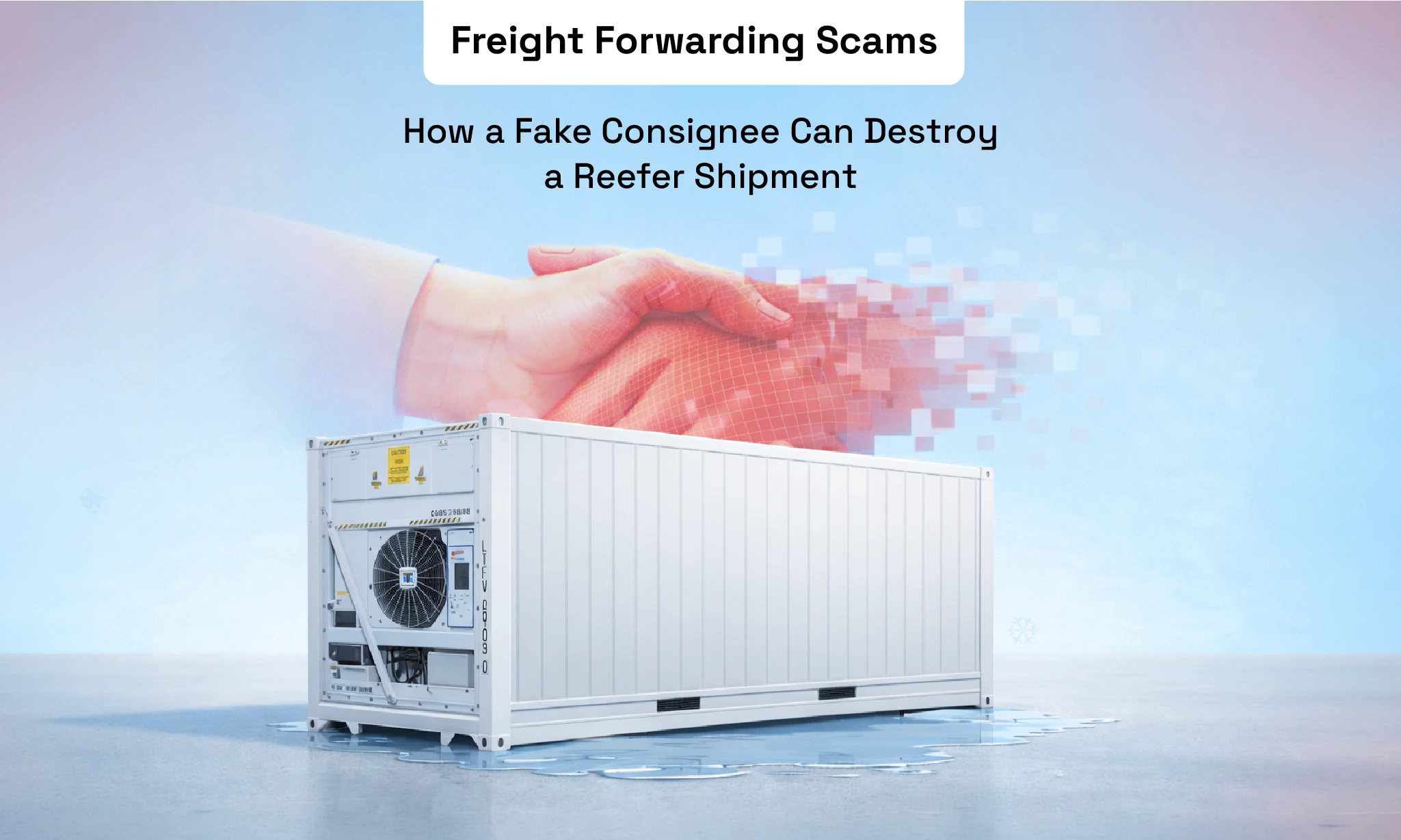
Freight Forwarding Scams: How a Fake Consignee Can Destroy a Reefer Shipment
Author:
Aashinya
Published On:
Feb 20, 2026
1 min read
As freight operations become more digitized, fraud is no longer limited to stolen cargo or forged documents. Scammers are now targeting identities within the shipment lifecycle, posing as legitimate consignees to reroute, delay, or unlawfully claim cargo.
Industry reports estimate that cargo theft and fraud cost the global supply chain over USD 50 billion annually, highlighting the growing scale of the problem. For reefer shipments, where controls are tight and margins for error are thin, such deception can trigger immediate operational disruptions, temperature deviations, and irreversible cargo losses.
What Is a Fake Consignee Scam?
A fake consignee scam occurs when fraudsters impersonate a legitimate consignee or insert themselves into the shipment process using manipulated contact details, emails, or documents. Their objective is not to deal with the freight forwarder financially, but to gain control over the cargo itself.
Scammers exploit the routine operational workflow by requesting last-minute delivery changes, altered release instructions, or unauthorized pickups to redirect or delay shipments without raising immediate suspicion.
These scams often target weak verification steps and the pressure to move shipments quickly, especially during critical delivery windows. Freight forwarding fraud often unfolds in stages, exploiting trust, urgency, and fragmented communication.
Scammers typically begin by monitoring shipment-related email threads or posing as legitimate stakeholders within an ongoing transaction. By closely mimicking real consignee details, email signatures, or communication styles, they blend seamlessly into the process.
Once embedded, fraudsters introduce subtle changes such as updated delivery instructions, alternate pickup locations, or revised contact details. These requests often appear routine and time-sensitive, making them easy to overlook.
In many cases, the fraud is only discovered after the cargo has been delayed, misdelivered, or compromised. For reefer shipments, this manipulation doesn’t just cause confusion. It directly impacts temperature control, dwell time, and cargo integrity.
How Reefer Shipments Get Impacted
Reefer shipments operate within extremely tight timelines and temperature tolerances, making them highly vulnerable to any form of interference. When a fake consignee introduces unauthorized changes or delays, containers may remain idle at ports, yards, or unauthorized locations longer than planned.
Even short disruptions can result in temperature deviations that compromise product quality. In many cases, delayed clearances or misdirected deliveries prevent timely plug-in to power sources that cause spoilage, contamination, or complete cargo rejection.
Perishable goods such as food, pharmaceuticals, and chemicals often cannot be recovered once temperature integrity is lost. Beyond cargo damage, these incidents trigger a chain of financial and operational consequences.
Forwarders face claims, insurance disputes, detention and demurrage charges, and strained customer relationships. What begins as a small instruction change can quickly escalate into total shipment loss and long-term reputational damage.
Common Red Flags Forwarders Often Miss
Fake consignee scams rarely involve obvious warning signs. Instead, they rely on subtle changes that appear routine in day-to-day operations.
Last-minute consignee or delivery changes after booking confirmation or document issuance.
Requests to alter release instructions without formal authorization.
Mismatched shipment documents, including discrepancies between the bill of lading, invoice, and packing list.
New or unverified email addresses suddenly joining shipment-related communication.
Changes in contact numbers or pickup personnel not previously listed.
Pressure-driven communication, citing urgency due to demurrage, spoilage risk, or port delays.
Requests to move reefer containers to alternate locations without clear justification.
Inconsistent consignee details across emails, documents, and system records.
Bypassing standard verification procedures to save time during critical delivery windows.
A Real Reefer Fraud Case from the Field
In one widely discussed industry case involving a reefer shipment of grapes, the shipment initially progressed as planned until unexpected communication changes began to surface.
A Chilean exporter faced a crisis that underscores how devastating fake consignee scams can be for reefer shipments. Two refrigerated containers loaded with fresh grapes, valued at approximately £15,000, arrived at London Gateway after a standard 21-day ocean transit. On paper, the shipment appeared completely legitimate.
The problem surfaced the moment the containers landed. The UK-based buyer who had placed the order suddenly disappeared. The company turned out to be fictitious, supported by fabricated documents and false contact details. With no payment received and no response from the supposed consignee, the cargo remained stuck at the port.
As the days passed, demurrage charges escalated rapidly, which was more than half the value of the shipment itself. The grapes, highly perishable by nature, were losing commercial viability with every passing hour.
The shipper was left with two grim options. Returning the containers to Chile would result in total cargo loss, along with additional freight costs. The only viable alternative was to find an emergency buyer in the UK willing to accept the risk.
Eventually, a legitimate importer agreed to take the shipment, but only at a heavily discounted price. By the time the cargo was sold, the combined impact of demurrage charges and the reduced sale value had nearly wiped out the shipment’s worth. The exporter managed to stay afloat, but only narrowly.
This incident highlights how a fake consignee doesn’t need to steal cargo outright to cause damage. Simply disappearing at the wrong moment can turn a routine reefer shipment into a near-total financial loss.
How to Prevent Fake Consignee Fraud
Fake consignee fraud can be prevented with basic due diligence and stronger risk awareness, especially during first-time transactions.
Verify the consignee before shipping, particularly for first-time buyers and high-value or perishable cargo.
Validate company registration details using official government or trade registries.
Confirm VAT, EORI, or tax identification numbers through authorized validation portals.
Request and cross-check trade references from other suppliers or logistics partners.
Verify the physical business address, not just a website or serviced office location.
Be cautious with CFR or similar Incoterms when shipping perishables to unverified buyers, as risk shifts early in the journey.
Assess payment terms alongside Incoterms, not in isolation.
Recommend secure payment methods, such as advance payment or Letters of Credit, for first-time or high-risk shipments.
Flag risk proactively as a freight forwarder, especially when a new shipper is sending high-value reefer cargo to an unknown consignee.
Establish clear SOPs for consignee changes, ensuring no delivery or release updates are accepted without independent verification.
By taking time to question, verify, and escalate potential risks, forwarders can protect customers from losses that may otherwise go unnoticed until it is too late.
Conclusion
In reefer logistics, fraud doesn’t need to be complex to be catastrophic. A single fake consignee, a missed verification step, or a rushed approval can turn a routine shipment into a total loss. As scams grow more sophisticated and digital communication becomes the norm, proactive checks are no longer optional and are now essential.
For freight forwarders, protecting cargo today means protecting customers from risks they may not even see coming. In temperature-sensitive logistics, there is no margin for error. With the right controls, awareness, and verification practices in place, many of these losses can be prevented before they begin.
Frequently Asked Questions (FAQs)
1. Why are reefer shipments more vulnerable to fraud?
Reefer shipments are time-and temperature-sensitive. Even short delays caused by unauthorized changes or miscommunication can result in temperature deviations, spoilage, and complete cargo loss.
2. Does the freight forwarder lose money in fake consignee scams?
While forwarders are not usually paying the fraudster, they often face claims, disputes, demurrage costs, insurance complications, and reputational damage when shipments are compromised.
3. What are the biggest red flags of a fake consignee scam?
Common red flags include last-minute delivery changes, altered release instructions, unverified email addresses, pressure-driven urgency, and inconsistencies across shipment documents.
4. How can freight forwarders help prevent fake consignee fraud?
Forwarders can reduce risk by verifying new consignees, enforcing strict SOPs for changes, validating documents independently, and flagging high-risk shipments, especially first-time reefer movements to unknown buyers.
5. Why do payment terms matter in preventing these scams?
Payment terms determine who bears financial risk. Shipping high-value perishables under CFR or similar terms to an unverified buyer increases exposure. Advance payments or Letters of Credit significantly reduce risk.
Don't forget to share this blog!