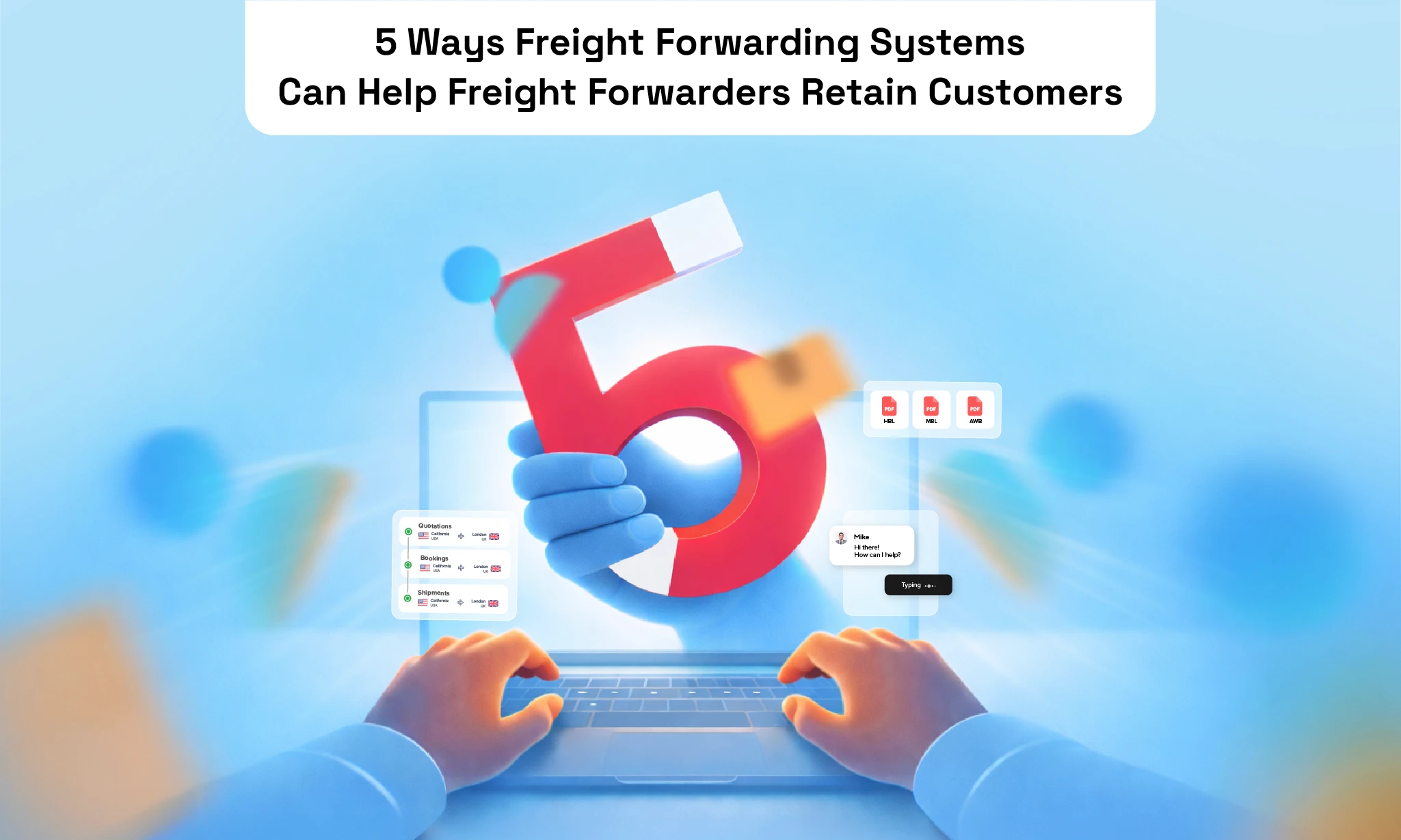
5 Ways Freight Forwarding Systems Can Help Freight Forwarders Retain Customers
Author:
Aashinya
Published On:
Feb 20, 2026
1 min read
Customer retention in freight forwarding is no longer driven only by rates. Research studies indicate that acquiring a new B2B customer can cost 5–7 times more than retaining an existing one, yet service failures remain the leading cause of customer churn. Shippers now expect consistency, visibility, and reliability across every shipment.
To retain customers, freight forwarders must clearly understand these needs and expectations and deliver against them consistently. This blog outlines the key strategies freight forwarders can adopt to improve customer retention and build long-term relationships.
How Freight Forwarding Systems Drive Customer Retention
Freight forwarders replace software when it becomes an operational constraint rather than a support system. Customer retention depends on visibility, accuracy, and consistent execution. The capabilities below highlight how technology supports more reliable customer outcomes.
1. End-to-End Visibility Builds Trust
Lack of visibility remains one of the most common reasons shippers lose confidence in their freight forwarders. As per industry research, more than two-thirds of shippers cite real-time shipment visibility as a critical factor in evaluating logistics partners, and a significant share of customer dissatisfaction stems from delayed or unclear status updates.
Modern freight forwarding systems address this by providing real-time tracking across air, ocean, and road, giving customers continuous access to shipment status without relying on manual follow-ups.
Instead of customers chasing updates, milestone-based notifications automatically inform them when key events occur, such as cargo pickup, departure, arrival, customs clearance, or delivery. Centralized dashboards further enhance transparency by offering a single, unified view of all shipments for both internal teams and customers.
When customers are consistently informed and never left guessing, trust naturally strengthens. Industry studies also indicate that proactive visibility can reduce customer escalations by over 30%, directly impacting satisfaction and retention. By eliminating uncertainty and improving communication, end-to-end visibility becomes a foundational driver of long-term customer loyalty.
2. Faster, More Accurate Documentation Reduces Friction
Documentation delays and errors remain a major source of operational friction in freight forwarding. As reported by freight forwarders across global trade lanes, documentation-related issues account for nearly 30–40% of shipment delays and customer escalations.
Freight forwarding sosftware reduce this friction by automating the creation of critical documents using data captured once at the booking stage. Forwarders report that automation eliminates repeated data entry and significantly reduces manual touchpoints, which are often the root cause of inconsistencies and rework.
Accurate, on-time documentation prevents avoidable delays, minimizes disputes, and reduces back-and-forth communication with customers. From a customer perspective, this translates into smoother shipment execution and fewer surprises.
3. Proactive Management Improves Service Experience
Disruptions are inevitable in logistics, but customer perception depends on how effectively they are handled. Freight forwarding systems enable proactive management by automatically identifying delays, rollovers, route deviations, or documentation issues as soon as they occur.
Instead of reacting after a customer raises a concern, operations teams receive system alerts and can initiate corrective actions immediately. Integrated workflows assign ownership, track resolution status, and ensure accountability across teams.
When customers are informed early and offered solutions proactively, service failures are less damaging. This ability to manage exceptions transparently and efficiently turns potential dissatisfaction into confidence and strengthens customer loyalty.
4. Data-Backed Decision-Making
In freight forwarding, customer retention often depends on how quickly and confidently decisions are made. As reported by freight forwarders, limited access to reliable operational data is one of the key reasons service issues escalate into customer dissatisfaction. Research suggests that forwarders using data analytics software integrated into their operations are able to identify risks and performance gaps far earlier than those relying on manual reports.
Modern freight forwarding systems consolidate shipment, cost, carrier, and performance data into centralized dashboards. Forwarders report that access to real-time analytics helps reduce reactive firefighting by over 30%, allowing teams to focus on proactive customer management instead of issue resolution.
Data analytics also enables forwarders to track customer-specific performance such as transit time reliability, exception frequency, and cost deviations. According to industry feedback, customers are up to 40% more likely to stay with forwarders who proactively share performance insights and improvement recommendations rather than only communicating during disruptions.
By using data to support informed decision-making, freight forwarders move beyond execution and into an advisory role. This shift from reactive service to insight-driven engagement strengthens customer confidence and positions the forwarder as a long-term logistics partner.
5. Implementing Effective Customer Support
Customer support plays a critical role in shaping a shipper’s overall experience. As reported by freight forwarders, nearly 70 percent of customer dissatisfaction stems from delayed responses, lack of ownership, or inconsistent communication during shipment issues, rather than the issue itself.
Modern freight forwarding systems centralize customer interactions, shipment details, and communication history, enabling support teams to respond faster and with greater context. Forwarders using system-driven support workflows report a 30 to 40 percent reduction in response times, leading to quicker resolutions and improved customer confidence.
Effective customer support is not just reactive but proactive. By keeping customers informed and addressing concerns before they escalate, forwarders improve satisfaction and loyalty, which in turn helps with customer retention.
Conclusion
In an industry where service expectations continue to rise, customer retention in freight forwarding is shaped by more than competitive pricing. Visibility, reliability, data-driven decision-making, value-added services, and responsive customer support all play a critical role in how customers perceive their logistics partners.
Modern freight forwarding platforms like CargoEz play a key role in enabling this shift. By centralizing operations, automating documentation, providing real-time visibility, and offering actionable analytics, such platforms help forwarders deliver a more consistent and transparent customer experience. These capabilities allow teams to proactively manage exceptions, engage customers with meaningful insights, and respond faster to changing requirements.
Frequently Asked Questions (FAQs)
1. Why is customer retention important in freight forwarding?
Customer retention is critical because acquiring new B2B customers can cost significantly more than retaining existing ones. Retained customers are more likely to ship consistently, expand volumes over time, and maintain long-term partnerships. In freight forwarding, stable customer relationships also reduce revenue volatility and operational pressure.
2. How do freight forwarding systems help improve customer retention?
Freight forwarding systems improve retention by enhancing visibility, reducing errors, enabling proactive communication, and standardizing service delivery. By providing real-time shipment updates, accurate documentation, and faster issue resolution, these systems help forwarders meet customer expectations consistently.
3. What role does data analytics play in retaining customers?
Data analytics enables forwarders to make informed decisions by analyzing shipment performance, costs, transit times, and exceptions. Sharing these insights with customers helps build trust and positions the forwarder as a strategic partner rather than just a service provider, which strengthens customer loyalty.
4. Can technology reduce customer churn in freight forwarding?
Yes. By minimizing service failures, improving communication, and enabling data-driven engagement, technology directly addresses the common reasons customers leave freight forwarders. Forwarders that invest in modern platforms are better positioned to reduce churn and build long-term customer relationships.
Don't forget to share this blog!