Overcoming freight forwarding hurdles in 2026
Author:
Aashinya
Published On:
Feb 20, 2026
1 min read
Freight forwarding in 2026 is shaped by constant volatility rather than occasional disruption. Capacity swings, tighter regulations, and rising customer expectations are now part of everyday operations. What could once be managed through experience and workarounds increasingly requires consistency, speed, and precision at scale.
In this environment, traditional and manual-heavy operating models are reaching their limits. Forwarders that continue to rely on fragmented processes face growing pressure on margins, compliance, and service reliability. Overcoming these hurdles calls for stronger execution, clearer visibility, and operational readiness built for sustained complexity.

The Key Challenges Reshaping Freight Forwarding in 2026
Freight forwarding challenges in 2026 are no longer isolated operational issues. They are interconnected pressures that affect cost control, service reliability, and long-term scalability. Forwarders are required to manage uncertainty across capacity, compliance, and execution simultaneously, often with limited room for error.
Capacity Uncertainty and Rate Volatility
Capacity uncertainty remains a defining challenge for freight forwarders in 2026. Ocean and airfreight capacity continue to fluctuate due to geopolitical shifts, network realignments, and carrier capacity management strategies. These fluctuations make it increasingly difficult to forecast availability and plan pricing with confidence.
At the same time, contracting cycles are becoming shorter, reducing price stability and increasing margin pressure. Forwarders must constantly balance long-term contracts with spot market opportunities, often without full visibility into future demand or carrier behavior. Without accurate, real-time data and strong cost controls, this volatility can quickly erode profitability.
Growing Documentation and Compliance Complexity
Growing documentation and compliance complexity has become one of the most persistent operational struggles for freight forwarders in 2025–2026. Rapid and frequent regulatory updates across regions and combined with tighter data governance requirements, have made compliance far more demanding than in the past.
This rising burden is widely felt across the industry. Recent surveys indicate that 85 percent of companies report compliance has become more complex over the past three years, while 74 percent say compliance represents a significant operational burden. Forwarders are expected to submit accurate data earlier in the shipment lifecycle, often while shipment details are still changing. Any inconsistency across documents can trigger delays, rework, or regulatory scrutiny.
Manual and fragmented documentation processes intensify these challenges. Multiple document versions, repeated data entry, and limited visibility across teams increase the likelihood of errors and missed deadlines. Even small documentation issues can escalate into clearance delays, penalties, or customer dissatisfaction, making compliance one of the most high-risk and resource-intensive areas of freight forwarding operations in 2026.
Operational Bottlenecks During Extended Peak Seasons
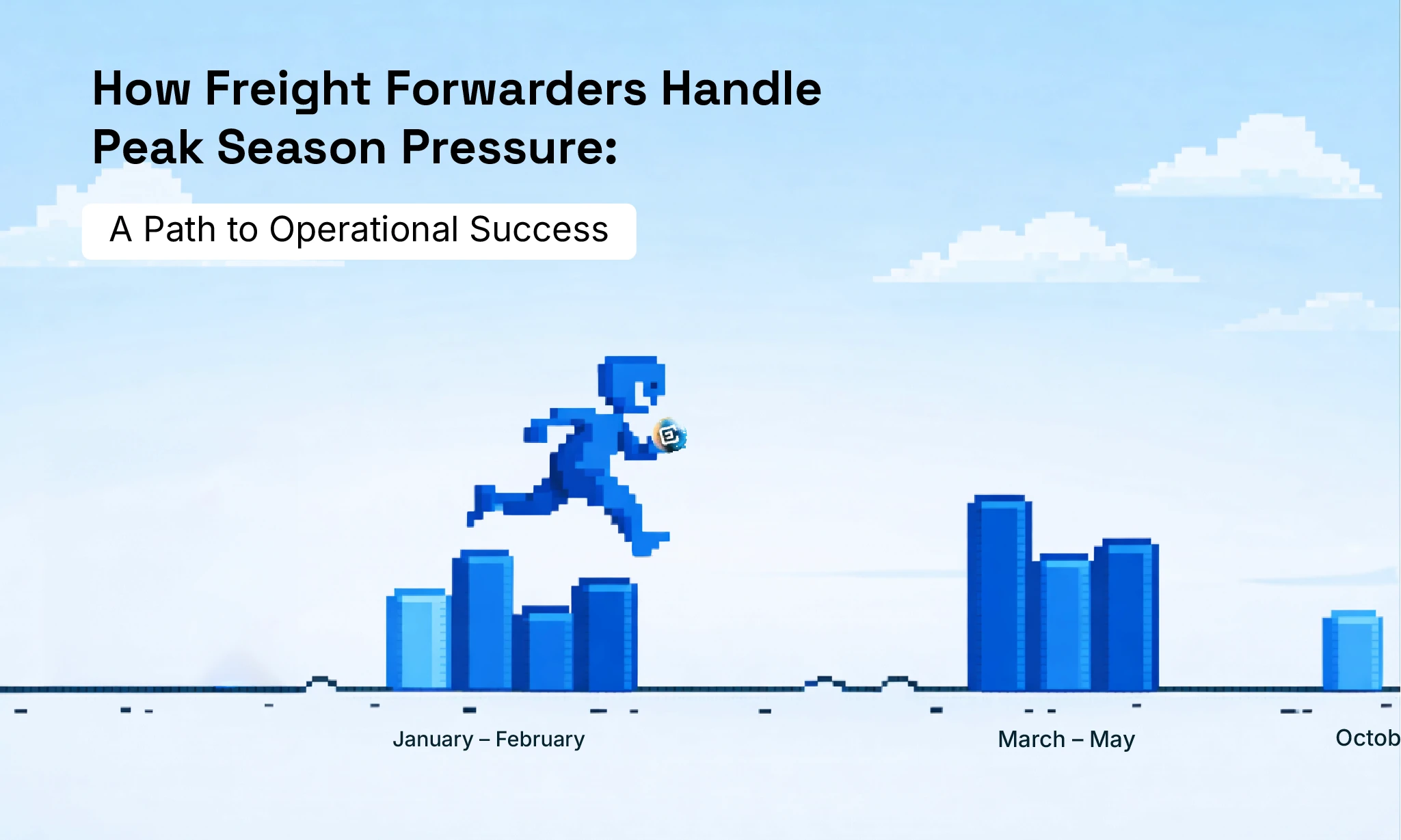
Peak season is no longer confined to a predictable window. Freight forwarders are now operating in extended periods of high demand, punctuated by sudden volume spikes. This sustained pressure exposes weaknesses in manual workflows, resource planning, and cross-team coordination.
When shipment volumes rise, teams relying on spreadsheets, emails, and fragmented systems struggle to maintain control. Bottlenecks emerge in booking management, documentation, and milestone tracking, leading to delayed responses and inconsistent execution. Without standardized processes and end-to-end visibility, operational strain becomes a recurring challenge rather than a temporary one.
Rising Customer Expectations for Visibility and Speed
Shippers in 2026 expect more than cargo movement. They demand real-time visibility, accurate timelines, and proactive communication throughout the shipment lifecycle. Delays or issues are increasingly tolerated only when they are communicated early and managed transparently.
Forwarders that lack centralized visibility into shipments and documents struggle to meet these expectations consistently. Manual status updates and reactive communication increase service risk and weaken customer confidence. As a result, customer experience is now directly tied to operational maturity and information control.
How Can Freight Forwarders Overcome Industry Hurdles in 2026?
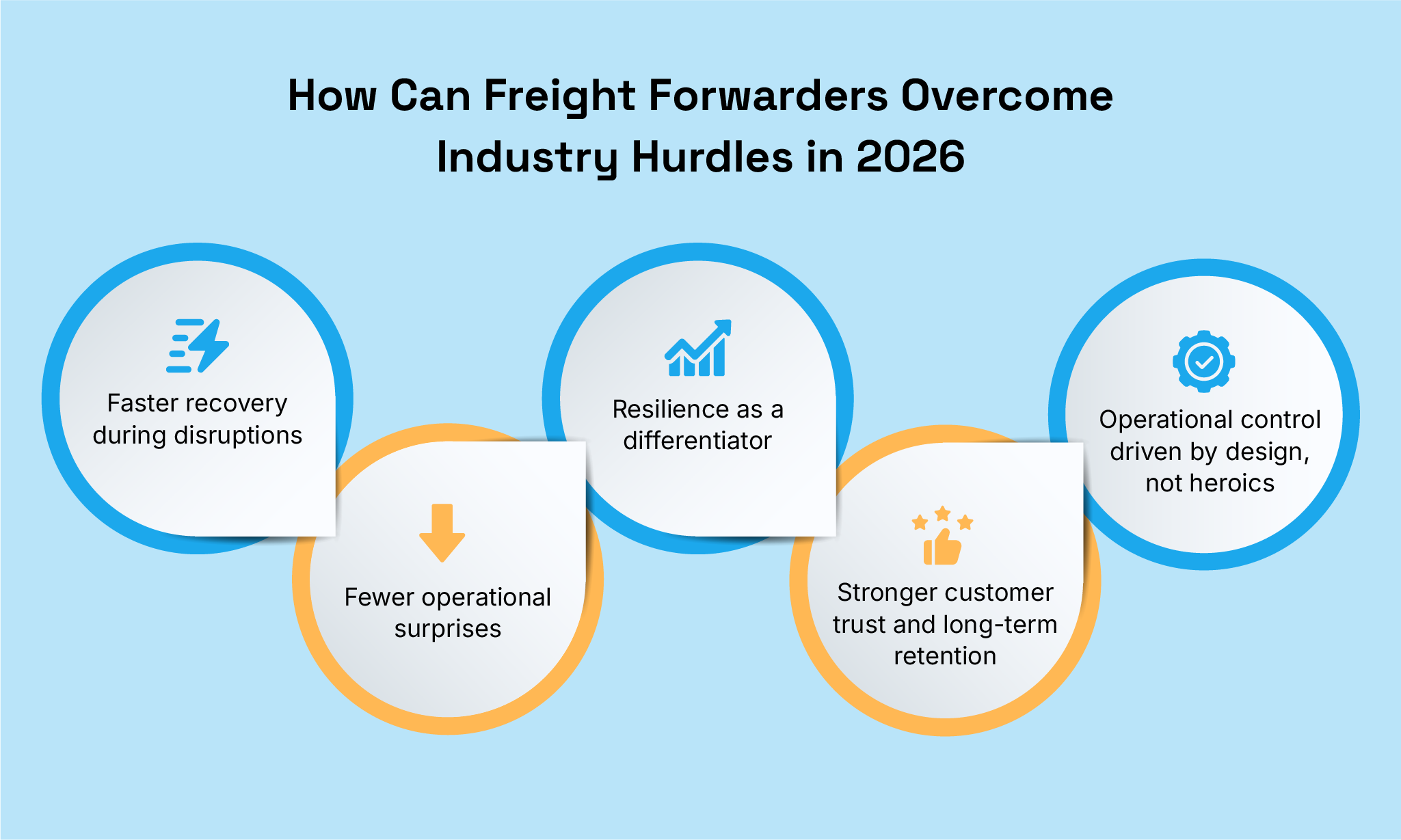
As operational pressure continues to rise across capacity, compliance, and execution, forwarders are being forced to rethink how their businesses are structured. These approaches highlight how forwarders are overcoming industry hurdles, backed by recent research and market observations.
Faster recovery during disruptions
The 2026 Trends Report highlights that organizations investing in connected systems and predictive intelligence recover faster from disruptions. When operations are designed to anticipate change rather than react to it, disruptions result in controlled adjustments instead of widespread breakdowns.Fewer operational surprises
Predictive intelligence reduces last-minute firefighting by identifying risks early across capacity, documentation, and execution stages. Forwarders with connected data flows experience fewer unexpected delays, cost overruns, and compliance escalations, improving overall operational stability.Resilience as a differentiator
Resilience is increasingly a competitive advantage. Forwarders that consistently deliver during volatile conditions gain stronger shipper confidence, especially when competitors struggle to maintain service continuity.Stronger customer trust and long-term retention
Reliable execution under pressure builds credibility. Customers value partners that can absorb shocks without constant service degradation, making operational resilience a key factor in long-term relationship strength.Scalable growth without linear cost increases
Deliberate operational design enables forwarders to scale volumes without proportionally increasing headcount or manual effort. Connected systems and standardized execution reduce operational friction as complexity grows.Operational control driven by design, not heroics
The report reinforces that resilience starts with deliberate design rather than individual effort. Organizations that embed intelligence, visibility, and collaboration into their operating model rely less on reactive problem-solving and more on predictable execution.
Conclusion
Freight forwarding in 2026 is defined by sustained operational pressure across capacity, compliance, and execution. While these hurdles are becoming more complex, they are also more predictable in nature. Forwarders that take a structured, research-backed approach to building resilience and operational control are better positioned to navigate disruption with fewer surprises. The ability to respond consistently under pressure is fast becoming a defining factor for long-term competitiveness in the industry.
Frequently Asked Questions (FAQs)
1. What are the biggest challenges freight forwarders face in 2026?
Freight forwarders in 2026 face persistent capacity volatility, increasing documentation and compliance complexity, geopolitical disruptions, extended peak seasons, and rising customer expectations for visibility and reliability.
2. Why is compliance becoming more difficult for freight forwarders?
Compliance is becoming more challenging due to frequent regulatory updates, stricter data accuracy requirements, increased use of AI by customs authorities, and growing data governance across global trade lanes.
3. How do geopolitical factors impact freight forwarding operations?
Geopolitical tensions can disrupt trade routes, affect carrier capacity, introduce sanctions or restrictions, and increase transit times, making planning and execution more complex for freight forwarders.
4. Why is operational resilience important for freight forwarders in 2026?
Operational resilience allows forwarders to recover faster from disruptions, maintain service continuity, and reduce unexpected delays and costs, which directly impacts customer trust and retention.
5. How are customer expectations changing in freight forwarding?
Customers increasingly expect real-time shipment visibility, proactive communication, and consistent service delivery, even during periods of disruption or high demand.
Don't forget to share this blog!