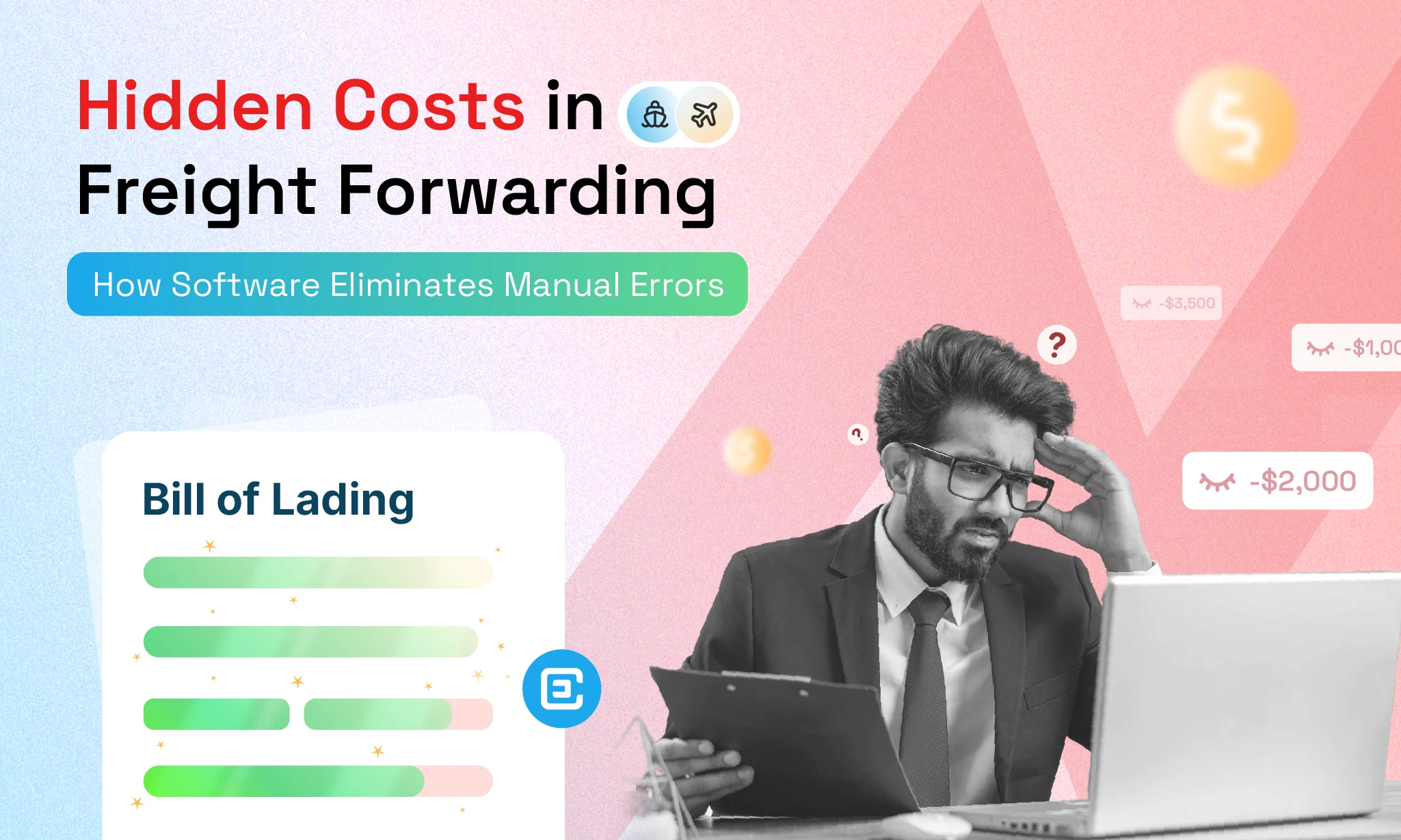
Hidden Costs in Freight Forwarding: The Manual Error Trap
Author:
Pamela
Published On:
1 min read
Freight forwarding is full of complexities, but the most expensive problems often appear in places nobody checks closely. A small typo, a missed surcharge, a vendor rate mismatch, or a copied figure that does not match the job file can quietly drain profit. Industry studies estimate that 5–10% of freight invoices contain errors, and these mistakes rarely show up as a line item on a P&L, which makes them even more dangerous. They create a silent financial leakage that accumulates across hundreds of shipments every month.
Most forwarding teams work hard and operate under tight timelines. The issue is not effort. The issue is that manual systems cannot keep up with how fast freight data moves. Modern freight software changes this dynamic completely by turning unstructured work into a controlled, predictable process. To understand the value, you need to see why human error is not just an occasional issue but a built-in structural risk.
The Three Core Categories of Hidden Freight Costs
Human error in freight forwarding is not a one-off incident. It is a natural outcome of workflows that depend heavily on manual coordination. Freight operations move fast. Rates change, schedules shift, carriers introduce new surcharges, and customers request customized pricing. When teams manage this complexity manually, errors become unavoidable.
These errors are not random. They fall into three core categories of hidden freight costs, each driven by process gaps rather than individual mistakes.
1. Operational Error Costs
Delays, incorrect classifications, rework, and compliance penalties
Operational costs arise when shipment execution relies on fragmented data and manual interpretation.
Freight workflows require teams to continuously interpret shipment details, rate sheets, vendor invoices, commodity rules, and customer-specific instructions. When this information is scattered across emails, spreadsheets, PDFs, WhatsApp messages, and shared drives, accuracy depends entirely on memory and manual cross-checking.
Every shipment also involves multiple contributors. Operations updates milestones, billing adds charges, accounts reconciles vendor bills, and sales manages customer expectations. Each handoff introduces friction. Small slips compound into delays, incorrect documentation, customs issues, or classification errors that may result in fines or shipment holds.
These operational errors slow execution and create downstream financial consequences that are rarely tracked back to their source.
2. Accessorial and Service Fee Costs
Demurrage, detention, storage, chassis, and missed local charges
Accessorial costs are one of the most common areas of silent revenue leakage.
Freight rates change constantly. Airlines adjust fuel surcharges. Ocean carriers revise GRI levels. Local vendors apply seasonal pricing or location-based fees. In manual environments, updates rarely propagate across every active job in time.
As work pressure increases, teams take shortcuts. Charges are copied from old jobs, rate tables are reused without verification, or fees are estimated temporarily and never revisited. As a result, local charges, documentation fees, detention, demurrage, storage, or special handling costs are either missed entirely or applied incorrectly.
Without real-time visibility and structured billing rules, these accessorial costs quietly erode margins or trigger customer disputes when billed inaccurately.
3. Financial Leakage Costs
Revenue loss, disputes, delayed invoicing, and cash flow strain
Financial leakage is the cumulative result of operational and accessorial errors flowing into billing.
Manual invoice preparation requires teams to reconcile operations data, vendor bills, exchange rates, and customer contracts after the shipment is already completed. Without a centralized logistics accounting software to automate these touchpoints, firms often struggle with missed charges, outdated rates, and incorrect currency conversions. This lack of automation frequently results in invoices being held back while teams wait for manual confirmations and physical documents.
Over time, this creates delayed invoicing, slower cash cycles, higher dispute volumes, and excessive dependence on individual employees who “know the rules.” When those individuals are unavailable, accuracy drops and risk increases.
These financial distortions are predictable, recurring, and expensive. They do not appear clearly on monthly reports, which is why many forwarders underestimate their true cost.
Why These Costs Persist
These hidden costs are not caused by poor employees or lack of effort. Most forwarding teams work under intense time pressure and do their best with the tools available. The problem is structural.
Manual systems rely too heavily on human accuracy in an environment where accuracy is increasingly difficult to maintain. Without automation, errors scale as volume grows.
This is why modern freight software does not just improve efficiency. It addresses the root causes of hidden freight costs by replacing memory-based processes with structured, system-driven control.
Top 6 Hidden Costs in Freight Forwarding Driven by Manual Errors
Most forwarders underestimate the financial impact of manual work. They expect small errors but overlook the systemic cost across the entire operation. Here are the top seven hidden costs that most companies feel but rarely calculate.
1. Revenue leakage from missed, incorrect, or outdated charges
Forwarders often miss local charges, documentation fees, handling, storage, GRI, CAF, or seasonal surcharges simply because they are buried in emails or not updated in spreadsheets. Even a small mismatch repeated across hundreds of shipments becomes a serious loss.
2. High reconciliation workload across departments
Manual billing requires teams to compare operations data, vendor bills, exchange rates, and actual costs. Reconciliation becomes a continuous loop where people fix the same categories of mistakes month after month.
3. Delayed invoicing that slows cash flow cycles
Invoices often remain stuck because teams wait for PODs, vendor bills, carrier confirmations, or internal approvals. These delays directly slow down receivables and push forwarders into cash flow crunches.
4. Dispute management, which drains staff time
Every dispute forces the team to retrace the shipment timeline, pull documents, justify charges, and coordinate with carriers. These hours are rarely counted but heavily impact operational capacity.
5. Compliance and audit risk
Manual workflows make it hard to prove rate validity, trace how charges were applied, or show who approved what. Missing small documents during audits can create serious penalties or shipment delays.
6. Excessive dependence on individual employees
When one operations executive or billing staff member remembers client-specific rules, the business becomes vulnerable. If that person is unavailable, the workflow breaks down and accuracy drops.
These costs rarely appear in monthly reports, which is why they silently erode profitability.
The Top Manual Errors Stealing Your Profit
Error 1: Reusing Charges From Previous Shipments
What happens:
Operations or billing teams copy charges from an older job to save time, assuming rates and surcharges remain the same.
Real-world example:
A forwarder copies an ocean freight charge from a shipment handled last month. In the meantime, the carrier has updated fuel surcharges and peak season fees. The invoice goes out without the revised charges. The shipment is profitable on paper, but the missing surcharges quietly reduce margin.
Impact:
Missed revenue, underbilling, and distorted profitability reports that make healthy accounts look weaker than they actually are.
Error 2: Missed or Incorrect Accessorial Charges
What happens:
Local and accessorial charges are not applied consistently because they are tracked in emails, verbal instructions, or individual memory instead of the system.
Real-world example:
A shipment incurs detention at the port due to customs clearance delays. Operations resolves the issue, but the detention charge is never communicated to billing. The customer invoice excludes the fee, while the vendor invoice includes it, forcing the forwarder to absorb the cost.
Impact:
Direct margin loss, frequent billing disputes, and increased reconciliation workload for the finance team.
Error 3: Vendor Bills Not Matched Against Job Costs
What happens:
Vendor invoices are approved manually without being compared against expected job costs or agreed rates.
Real-world example:
A trucking vendor submits an invoice with a higher rate due to a route change. The accounts team processes the bill quickly to avoid delay, but the extra cost is never reflected in the customer invoice. The job closes with reduced or negative margin.
Impact:
Financial leakage, inaccurate job costing, and long-term erosion of profitability that goes unnoticed in monthly summaries.
These errors rarely trigger alarms on their own. They accumulate across shipments, customers, and months, which is why they silently erode profitability and create unpredictable financial outcomes.
How Modern Software Plugs the Leak
Modern freight software is designed to remove friction from the workflow and eliminate predictable manual errors. It does this by creating structure, catching discrepancies early, and automating repetitive checks that humans naturally overlook.
1. Automated and centralized rate management
The primary advantage of freight rate management software is that it stores all client rates, carrier contracts, surcharge rules, minimums, and commodity-based pricing in one place. The system applies them correctly every time. Nobody needs to reference old spreadsheets or rely on memory for special cases.
2. Synchronization between operations and finance
Shipment milestones, PODs, weight updates, charges, and vendor costs flow automatically into billing. This creates a single source of truth and removes duplicate entries.
3. AI-powered vendor bill capture
OCR and machine learning extract details from carrier bills and compare them against expected costs. Variances are flagged early so profitability does not get distorted.
4. Instant invoice generation
Once a shipment hits the final milestone or meets the billing trigger rule, the system produces an invoice instantly. This compresses billing cycles from days to minutes.
5. Automatic exception detection
The system flags issues like rate mismatches, missing surcharges, incorrect commodity codes, wrong currency conversions, or inconsistent volumes. Humans no longer spend time searching for errors. They only fix what the system identifies.
6. Transparent audit trails
Every adjustment, approval, and document upload is recorded. Compliance becomes easier, and disputes are resolved faster.
7. Real-time customer visibility
A customer portal reduces confusion, clarifies charges, and prevents unnecessary follow-up questions. This also reduces friction in payment cycles.
Software solves the problems at the root by removing dependence on human memory and manual verification.
The ROI of Transitioning to Automation
Freight automation creates measurable ROI because it improves revenue capture, operational speed, and cost efficiency. The value compounds as shipment volume grows.
1. Revenue recovery and error elimination
Automation ensures that every shipment captures the correct charges. Forwarders often discover that revenue leakage was happening on a large scale but undetected.
2. Faster invoicing and improved cash flow
Automated invoice triggers allow teams to send bills sooner. Shorter billing cycles directly improve cash flow and reduce overdue payments.
3. Productivity gains across the organization
Teams no longer spend hours on manual data entry, double-checking figures, or hunting for supporting documents. They can focus on customer relationships and higher-value tasks.
4. Reduced dispute rate
Clean, accurate invoices reduce customer disputes drastically. The time saved here directly contributes to ROI.
5. More accurate job costing
By matching vendor bills with expected charges, companies gain clearer insight into shipment profitability and can optimize pricing strategies.
6. Scalability without proportional headcount growth
Automation allows businesses to handle more volume without increasing staff, making the operation more cost-effective as it grows.
Automation is not just a cost-saving tool. It is a profitability stabilizer.
CargoEZ: How It Eliminates Manual Errors and Hidden Costs
CargoEZ is designed specifically to address the structural weaknesses in manual freight workflows. It combines rate automation, document control, financial accuracy, and operational visibility inside one unified platform.
Here is how CargoEZ strengthens a forwarding business.
1. Automated invoicing tied directly to shipment status
CargoEZ generates invoices automatically when shipments meet defined milestones. Every charge is matched with operational data, so errors are caught before the invoice goes out.
2. Centralized rate and surcharge management
Customer rates, carrier tariffs, local charges, commodity-based pricing, and zone-based rates are stored in a single structured module. This prevents underbilling and missed fees.
3. Vendor bill capture and matching
CargoEZ reads vendor invoices digitally and compares them with expected job costs. Variations are flagged for review, which protects margins.
4. Real-time operations to billing sync
No more copying details between operations and accounts. All job updates flow automatically into billing, ensuring accuracy at every step.
5. Clear audit trails and supporting documents
Every change is logged, and documents such as HAWB, MAWB, BL, POD, rate sheets, and vendor bills are linked directly to the job. This reduces disputes and strengthens compliance.
6. Customer self-service portal
Customers get visibility into invoices, charges, job status, and supporting documents, which leads to fewer questions and faster payments.
CargoEZ removes the operational friction that causes financial leakage and helps forwarders run faster, cleaner, and more profitably.
Conclusion
Manual errors in freight forwarding are not small annoyances. They are structural weaknesses that quietly drain revenue, slow down cash flow, frustrate customers, and limit scalability. These issues cannot be solved with more manpower because the workflow itself is the source of the problem. Automation removes the guesswork, applies rules consistently, captures revenue accurately, and gives forwarders the control they need to protect margins and grow confidently.
Freight is unpredictable, but your financial processes should not be. Modern software like CargoEZ ensures that accuracy is built into the system instead of depending on people to catch every detail.
Frequently Asked Questions (FAQ)
1. How fast can I see ROI from freight software?
Many forwarders see improvements within one to three months. Faster billing, lower dispute rates, and accurate charge capture create a noticeable financial impact quickly.
2. Is this software only for large enterprises?
No. Smaller and mid-sized forwarders often gain even more benefit because automation replaces multiple manual steps that typically slow them down.
3. What is the typical percentage of freight invoice errors?
Industry data suggests that 5 to 10 percent of freight invoices contain errors. In manual environments, the number can be much higher due to mismatched data, missing charges, and inconsistent rate application.
Author

Don't forget to share this blog!