The Data Duplication Problem in Freight Forwarding
Author:
Pamela
Published On:
1 min read
If freight forwarding had a silent productivity killer, this would be it.
Not market volatility. Not fuel prices. Data duplication.
Most forwarding teams do not realize how much of their day disappears into repetitive typing until they step back and look at their workflows end to end. Shipment data is created once, but it is re-entered everywhere. Quotes, jobs, documents, invoices, customs filings, reports. Same data, different screens.
Industry benchmarks show that operations teams spend nearly one-third of their working hours handling data entry, validation, and correction. That time does not create value. It simply keeps shipments moving despite broken information flows.
Understanding where this duplication starts is the first step to eliminating it.
How Data Redundancy Occurs in the Shipment Lifecycle
Data redundancy is not a single mistake. It is a chain reaction.
In most freight forwarding operations, shipment data is treated as something that belongs to departments instead of something that belongs to the shipment itself. Each team recreates the data they need, often without visibility into what already exists.
As shipments move from commercial to operational to financial stages, the same data is manually reconstructed multiple times. Each reconstruction increases the probability of mismatch and delay.
From Quote to Bill of Lading: How a Single Data Point Propagates Across Systems
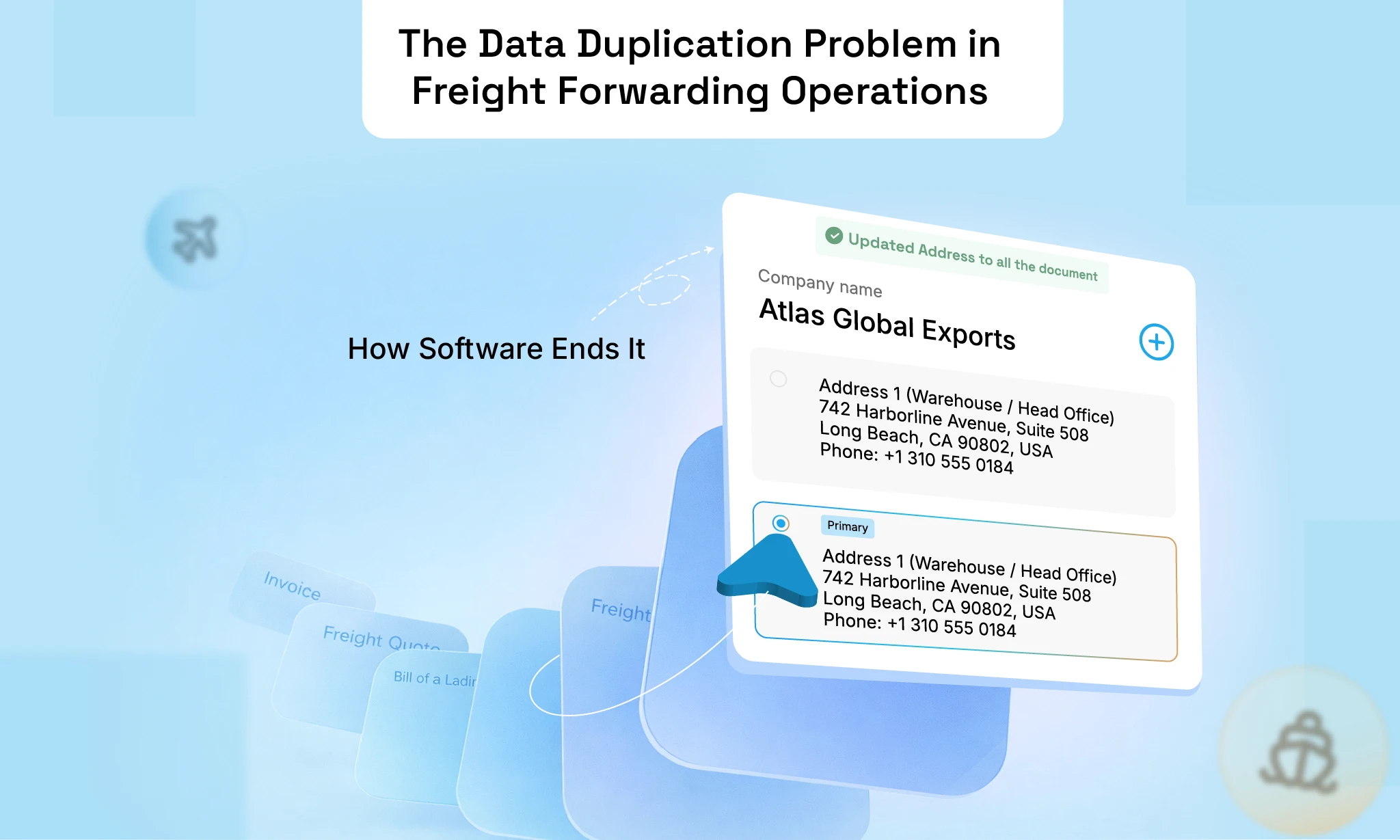
Take a simple example. A shipper address.
It is entered once during quotation.
Re-entered when the job is created.
Typed again while preparing the Bill of Lading.
Entered once more for invoicing and customs documentation.
In many forwarding companies, this single data point appears in five or more systems. If one version changes, the others often do not. This creates inconsistencies that surface only when documents are rejected, invoices are disputed, or shipments are held.
The real issue is not the number of systems. It is the lack of continuity between them.
Five Structural Causes of Repetitive Data Entry
1. Heavy Reliance on Emails, PDFs, and Manual Inputs
Email is still the primary data intake channel for freight forwarders.
Shipment instructions arrive as PDFs, Excel files, scanned documents, and sometimes plain text emails. Someone must read them, understand them, and manually enter the details into internal systems.
Research across logistics operations shows that over 70 percent of shipment data originates outside structured systems. This forces teams into constant manual interpretation and re-entry, increasing both workload and error rates.
2. Document-First Processes That Ignore Structured Data
Many workflows are designed around documents instead of data.
Teams focus on producing the correct Bill of Lading, invoice, or packing list, but the data behind those documents is never centralized. As a result, documents become both input and output, forcing repeated extraction and re-entry of the same information.
This approach locks organizations into manual processes even when digital tools are present.
3. Fragmented and Poorly Integrated Software Systems
Most freight forwarders use multiple tools across departments.
Sales systems, operations platforms, accounting software, and customs tools often operate independently. Without integrations, employees bridge the gap manually.
Industry studies indicate that manual handoffs between systems account for up to one quarter of operational data errors. These errors are rarely caught immediately and often surface during audits or customer escalations.
4. Lack of Standardized Data Exchange with Shippers, Carriers, and Customs
Each external partner speaks a different data language.
Shippers use their own templates. Carriers send confirmations in varied formats. Customs portals require specific data structures.
Without standardized exchange formats, forwarders must normalize data manually. This normalization effort grows with volume and complexity, making scale increasingly difficult.
5. Absence of Automated, Event-Driven Data Sharing
In many operations, nothing happens automatically.
When a shipment is booked, downstream systems are not updated unless someone triggers the update. When documents are finalized, finance may not know until an email is sent.
This dependence on human reminders creates delays and internal friction. It also increases the risk of missed updates during peak periods.
Quantifying the Financial Impact of Manual Data Entry
Manual data entry carries a direct and indirect cost.
Directly, it consumes labor hours. Indirectly, it introduces errors that trigger rework, penalties, and customer dissatisfaction.
Operational studies suggest:
Logistics companies lose 15 to 20 percent of operational efficiency due to data errors
Documentation mistakes can increase shipment handling costs by up to 30 percent
Rework and exception handling consume significant management attention
Correcting data at the source costs almost nothing. Fixing it mid-process costs time and coordination. Fixing it after execution leads to penalties, storage charges, and reputational damage.
Moving Toward a Single Source of Truth
A single source of truth means one shipment record that every team relies on.
Instead of recreating data, departments access and update the same dataset. Changes are reflected everywhere in real time. Conflicts are visible immediately, not discovered days later.
Forwarders that adopt this model report:
Fewer internal escalations
Faster onboarding of new staff
Easier compliance and audits
The shift is not technical alone. It is a change in how data ownership is viewed across the organization.
The Role of OCR and AI in 2026 Logistics
OCR technology has evolved significantly.
Modern OCR systems can extract structured data from shipping documents with accuracy levels exceeding 90 percent for standard formats. AI-based validation checks extracted data against existing records, flagging inconsistencies early.
This changes the role of operations teams. Instead of typing, they verify. Instead of correcting late-stage errors, they prevent them at the start.
Organizations using OCR-driven workflows have reduced documentation effort by 40 to 50 percent.
API Integrations: Replacing Manual Entry with "Data Pushing"
APIs enable systems to communicate automatically.
When a quote is confirmed, job data flows instantly into operations. When a shipment milestone occurs, finance and documentation are updated without manual intervention.
Forwarders using API-first platforms report:
50 to 60 percent reduction in repetitive data entry
Faster billing cycles
Improved data consistency across departments
Automation does not remove people from the process. It removes unnecessary repetition.
Conclusion
Data duplication is not a people problem. It is a systems problem.
Freight forwarding software designed around a single source of truth eliminates the need to re-enter the same data across departments. By combining structured data capture, OCR for document intake, and API-based integrations, modern platforms allow data to flow instead of being copied.
This shift reduces errors, lowers operational costs, and gives teams the breathing room they need to focus on customers and exceptions.
As shipment volumes grow and compliance requirements tighten, forwarders who continue to rely on manual data handling will struggle to scale. Those who invest in connected, data-driven software will move faster, operate cleaner, and compete more effectively.
Frequently Asked Questions (FAQs)
1. Why can’t I just use Excel to manage my shipment data?
Excel is useful for analysis but unsuitable as an operational backbone.
It lacks real-time validation, controlled access, automated workflows, and audit trails. Most importantly, it reinforces manual data entry rather than eliminating it.
2. Does OCR actually work for messy shipping documents?
Yes, within practical limits.
Modern OCR handles inconsistent layouts far better than earlier tools. While human review remains important, the volume of manual typing is significantly reduced.
3. How do APIs reduce my data entry workload?
APIs allow systems to exchange data directly without human intervention.
This removes duplication and ensures consistency across departments and partners.
4. What is the '1-10-100' rule in data management?
The 1-10-100 rule explains how the cost of fixing data errors increases the later they are found.
1 is the cost to fix an issue at the planning stage, 10 is the cost after execution, and 100 is the cost once the error reaches customers or live operations.
It highlights why catching data issues early saves time, money, and risk.
Author

Don't forget to share this blog!