Ocean Freight Visibility: The 2026 Guide to Tracking
Author:
Pamela
Published On:
1 min read
What Is Ocean Freight Visibility?
Ocean freight visibility refers to the ability to track and monitor container shipments in real time throughout the entire shipping process. It provides reliable, actionable insights into shipment status, container location, and estimated time of arrival (ETA), helping stakeholders maintain clarity across complex ocean supply chains.
However, ocean freight visibility goes beyond basic tracking. It enables informed decision-making by identifying potential disruptions early, improving coordination between supply chain partners, and reducing uncertainty during transit.
With end-to-end transparency into container movements from the point of origin to the final destination, businesses can mitigate risks, optimize operational planning, and maintain greater control over ocean freight operations in an increasingly volatile global trade environment.
Why Ocean Freight Visibility Matters?
Ocean freight operations are inherently complex, and even minor delays or changes in weather conditions can significantly impact delivery timelines. In today’s increasingly interconnected global supply chain, ocean freight visibility plays a critical role in minimizing such delays and managing rising transportation costs.
Customers now expect accurate, timely updates on their shipments, and enhanced supply chain visibility helps meet these expectations by enabling proactive management of exceptions such as weather-related disruptions, port congestion, and equipment shortages.
Without real-time container tracking and actionable insights, shippers face the risk of costly delays, demurrage and detention charges, inefficient inventory planning, and disruptions that can cascade across the entire supply chain.
Key Challenges in Ocean Freight Tracking
Ocean freight tracking faces several challenges due to frequent disruptions such as port congestion, vessel schedule changes, and weather-related delays. At the same time, shipment data must be coordinated across multiple stakeholders, including ocean carriers, port operators, freight forwarders, and customs brokers. This fragmentation makes it difficult to maintain consistent visibility and timely decision-making across the supply chain.
The key challenges faced in ocean freight tracking are outlined below.
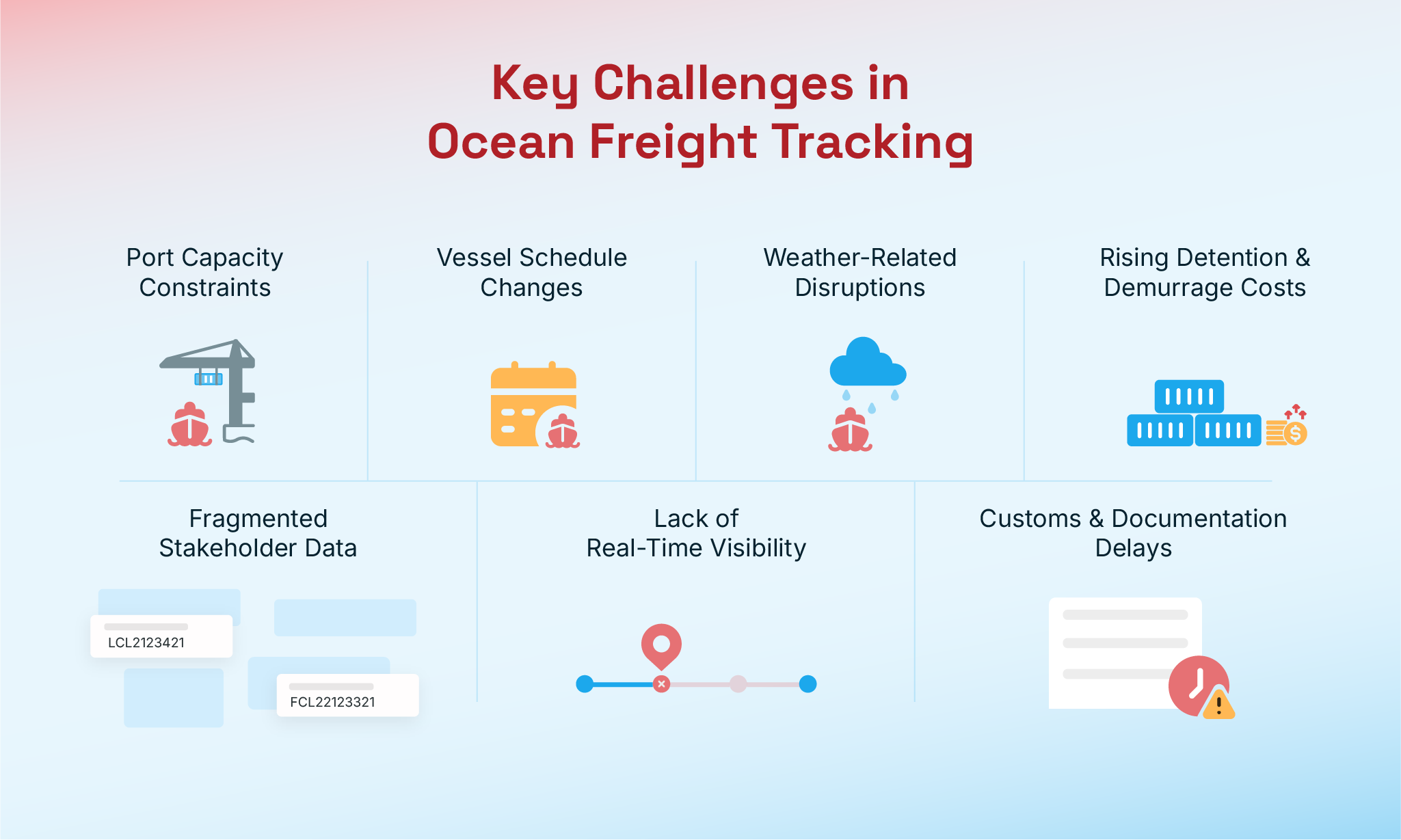
Port congestion and terminal capacity constraints
High cargo volumes and limited port infrastructure often lead to vessel backlogs and slow container movement, resulting in missed connections and extended transit times.
Vessel schedule changes and blank sailings
Frequent schedule adjustments, rolled cargo, and canceled sailings create uncertainty around ETAs and make shipment planning difficult for shippers and consignees.
Weather-related disruptions
Adverse weather conditions, such as storms or rough seas, can delay vessel arrivals and departures, impacting delivery commitments and downstream operations.
Limited real-time shipment visibility
Many stakeholders still lack access to timely and accurate container status updates, forcing teams to rely on manual follow-ups and delayed information.
Fragmented data across multiple stakeholders
Ocean freight involves carriers, ports, forwarders, customs brokers, and inland transport providers, each operating on different systems, making data consolidation challenging.
Rising detention and demurrage costs
Limited visibility into container status and free-time usage makes it hard to anticipate pickup or return delays. This often results in detention and demurrage charges, impacting budget predictability.
Customs clearance and documentation delays
Incomplete or inaccurate documentation can result in cargo holds, inspections, and clearance delays that disrupt delivery schedules.
Key Visibility Events You Must Track
Effective ocean freight tracking relies on monitoring critical shipment milestones across the end-to-end journey. Timely visibility into these events helps teams anticipate delays, coordinate stakeholders, and minimize operational cost and cost-related risks.
Key milestones to track for effective ocean freight visibility
Booking confirmation and container allocation to ensure space and equipment readiness
Vessel departure and arrival at ports to validate schedules and plan downstream activities
Container loading, discharge, and availability for accurate handoffs at the destination
Gate-out and inland transportation milestones to coordinate last-mile movement
Customs clearance and documentation status to avoid clearance-related delays
Last free day tracking to prevent detention and demurrage charges
Final delivery confirmation to close the shipment lifecycle
How Modern Ocean Freight Visibility Works
Modern ocean freight visibility ensures that it integrates data from multiple sources and streams all the data together to create a single, consistent view of the shipment progress across the ocean freight journey.
Advanced analytics transforms this data into predictive analysis by improving the ETA accuracy, identifying potential delays, and highlighting exceptions that require attention. This enables teams to respond proactively rather than reactively.
Cloud-based platforms centralize shipment information, automate disruption alerts, and standardize tracking milestones across carriers and regions. Real-time data collaboration among shippers, freight forwarders, carriers, and customs partners improve visibility and supports faster decision-making.
Business Impact of Ocean Freight Visibility
The business case for ocean freight visibility is compelling and quantifiable. Based on 2024 industry benchmarks, companies implementing comprehensive visibility solutions typically achieve:
Cost Reduction:
35-45% decrease in detention and demurrage charges (average savings: $125K-$380K annually for mid-size importers)
60-70% reduction in manual tracking labor (equivalent to 12-18 hours per week per logistics coordinator)
25-30% fewer emergency expedited shipments due to proactive exception management
Operational Efficiency:
On-time delivery rates improve from the industry average of 68% to 85-92%
Dwell time at destination ports reduced by 2.3-4.1 days on average
Customer service inquiries ("Where is my shipment?") decline by 55-70%
Strategic Advantages:
Inventory carrying costs reduced through improved demand planning accuracy
Warehouse labor scheduling optimized with 48-72 hour delivery windows
Supplier performance visibility enables data-driven carrier and route optimization
Customer satisfaction scores increase 18-25% due to proactive communication
One mid-market furniture importer reported that after implementing end-to-end visibility across 850 annual containers, they recovered their platform investment in 6.5 months purely through detention cost savings and avoided expedited air freight fees.
What to Look for in Ocean Freight Visibility Software
Choosing the right ocean freight visibility software is critical for maintaining control over complex, multi-party supply chains. An effective solution should deliver reliable, actionable insights while reducing manual effort and operational risk.
Key features to look for in ocean freight visibility software are listed below
Real-time container tracking
Continuous visibility into container location and status across ports, vessels, and inland movements to support accurate planning and faster response to disruptions.
Broad carrier and partner integration
Native integration with multiple ocean carriers, freight forwarders, terminals, and data providers to ensure consistent tracking across routes and regions.
Centralized shipment data and documentation
A single platform that consolidates shipment milestones, shipping instructions, bills of lading, and customs documents to eliminate fragmented data and manual follow-ups.
Predictive ETA and delay forecasting
Advanced analytics that improve ETA accuracy by factoring in historical performance, port congestion, and real-time vessel data.
Actionable analytics and reporting
Dashboards and reports that highlight trends, carrier performance, and recurring bottlenecks to support data-driven decisions.
Collaboration and role-based access
Shared visibility across shippers, freight forwarders, carriers, and customs partners with controlled access to relevant information.
Real-World Example
Freight forwarders often face challenges such as limited visibility across carriers and ports, missed vessel cut-offs, delays in container pickup or return, and unexpected detention or demurrage charges. These issues can lead to higher costs, missed deadlines, and inefficient communication between freight forwarders, carriers, and port operators.
Modern ocean freight visibility software addresses these challenges by providing real-time container tracking, predictive ETAs, and automated alerts for potential delays. It also improves collaboration across all stakeholders, helping reduce costs, increase on-time deliveries, and streamline overall ocean freight operations.
Conclusion
In an increasingly complex and unpredictable global supply chain, ocean freight visibility is no longer optional, it is essential. Real-time tracking, predictive insights, and centralized shipment data enable shippers to move from reactive problem-solving to proactive control, reducing delays, avoiding unnecessary costs, and improving reliability.
As customer expectations rise and supply chains continue to face disruption, organizations that invest in strong ocean freight visibility will be better equipped to respond, adapt, and scale with confidence. Ultimately, visibility is not just about tracking shipments. It is about building resilient, efficient, and future-ready ocean freight operations.
Frequently Asked Questions (FAQs)
1. What are common challenges in ocean freight visibility?
Challenges include port congestion, vessel schedule changes, weather disruptions, fragmented data from multiple parties, limited real-time updates, and delays in customs clearance and documentation. These issues can cause costly delays and inefficiencies.
2. How does predictive ETA improve ocean freight visibility?
Predictive ETA uses real-time data, historical trends, and external factors like weather and port congestion to provide more accurate arrival times than standard carrier estimates. This allows shippers to plan better and avoid unnecessary costs.
3. What features should I look for in ocean freight visibility software?
Key features include real-time container tracking, broad carrier and partner integration, centralized shipment data and documentation, predictive ETA and delay forecasting, actionable analytics and reporting, and collaboration tools with role-based access.
4. How can ocean freight visibility reduce detention and demurrage fees?
By providing real-time insights into container status and free-time usage, visibility solutions enable shippers to proactively manage container pickups and returns, avoiding costly detention and demurrage charges.
5. Can ocean freight visibility integrate with existing supply chain systems?
Yes, many ocean freight visibility platforms provide API integration, allowing seamless data sharing with transportation management systems (TMS), enterprise resource planning (ERP), and other supply chain tools to enhance operational efficiency.
6. How does ocean freight visibility improve customer satisfaction?
Ocean freight visibility provides accurate, timely updates and reliable delivery forecasts, keeping customers informed and setting clear expectations, reducing inquiries, and enhancing trust in the shipping process.
7. How is ocean freight visibility evolving with technology?
Advancements in artificial intelligence, machine learning, and data integration are enhancing predictive analytics, improving ETA accuracy, automating exception management, and enabling end-to-end visibility across multimodal ocean shipments.
Author

Don't forget to share this blog!