10 Questions to Ask When Buying a Freight Forwarding Software
Author:
Dharshini Balamurugan
Published On:
Feb 13, 2026
1 min read
Today’s freight forwarders operate under constant pressure. Shipment volumes are rising, margins are tightening, compliance requirements are becoming more complex, and customers expect speed, transparency, and real-time visibility as standard. In this environment, legacy systems, spreadsheets, and disconnected tools are no longer enough to support efficient operations.
At the same time, not all freight forwarding software delivers what it promises.
Many platforms look polished in demos but struggle when exposed to real-world operational complexity. Others solve isolated problems while leaving critical gaps across workflows, forcing teams to rely on multiple systems and manual workarounds once again.
This is why asking the right questions before choosing a platform matters.
This guide outlines 10 essential questions every freight forwarder, logistics leader, and operations head should consider before investing in freight forwarding software, helping you select a system that supports your business today and scales with you tomorrow.

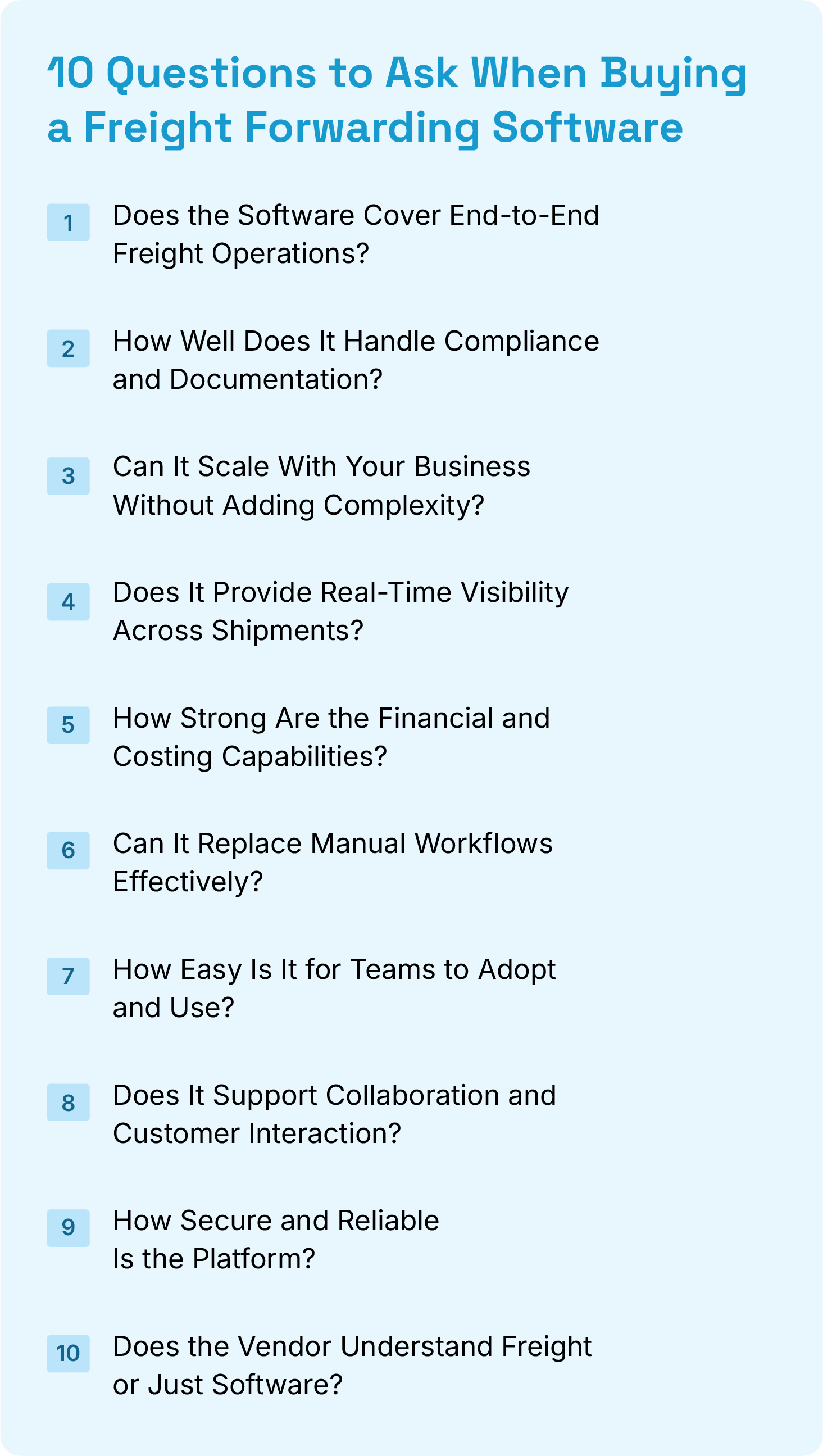
1. Does the Software Cover End-to-End Freight Operations?
Freight forwarding is not a single action. It is a series of interconnected processes spanning multiple teams, systems, and stakeholders. Strong freight forwarding software must support the entire shipment lifecycle, not just isolated functions.
End-to-end coverage means handling everything from shipment creation to invoicing and closure, including booking management, operational execution, documentation, tracking, financial processing, and customer communication.
Software that only addresses parts of the workflow forces teams to bridge gaps with emails, spreadsheets, and external tools, leading to duplicated data entry, inconsistent information, delays, and higher error rates.
A truly end-to-end system ensures data entered once flows seamlessly across departments. Operations, finance, and customer service all work from the same source of truth, reducing friction and improving efficiency.
When evaluating software, look for unified shipment management, real-time updates, integrated documentation workflows, and smooth handoffs between operations and finance. End-to-end coverage is the foundation for scalable, efficient freight operations.
2. How Well Does It Handle Compliance and Documentation?
Compliance errors are among the most costly risks in freight forwarding. Incorrect documentation, missing filings, or inconsistent data can cause shipment delays, penalties, audits, or cargo holds at ports.
Freight forwarding software should actively support compliance, not just store documents. The system should guide users through standardized workflows that minimize errors.
Strong compliance features include automated Air Waybill and eAWB generation, standardized templates, built-in data validation, support for regulatory filings like AMS and ISF, and audit-ready records accessible when needed.
As shipment volumes grow, manual documentation becomes riskier. A system that enforces consistency and accuracy protects your business from compliance disruptions while improving operational confidence.
3. Can It Scale With Your Business Without Adding Complexity?
Growth is often where systems are tested the hardest. Many freight forwarders realize too late that their software cannot handle higher volumes or expanded operations without significant workarounds.
Scalability is not just about handling more shipments; it is about identifying sustainable ways to scale freight forwarding business models without slowing teams down or increasing overhead. When systems fail to scale, businesses compensate by adding manual processes or hiring more staff, which directly impacts margins. Scalable freight forwarding software allows growth without a proportional increase in operational complexity.
When speaking to vendors, ask whether the platform can handle increased volumes without performance issues, whether it supports multi-branch and multi-country operations, and whether workflows can be configured as complexity increases. The right system should grow with your business, not hold it back.
4. Does It Provide Real-Time Visibility Across Shipments?
Real-time cargo tracking is no longer optional in freight forwarding. Customers expect real-time tracking, operations teams need live updates to manage exceptions, and leadership needs visibility to make informed decisions.
Modern freight forwarding software should provide real-time shipment tracking, milestone-based updates, proactive exception alerts, and centralized dashboards that offer a clear overview of operations.
Without visibility, teams are forced to react after problems occur rather than addressing issues proactively. This leads to missed deadlines, frustrated customers, and unnecessary firefighting.
Real-time visibility improves customer communication, enables better operational planning, speeds up issue resolution, and builds trust across stakeholders. It transforms freight management from reactive to proactive.
5. How Strong Are the Financial and Costing Capabilities?
Freight forwarding is a margin-driven business. Without accurate and timely financial insights, profitability becomes difficult to measure and even harder to improve.
Freight forwarding software should tightly integrate operations and finance so that every shipment is accurately costed, billed, and reconciled. Financial data should not live in a separate system disconnected from operational reality.
Key financial capabilities include automated costing, shipment-level profit and loss visibility, integrated invoicing, multi-currency support, and clear reconciliation workflows.
When finance and operations are aligned within the same system, errors are reduced, revenue leakage is minimized, and decision-making becomes more data-driven. Strong financial visibility is essential for sustainable growth.
6. Can It Replace Manual Workflows Effectively?
One of the main reasons freight forwarders invest in software is to reduce manual work. However, not all systems deliver on this promise.
Some platforms simply digitize existing tasks without truly optimizing them. This means teams still spend time entering data multiple times, managing emails, and maintaining spreadsheets alongside the system.
Effective freight forwarding software should automate repetitive data entry, eliminate duplicate inputs, reduce reliance on emails, and enforce structured workflows that guide users through processes.
Manual work does not scale. Automation allows teams to focus on higher-value activities such as customer relationships, exception management, and strategic planning rather than administrative tasks.
7. How Easy Is It for Teams to Adopt and Use?
Even the most powerful software fails if teams struggle to use it. Poor usability leads to resistance, partial adoption, and workarounds that undermine the system’s value.
Ease of use should be a core evaluation criterion. The interface should be intuitive, workflows should be logical, and onboarding new users should not require extensive training.
Role-based workflows ensure that users see only what is relevant to them, reducing complexity and confusion. Mobile access can also be valuable for teams that need to stay connected while on the move.
High adoption rates directly impact return on investment. Software that teams enjoy using delivers better outcomes across the organization.
8. Does It Support Collaboration and Customer Interaction?
Freight forwarding involves constant coordination between internal teams, customers, carriers, and agents. Software should facilitate collaboration rather than create silos.
Strong collaboration features include shared access to shipment data, customer portals for tracking and documents, role-based permissions, and centralized communication logs.
When everyone works from the same information, miscommunication is reduced, approvals move faster, and customer experience improves. Collaboration-ready software strengthens relationships and operational efficiency.
9. How Secure and Reliable Is the Platform?
Freight data is sensitive, and system reliability is critical. Downtime or data breaches can disrupt operations and damage customer trust.
Security and reliability should be non-negotiable. Look for cloud-based infrastructure, compliance with standards such as ISO, SOC, or GDPR, strong data encryption, regular backups, and high system uptime.
Enterprise-grade security ensures your operations remain resilient, compliant, and protected as your business grows.
10. Does the Vendor Understand Freight or Just Software?
This is often the most overlooked question.
Freight forwarding software is not generic business software. It requires a deep understanding of logistics workflows, regulatory nuances, and day-to-day operational challenges. When evaluating your options, remember that the best freight forwarding software isn't just a collection of features; it is a specialized tool built by people who understand demurrage, detention, and the pressure of a closing gate.
Evaluate whether the vendor specializes in freight and logistics, whether they can speak your operational language, and whether they understand real-world scenarios. A true partner continues to evolve the platform as regulations, markets, and customer expectations change.
Software built with industry insight delivers far greater long-term value.
Bringing It All Together: Choosing the Right Platform
Buying freight forwarding software is a long-term decision. The right platform should simplify operations, improve financial clarity, strengthen compliance, support growth, and reduce manual effort.
As freight operations become more complex, having a unified and structured system becomes a competitive advantage rather than just an operational tool.
A Practical Pre-Purchase Checklist for Freight Forwarders
Before signing a contract or committing to implementation, freight forwarders should step back and validate whether a platform truly meets their operational needs. This checklist acts as a final filter to ensure nothing critical is overlooked.
- Confirm that the software supports your complete shipment lifecycle, from booking to invoicing, without relying on external tools.
- Verify that compliance workflows are built into daily operations and not treated as an afterthought.
- Ensure the platform can scale across branches, regions, and increasing shipment volumes without performance or usability issues.
- Check that real-time visibility is available for both internal teams and customers, with clear exception handling.
- Review financial features carefully, including shipment-level profitability, automated costing, and reconciliation workflows.
- Assess how much manual work the system actually removes rather than simply digitizing existing processes.
- Evaluate ease of use by involving end users early, not just decision-makers.
- Confirm data security standards, uptime reliability, and vendor support readiness.
- Finally, assess whether the vendor understands freight operations deeply and demonstrates a long-term product vision.
A checklist like this helps turn a complex software decision into a structured evaluation, reducing risk and increasing confidence in the final choice.
Red Flags to Watch for When Evaluating Freight Forwarding Software
While feature lists often highlight strengths, red flags reveal where a platform may struggle in real-world use. Identifying these early can prevent costly mistakes later.
One major red flag is partial workflow coverage. If the software handles operations but pushes finance, compliance, or customer communication into separate tools, fragmentation will persist and manual work will continue.
Another warning sign is heavy reliance on customization for basic workflows. A platform that requires extensive configuration just to support standard freight processes may indicate a lack of industry depth.
Be cautious of systems that prioritize aesthetics over functionality. Polished demos can mask weak exception handling, limited reporting, or poor performance under real shipment volumes.
Limited financial visibility is another concern. If shipment-level profitability is unclear or requires external spreadsheets, the system may hinder rather than support margin control.
Watch for platforms that simply digitize manual processes instead of redesigning them. Automation should reduce effort, not replicate existing inefficiencies in a digital format.
Poor usability is a subtle but serious risk. If teams struggle to navigate the system or rely on workarounds, adoption will suffer and ROI will decline.
Vendor capability matters as much as the software itself. A lack of freight-specific expertise, vague product roadmaps, or slow support responses can signal long-term challenges.
Finally, unclear security standards or vague uptime commitments should never be overlooked. In freight operations, system reliability is mission critical.
Recognizing these red flags early helps organizations avoid platforms that look promising on the surface but fall short when operational complexity increases.
Where CargoEZ Fits In
CargoEZ is built specifically for modern freight forwarders looking to bring structure, visibility, and control to their operations.
The platform combines end-to-end freight management, integrated financial workflows, compliance-ready documentation, real-time tracking, and structured processes that scale as your business grows.
CargoEZ is designed to replace fragmented systems with one unified freight management platform, helping teams move faster, operate more efficiently, and make confident, data-driven decisions.
For forwarders ready to move beyond spreadsheets and disconnected tools, CargoEZ offers a practical and scalable path forward.
Conclusion
The right freight forwarding software does more than digitize processes. It transforms how your business operates.
Ask the right questions, evaluate thoroughly, and choose a platform that grows with you.
Because in freight, control is everything.
Don't forget to share this blog!